AI companies face uneven public perceptions
Strong perception rankings for tech companies don't extend to AI firms. Read More

-
Public perceptions of AI companies vary sharply across markets, reflecting uneven societal acceptance.
-
AI companies are judged separately from the broader technology sector, indicating that the public is making deliberate distinctions within the technology ecosystem.
-
As a result, societal reputation may become a material risk in global AI competition.
For all their promise, AI companies appear to have a trust problem.
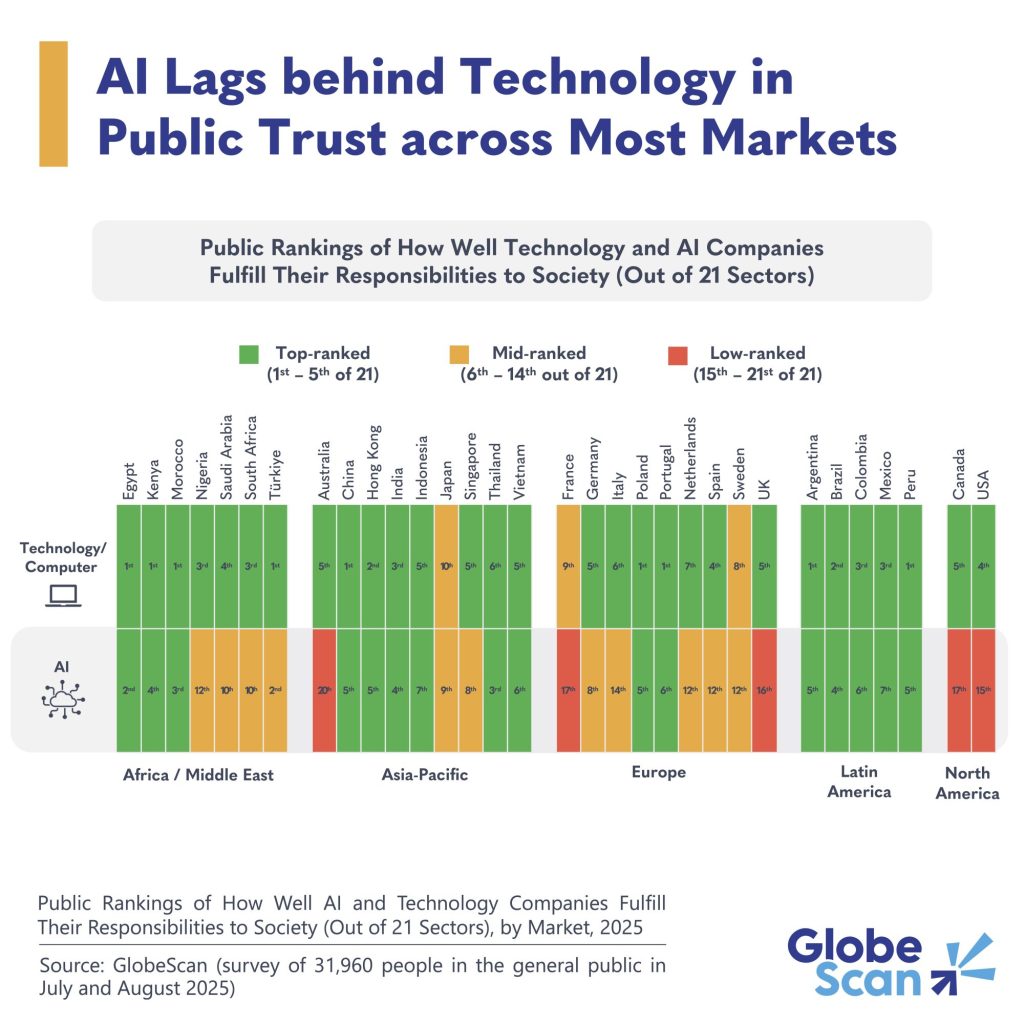
Trellis data partner GlobeScan surveyed nearly 32,000 people about how well sectors are fulfilling their responsibilities to society relative to other industries. While technology and computer companies performed strongly and consistently on societal reputation, ranking among the top five sectors in markets such as Germany, India and the U.S., AI companies show far greater variation. They rank high in countries like China and Kenya and quite low in Canada and France.
The contrast is particularly striking in advanced economies. In the U.K., technology and computer companies rank near the top of all sectors, while AI companies place further down the list. A similar pattern appears in America, where the technology sector ranks highly, but AI companies lag behind many other industries. This suggests that positive views of technology don’t automatically translate into confidence in AI firms.
Elsewhere, perceptions are more favorable. In China, AI companies are ranked more similarly to technology companies, indicating greater acceptance of AI’s role in economic development and innovation.
It’s clear from the data that AI companies aren’t benefiting from a uniform global narrative. Instead, they’re being assessed through a more critical and differentiated lens, with rankings reflecting local expectations about benefits, risks and responsible use.
What this means
The societal standing of AI companies is being actively negotiated in each market, often independent of the broader technology sector. The divergence between technology and AI rankings in countries such as the U.K. and the U.S. highlights that people aren’t necessarily evaluating innovation in general terms. Instead, they’re likely asking more specific questions about consequences, safeguards and accountability.
For sustainability leaders, this means reputation strategies based on technological leadership or economic contribution alone are unlikely to be sufficient. Trust-building efforts require market‑specific engagement strategies that reflect local sensitivities, rather than assuming a single global story will resonate everywhere.
More broadly, in a period of intensifying global competition on AI, particularly between China and the USA, the data show that societal reputation may become a material variable shaping not only public acceptance, but the speed, scale and legitimacy of AI’s development across markets.
Based on a survey of nearly 32,000 people conducted July — August 2025.

Subscribe to Trellis Briefing