Fragrance startup Osmo hires execs, raises $70M
Google Research spinout seeks to offer fast, affordable fragrance creation for personal care and household goods. Read More
- Founded by a neuroscientist, Osmo uses AI to speed product development from months to days.
- The startup aims to ‘democratize’ scent creation for smaller companies in household and personal care products.
- As it prepares to commercialize, Osmo suggests a later expansion in public health and environmental monitoring.
“Digital nose” startup Osmo hired three executives and raised $70 million on Feb. 4. The New York company seeks to disrupt the secretive $57 billion fragrance industry by shrinking product development from months to days.
With plans to build a plant in Elizabeth, New Jersey, the company aims to “democratize” fragrance-making for modest-size personal care and household-product brands, and even individuals. “Clean” beauty label Kindred was an early client of the fragrance house Osmo launched 11 months ago.
“We want to create products that are safe, clean and biodegradable,” Founder Alex Wiltschko told the Brave New World podcast in July 2025. “Our AI system is digesting huge amounts of scent data. And it’s getting quite good at reasoning about what is natural, good, affordable or clean.”
In addition, Osmo seeks to perform environmental monitoring by identifying the chemical signatures of problematic mold and volatile organic compounds.
Using $8.6 million from the Gates Foundation, Osmo says it has identified more than a dozen better alternatives to DEET mosquito repellent. And there’s a supply chain safety angle: Osmo helps the StockX marketplace “sniff” out knockoff sneakers.
The latest, Series B funding round brings Osmo’s total raised to $133.5 million, according to Crunchbase.
Wiltschko, who holds a doctorate in neurobiology from Harvard, spent more than five years as a research scientist at Google Brain. He launched Osmo as a researcher in residence at Google Ventures. The former Twitter researcher has also cofounded two other AI startups, Whetlab and Syllable Life Sciences.
The hires
Osmo’s new executives include:
- Chief Commercial Officer Mike Rytokoski: He’s the former president of ingredients and fragrances at Amyris, which made fermentation-derived biochemicals. Rytokoski was also Clorox president of Latin America and Asia and held leadership roles at tire makers Goodyear, Crown International and ENSO.
- Chief Operating Officer Mateusz Brzuchacz: The former COO of Phoenix Flavors and Fragrances has held senior operational roles at fragrance giants Givaudan and IFF.
- Chief Financial Officer Nate Pearson: Pearson had been vice president of finance at Mercedes-Benz North America EV charging.
In addition, Boet Brinkgreve becomes an independent board member. He’s the former CEO, Beauty, at luxury brand Richemont; and CEO of fragrances and flavors at Firmenich.
CCO Rytokoski noted that Osmo can use chemistry and AI to replace problematic legacy ingredients. “Every time we look for a new molecule, we are filtering for safety and biodegradability from Day 1, ensuring that the next generation of products is inherently better for the planet,” he said.
“We can predict through software whether an ingredient will perform in a specific application before we ever touch a beaker,” Rytokoski added. “This doesn’t just speed things up, it drastically slashes the waste and the carbon footprint associated with traditional chemical R&D.”
“Osmo is unlocking an entirely new sensory dimension for AI,” stated Colin Beirne, now an Osmo board observer, and a partner at Two Sigma Ventures, the hedge fund leading the latest funding. “But fragrance is just the beginning.”
How it works
Osmo’s technology also promises to do for scent what microphones, digital recordings and replay do for sound, said Chief Technology Officer Richard Whitcomb said on the Talking AI podcast in December.
In a proof of concept in 2024, the Google Research spinout “teleported” the aroma of a mashed-up plum, drawing inevitable comparisons to the quirky pitch of Smell-O-Vision in the 1960s.
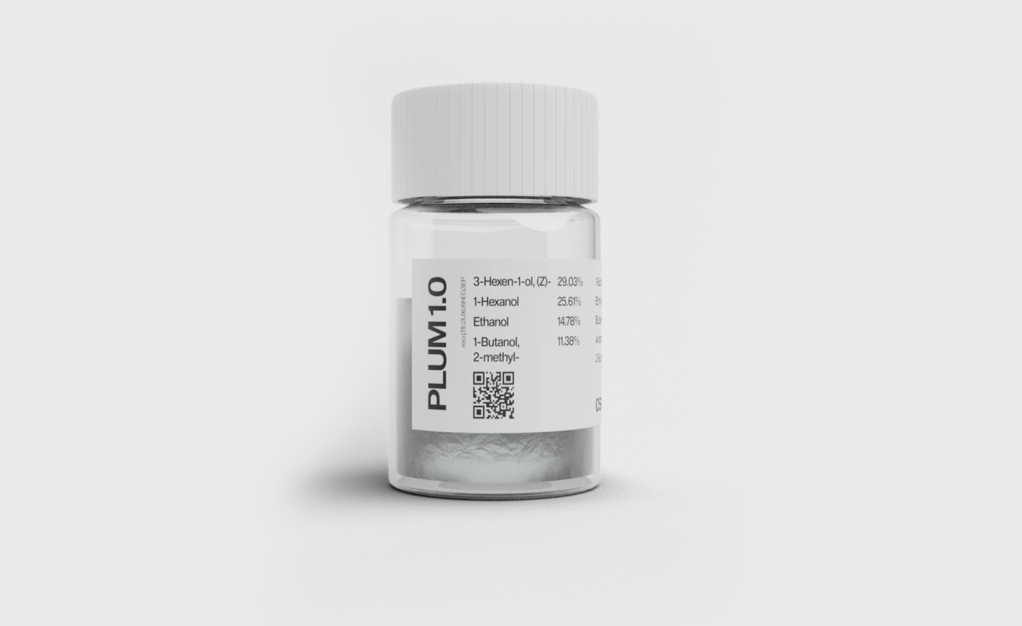
First, dishwasher-size hardware with gas chromatography-mass spectrometry sensors sipped the air from a vial of plum puree. Then Osmo mapped the odor molecules and created a recipe. Finally, its robots “printed” molecules to match the formula. The result was Plum 1.0 liquid, replicating the distilled essence of the fruit.
Osmo employs three master perfumers, a tiny profession believed to comprise less than 2,000 people globally.
The market
Grand View Research estimates that the overall fragrance market, including for household products, will grow to $74.8 billion by 2030.
The smaller market of “AI-curated” fragrances and flavors will see growth of 14.6 percent annually from 2025 to 2035, according to an analysis by Fact.MR.
Fragrance giants DSM-Firmenich, Givaudan, IFF, and Symrise already use AI to suggest optimal chemistries and assist human perfumers.
Osmo takes a broader approach, per its website, digitizing “the sense of smell to improve human health and happiness.”
That said, the chemical industry has a long history of creating new substances that were later found to be toxic to the environment and human health. Safer chemistry advocates said they hope that Osmo will perform careful vetting as it formulates new molecules and compounds.