Amazon, eBay and Etsy help put Tesla trucks on the road
A new “book and claim” system aggregates demand from buyers willing to pay a premium for zero-emission freight. Read More
- Participating companies purchase certificates for the emission savings generated by electric trucks.
- Similar schemes are being used in aviation, cement and other industries.
- Organizers say such projects would scale faster if standard setters clarify rules on use of the certificates.
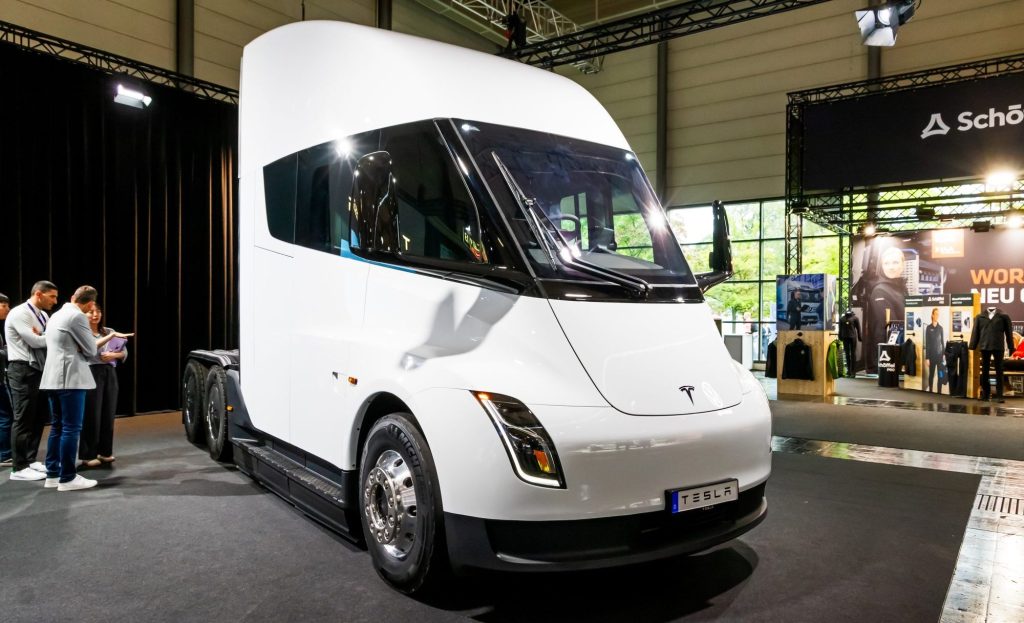
Roughly 40 new all-electric trucks will soon be working the route between Houston and Dallas thanks to a pilot program that aggregates demand from companies seeking to decarbonize their shipping emissions.
Amazon, eBay and Etsy are among the companies involved in the initiative, which will enable the San Francisco-based startup Nevoya to begin deploying new Tesla Semi trucks later this year or early next. The fleet of Class 8 vehicles — the largest truck classification — is expected to travel up to 7 million miles annually and avoid an estimated 60,000 metric tonnes of carbon-dioxide equivalent emissions across the multi-year contracts with participating buyers. All charging will be covered by renewable energy certificates.
Participating companies do not need to actually send shipments on the trucks to benefit from the emissions savings. Under the scheme, which is organized by the nonprofit Center for Green Market Activation (GMA), Nevoya will sell “environmental attribute certificates” (EACs) representing the emissions savings independently of contracts for freight. Buyers then deduct the emission savings represented by the certificates from their Scope 3 emissions, and retire the certificates to prevent further use.
Aviation playbook
Similar “book and claim” schemes are already being used to fund decarbonization of maritime shipping, cement, iron and other sectors. One well-established scheme — the Sustainable Aviation Buyers Alliance, a project co-managed by GMA, Environmental Defense Fund and RMI — has aggregated $550 million in demand for sustainable aviation fuel certificates since 2021. Amazon and Visa are among its members
Like these other areas, road freight is challenging to decarbonize in part because zero-emission options come with a premium. Battery electric trucks usually cost about twice as much as equivalent internal combustion vehicles, according to the GMA. The need to create charging infrastructure and purchase renewable electricity can further increase the price.
There are companies willing to pay these premiums for at least some shipments, but they often struggle to find zero-emissions options because less than 1 percent of new heavy-duty vehicles in the U.S. are electric. The book-and-claim approach solves this problem by aggregating demand across interested companies, regardless of their ability to access electric trucks.
Scaling the project
GMA described the purchase of trucking EACs as a pilot and said it planned on further developing the project. One move that would accelerate progress would involve leading standard setters integrating EACs into their guidelines — something the Science Based Targets initiative is considering. “That will provide stakeholders with confidence in the accountability of these solutions,” said Andre de Fontaine, GMA managing director.
The center also plans on combining book-and-claim agreements with more traditional contracts that involve companies paying directly for zero-emissions shipping.
“Layering book and claim into these efforts can increase asset utilization — trucks and chargers — lowering overall costs for all buyers,” said de Fontaine. “As costs decrease, we expect more shippers to get involved, increasing demand and, in turn, driving greater production and deployment of zero-emission heavy-duty trucks.”

Subscribe to Trellis Briefing