Despite global appetite for clean tech, cost and practicality limit uptake
The Global South is hungry for solar panels and electric vehicles, but Europe and North America show higher resistance to adoption. Read More

- Clean technologies enjoy strong global appeal, yet the share of people transitioning from interest to purchase remains limited.
- Affordability and practicality are key barriers, with around one‑third of people expressing interest in clean technologies but cannot afford it.
- Regional attitudes diverge, with Europe and North America showing higher proportions of people who aren’t interested, suggesting deeper cultural skepticism and slower consumer readiness compared to Global South attitudes.
Public interest in clean technologies is widespread, but the path to large‑scale adoption remains rocky.
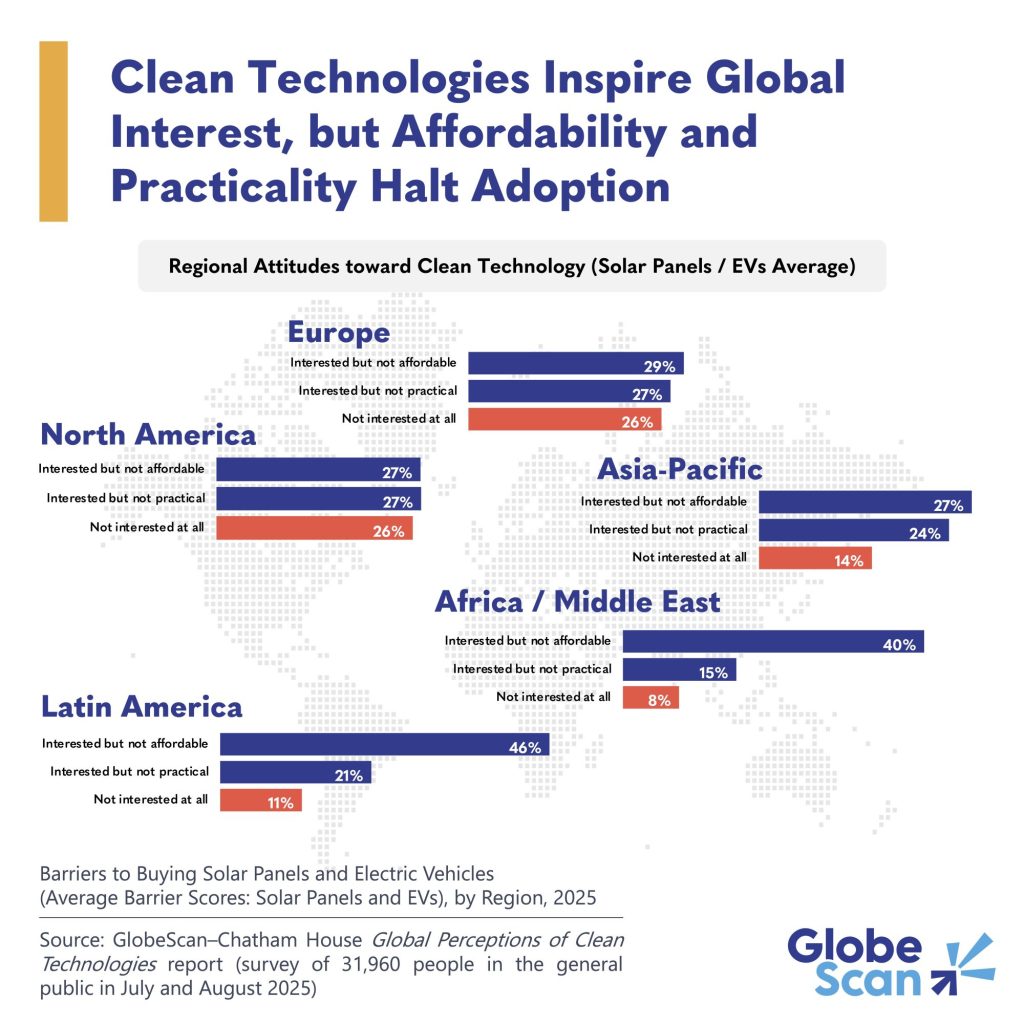
According to a recent survey by Trellis data partner GlobeScan, in conjunction with Chatham House, interest in clean tech such as solar panels and electric vehicles is robust. In emerging markets in Africa and the Middle East, Asia-Pacific and Latin America, only around one in ten people say they have no interest in investing in clean options, indicating particularly strong enthusiasm in the Global South.
However, the defining insight from the data is the systemic nature of the barriers that inhibit adoption. Affordability remains the foremost constraint, as roughly one in three respondents say they’re interested but cannot afford solar panels or EVs. This affordability gap is particularly stark in emerging markets, where enthusiasm outpaces access and financing options.
Practicality is the second critical barrier, as consumers have to face infrastructure challenges such as grid reliability, installation logistics and the availability of charging networks. In addition, there are perceived uncertainties related to performance, durability and ease of use. These aren’t merely product‑level issues but reflect broader ecosystem shortcomings that must be addressed to normalize clean‑technology ownership.
Europe and North America record meaningfully larger “not interested at all” segments, indicating cultural hesitation rather than just economic or practical barriers. In these markets, overcoming psychological and behavioral barriers may be as important as improving affordability and practicality.
What this means
The research shows fundamental barriers that the market hasn’t resolved are holding clean-tech adoption back. Affordability is the primary obstacle and many consumers who want to adopt clean solutions still can’t access them at a viable cost. Practicality challenges reinforce this gap as limited infrastructure, installation complexity and uncertainties about everyday performance continue to slow uptake.
These issues reveal a clear execution gap in the green transition. The path forward requires creating conditions where clean technologies are easy to access, simple to use, and seamlessly integrated into daily life. When costs come down, when infrastructure removes friction and when solutions feel convenient for the mainstream consumer, the significant latent demand can translate into widespread adoption especially in the Global South.
Based on a survey of nearly 32,000 people conducted July — August 2025.

Subscribe to Trellis Briefing