How Clorox sets climate goals
Strategy is now set by an executive-level committee, and starting in May the company will start requiring business units and brands to submit quarterly scorecards that track sustainability progress at the product level Read More
- Clorox’s strategy is advised by a steering committee led by its chief sustainability officer, but an executive committee has final authority.
- The consumer products company is rolling out software to centralize data and use AI to model potential outcomes of business decisions.
- Squads of sustainability advocates were assigned to help with training and grassroots adoption.
Like other large companies with maturing corporate sustainability strategies, Clorox is transitioning its business planning and quarterly management reviews to include emissions reduction metrics.
That effort has taken longer than anticipated because the right governance structure wasn’t in place, said Clorox CSO Niki King, who joined the cleaning and consumer products company three years ago to accelerate the integration efforts. She reports to the chief legal officer.
“Clorox has done amazing work, but it was time for a refresh,” she said. “I really had to take a step back and understand what wasn’t working, why it wasn’t working and what we needed to do differently.”
According to King, the biggest shortcoming of Clorox’s early efforts to get every team engaged in its sustainability initiatives was a failure to include Clorox’s top business leaders in setting emissions reduction targets and other environmental goals.
“Our governance structure was not leveraged,” she said. “We just made this attempt to go to our business units and say, ‘This is your fair share goal. You need to figure out how to do it.’ ”
Clorox revamped its governance structure in 2023 to create a sustainability executive committee that meets quarterly and reports to the company’s CEO and board of directors. It includes Clorox’s chief legal, administrative and supply chain officers, and the two business unit presidents. This group decides which sustainability metrics the company adopts. Full stop.
The sustainability executive committee receives guidance from a longer-standing steering committee, led by King, that meets more frequently. Members include individuals representing investor relations, sustainability reporting, diversity, equity and inclusion strategy, regulatory affairs, human resources, communications, procurement and research and development (R&D).
The makeup of the steering committee is likely to change when Clorox updates and whittles down its emissions reductions targets this year to focus on fewer strategic priorities, King said. Aside from the two committees, King meets with the Clorox governing committee quarterly and presents to the entire board at least once annually.
Long journey
Clorox’s environmental initiatives stretch back more than two decades; the company — which owns brands ranging from Burt’s Bees and Pine-Sol to Brita and Hidden Valley Ranch — had its first science-based targets approved by the Science Based Targets initiative in 2021.
The goals call for an emissions reduction of 50 percent across operations, and a 25 percent cut for the carbon footprint related to purchased goods and services, and the use of sold products (the two Scope 3 categories it’s working on officially).
Clorox has integrated its sustainability progress disclosures with its annual financial report since 2012. Based on its latest data from October 2025, the company already reached the first target with a 65 percent reduction; it so far has cut Scope 3 emissions by 18 percent.
The next wave of Clorox’s sustainability strategy, which includes changes in ingredient management and more use of recycled plastics and other materials, will require deeper changes to R&D and procurement processes.
Having senior leaders behind the strategy is important for clarity, said Michelle Claudnic, senior director of innovation and R&D at Clorox, during a panel at GreenBiz 26. It affects how product developers think about reducing waste or materials, or whether or not to follow eco-certification guidelines.
“When sustainability is embedded in the problem as I formulate,” she explained, “that’s very different from it being an end-of-process, check-the-box exercise. When we embed it up front, we have a lot more options in terms of how to deliver sustainability.”
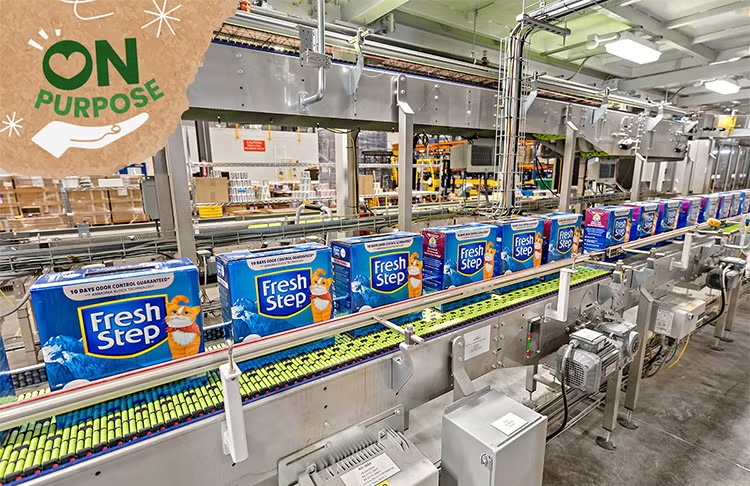
For example, formulation changes were made to Clorox’s Fresh Step cat litter, so it doesn’t need to be changed as often and requires less packaging. Clorox also adjusted its sourcing strategy, to buy the ingredients from more local sources.
Data and decisions
Starting in May, at the suggestion of one of Clorox’s directors, the company will start requiring business units and brands to submit quarterly scorecards that track progress at the product level toward key performance indicators for sustainability.
For the first year, those reports will focus on a simple question: Has the brand built a roadmap toward achieving the company’s 2030 goals? In the next phase, the scorecards will track how sustainability metrics are reflected in purchasing policies and how they have been integrated into innovation and product development.
Clorox is rolling out a data management system that will replace close to 30 spreadsheets used for this function to support the scorecards. “What was important to us, ultimately, was that we would have the data on a more consistent and robust basis,” King said.
The software will allow Clorox to gather actual data from suppliers, which account for close to 93 percent of Clorox’s emissions; the company now estimates these emissions using spending data.
Clorox’s procurement teams will be able to compare carbon metrics for suppliers when making buying decisions. The software will also allow the research and product management teams to model the potential impact of changes to formulations or packaging.
“It’s going to give our business units the tools that they need, so that they can go in and say, ‘Hey, if I want to change from this ingredient to this [one], what will be the impact to the carbon footprint of the product,’ ” King said.
Clorox appointed “squads” within each business unit that will be accountable for training employees about the new scorecards in advance of updated goals, which are expected to arrive anticipated later this year.
“All the coaching and guiding is beautiful, because we’re building the capability of the team, you’re really showing them the way to do it, and ultimately creating a deep connection,” said Pedro Diaz, senior procurement director for global business operations and ESG at Clorox, at GreenBiz 26. “That connection has really changed the way that sustainability is perceived within this function.”

Subscribe to Trellis Briefing