L’Oreal invests in 13 startups to speed materials innovation
The cosmetics and personal care giant seeks to accelerate commercialization of renewable and biodegradable ingredients, sustainable packaging and materials reuse models. Read More
- Ten of the 13 companies are developing sustainable packaging and materials alternatives.
- Each entrepreneur will have the opportunity to participate in a six- to nine-month pilot.
- L’Oreal’s primary goal: help commercialize these technologies, which will reduce its own costs and benefit the industry.
L’Oreal spends more than $1.5 billion on research and development annually, with the goal of using plants, minerals and recycled materials for 75 percent of its ingredients by 2030.
It is also investing close to $120 million on outside help through L’Accelerator, a five-year program to recruit entrepreneurs seeking to commercialize technologies that address the cosmetics company’s climate, nature and circular materials goals.
L’Oreal has selected 13 companies for the first phase of the program, which kicked off in mid-January. It hasn’t disclosed how much funding is dedicated to participants but plans to work with five annual cohorts during the lifetime of the program.
Each entrepreneur participates in a 12-week program at the University of Cambridge Institute for Sustainability Leadership, where they’ll learn skills such as how to pitch potential investors, sales plan development, financial and budgeting strategies, negotiating methods and so forth. From there, they’ll have the opportunity to team with L’Oreal brands for field tests that last between six and nine months.
L’Accelerator caters to companies with market-ready solutions that need more resources to reach commercial scale in the form of management coaching, funding and corporate pilots for their solutions, said L’Oreal Chief Corporate Responsibility Officer Ezgi Barcenas.
“We’re really looking for what I would call later-stage companies that are really at an inflection point,” she said. “They’ve created a product and they’re really looking for a customer to come in to design that product or put it into a use case — an application for that customer.”
Approximately 66 percent of L’Oreal’s products meet its 2030 ingredients commitment, and the company is looking outside its own R&D team for a spectrum of other business process and materials innovations that can help close the gap.
‘Test small, learn fast and iterate’
Each L’Accelerator relationship will be managed by an internal sponsor chosen from teams across the company including the supply chain organization, brand managers, R&D and finance, Barcenas said.
More than 80 L’Oreal employees were involved with selection and will continue to be involved in the relationships. That model mimics one in the 100+ Sustainability Accelerator initiative that Barcenas oversaw at her previous employer, beverage company AB InBev.
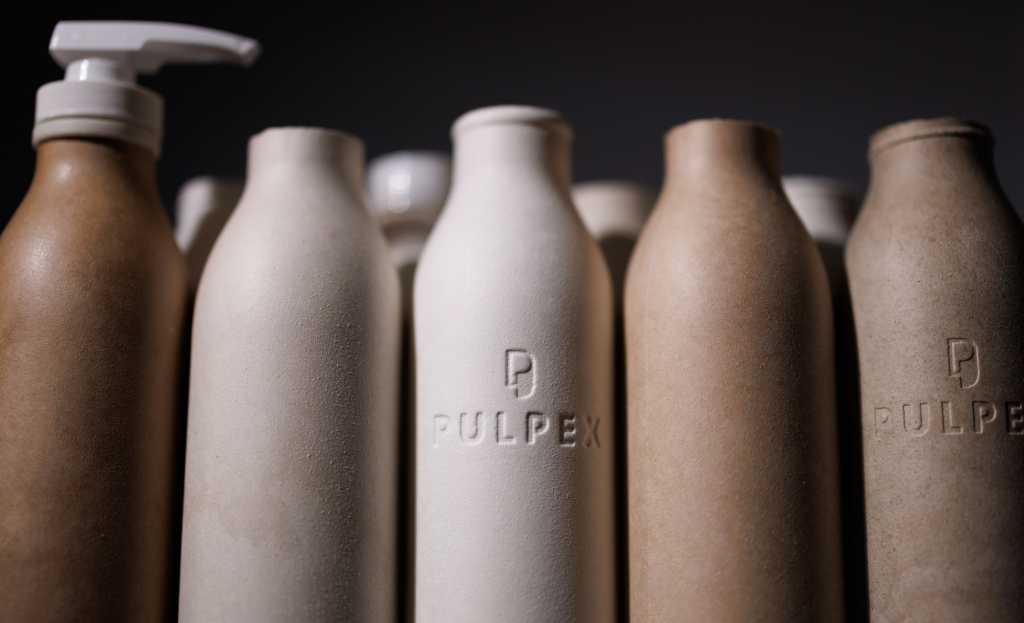
Ten of the 13 companies chosen for the first L’Accelerator cohort are developing sustainable packaging and materials alternatives, including Pulpex, which is working on recyclable paper bottles.
Pulpex is a venture spun out of adult beverage company Diageo, which has been testing fiber-based alternatives to glass and plastic bottles. The U.K. company has amassed an appreciable sum of financial backing, including more than $83 million from the U.K. and Scottish governments to build a factory in Glasgow, Scotland, scheduled to open in the second quarter.
The venture is considering a business model in which it will license its technology to packaging companies and manufacturers looking for fiber-based alternatives, said Scott Winston, managing director and chief science and sustainability officer at Pulpex. One thing the company is studying with L’Oreal is whether its packaging is more appropriate for business-to-business or business-to-consumer applications.
“It’s not about the technical functionality, it’s about the execution,” he said.
What makes L’Oreal’s initiative radical is a willingness to sprint at the speed of a startup, Winston said: “There has usually been a mismatch between how fast entrepreneurs work and the usual processes of a large company. This program will test small, learn fast and iterate.”
Success metrics
Some L’Accelerator participants could eventually see the relationship evolve into a commercial contract after their pilot is complete. L’Oreal may also consider taking an equity stake, but its larger interest is in accelerating commercialization of the technologies to help reduce costs across the cosmetics industry.
“I would say that we are really being intentional about the partners we’re selecting but also telling the world that this is not only for L’Oreal,” Barcenas said.

Subscribe to Trellis Briefing