Microsoft, Autodesk and SwissRe among companies with highest internal carbon fees
Companies are using the funds to invest in heat pumps, emissions accounting software and carbon removals. Read More
- Tech companies and professional service providers tend to set the highest internal carbon prices, a survey of more than 220 companies found.
- The diversity in prices is linked to companies’ profit-to-emissions ratio, suggested the survey’s author.
- Internal carbon prices date back more than a decade but are not widely used.
A survey of more than 220 companies with internal carbon prices (ICPs) has revealed the range of ways in which this powerful yet relatively little-used emissions reduction strategy is being deployed.
Companies that set carbon prices levy a fee on every ton of carbon dioxide emitted and commit to spending the funds on internal or external climate projects. Microsoft, one early adherent, first set an ICP in 2012. Proponents say the approach can incentivize different parts of an organization to cut emissions, yet fewer than 600 companies told CDP that they levied such a fee in 2024.
In theory, higher per-ton fees do more to motivate emissions cuts. If that’s the case, technologies companies are leading the way, according to data from the Carbon Capital Lab, a carbon markets research and advisory firm that examined company sustainability reports for 2024 and 2025.
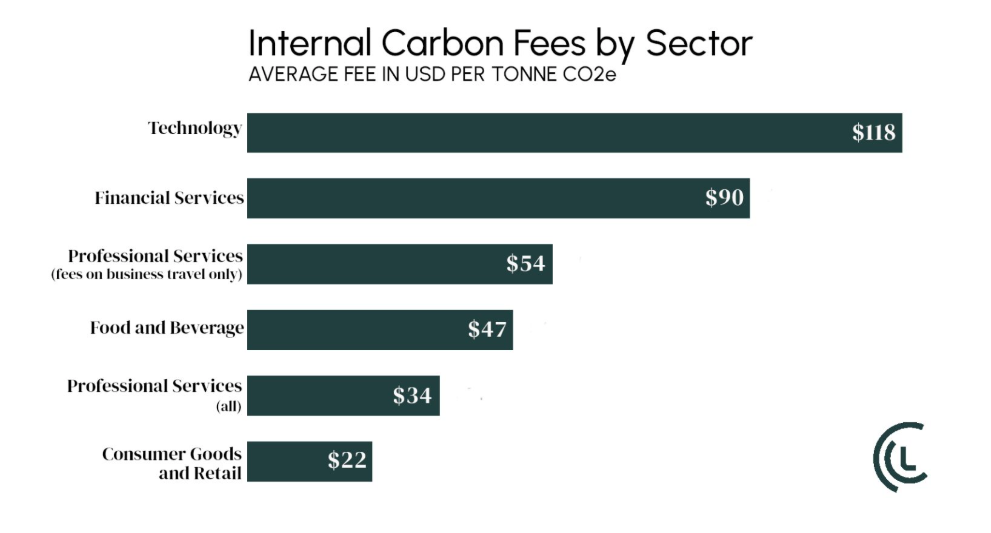
Tech companies with notable ICPs include Microsoft, which levies a $100-per-ton fee on business travel and $15 on emissions from other sources; Etsy, which charges business units $100-per-ton for emissions from Scopes 1 and 2 and business travel, alongside $15 for other Scope 3 sources; and Autodesk, which has a $33 fee on emissions from all scopes.
Companies with high fees outside of tech include SwissRe, which charges a $134 fee on emissions from Scopes 1 and 2 and business travel.
Solutions spending
The difference in fee size is likely related to ability to pay. Margaret Morales, the lab’s founder, noted that companies in sectors with high ratios of profits to emissions tend to have higher fees. (Morales is a former director of carbon at Trellis Group.)
But comparisons between companies and sectors should be treated with caution given the limited data available. The averages in the survey, for example, are based on the highest fee a company placed on any emissions category, and that will differ from the average price business units actually pay.
The survey also indicates how the money is spent. Funds went to carbon credits, policy advocacy and operational projects that include heat pumps, renewable energy and carbon inventory software. Several companies purchased carbon removals via the Climate Transformation Fund, a project of Milkywire, a Swedish company that helps businesses meet climate and nature commitments.

Subscribe to Trellis Briefing