Nothing is written: For sustainability, it’s still the middle of the story
President Dwight Eisenhower once said, “When I run into a problem I can’t solve, I always make it bigger.” Read More
- The job of sustainability professionals is changing — whether we like it or not.
- Every great story has a moment when the hero teeters on failure: Allies are scarce, confidence wavers, the sky darkens and the plot thickens.
- The question isn’t where we are in the story of sustainable business, but rather how we write the next chapter.
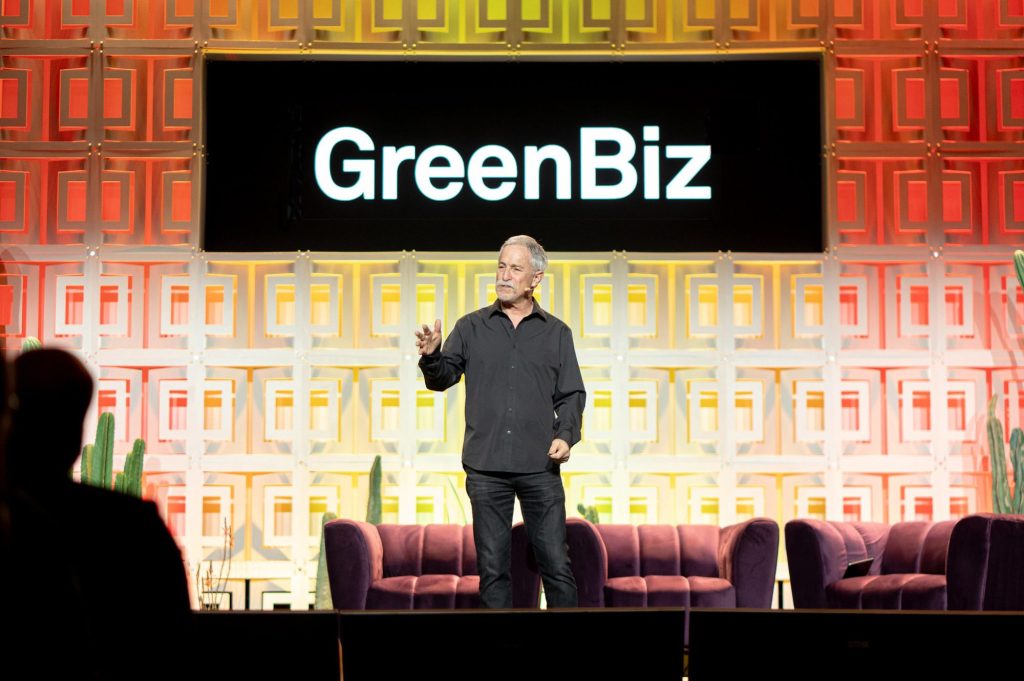
The following is adapted from my opening talk delivered yesterday at GreenBiz 26.
How was your 2025? It’s a serious question.
Not your company’s year. Not your sustainability department’s year. Your year.
How many of you would say you had a genuinely satisfying, impactful year as a sustainability professional?
How many would say it was frustrating and exhausting — maybe at times indistinguishable from a nonstop stress test?
And how many are somewhere in between — a little progress, a little whiplash, maybe a newfound appreciation for adult beverages?
It’s a strange time to be doing this work.
Two years ago, at GreenBiz 24, we were celebrating momentum — real commitments, real capital, real confidence.
Last year, we were asking each other, “What the hell is happening?” as we watched the political ground slip beneath our feet.
And today? Both things are still true. Progress continues. So does retreat. Two steps forward, one step back. Or maybe the other way around.
It’s a confusing, confounding moment.
Which makes this a good time not just to power through — but also to pause and ponder:
What does it mean to be a sustainability professional in 2026? What, if anything, should we be doing differently?
And I’ll say the quiet part out loud: Are we increasingly irrelevant?
In a few minutes, we’ll debate that last question for the profession overall. For now, ask it for yourself: Is my job still having a material impact?
If yes, how? If not, why not? And if the answer is “Well, sort of,” that’s worth examining, too.
Because the challenges aren’t going away. But the job is changing — whether we like it or not.
Overcoming barriers
If 2025 taught us anything, it’s that we can’t talk about climate and sustainability the way we used to. The old arguments don’t land the way they once did.
Misinformation is rampant. The public has other concerns. Investors are less engaged. Antagonists are throwing everything they can at us. The “business case,” such as it is, is harder to make — or at least it’s harder for others to hear.
That’s an inconvenient truth, especially if you’ve spent years getting the C-suite to sign off on projects or initiatives that are complicated, expensive or slow to demonstrate tangible progress.
So yes, the past year has been rough, to say the least. Some of our peers left the field — some voluntarily, others not so much. Budgets were cut. And companies rediscovered a fondness for, well, staying out of the limelight.
There’s fatigue out there. There’s resignation.
But there’s also resolve.
Because you’re still here. And that matters.
Middle of the story
My friend and podcast co-host Solitaire Townsend likes to remind us that every great story has a moment when the hero teeters on failure: Allies are scarce. Confidence wavers. The sky darkens. The plot thickens.
From Hamlet to Joan of Arc, Nelson Mandela to Erin Brockovich, Frodo Baggins to Katniss Everdeen. It’s a narrative arc that’s endured for centuries.
It’s simply “the middle of the story.”
That’s where we are in sustainable business right now: the middle of the story. Our hero is up against it. Enemies are circling. There seems to be no way out. Failure seems all but inevitable.
But the story isn’t over — not by a long shot. It’s only the middle!
The other thing Soli reminds us is that the hero of the story almost never succeeds by herself. There are usually allies, sidekicks, friends and veritable strangers who contribute to a successful outcome.
So, yes, sustainability is a team sport. You already know this, but it’s important to remember that, as Soli puts it, “The most powerful stories show us that transformation comes not from solitary strength — but from a shared purpose in community.”
That shared purpose is one of the many things that makes this community so incredibly important and impactful.
Lose, lose, lose
Here’s another truth: We like to imagine progress as a straight line. But history — and humanity — almost never cooperates.
The American Revolution following the signing of the Declaration of Independence in 1776 wasn’t “declare, fight, win.” For years, it was “lose, lose, lose.” New York fell. Philadelphia fell. Savannah and Charleston. The army nearly collapsed. Loyalty cracked. Money ran out. In Valley Forge, Pa., nearly 2,000 soldiers died from disease and malnutrition.
Lose, lose, lose.
Then came Yorktown in 1781, when the Continental Army finally beat the British. It wasn’t the end of the war, but the turning point in breaking away from British rule.
Lose, lose, lose … win.
And while it all may be seen as inevitable in hindsight, and in most history books, that outcome was far from preordained.
Sustainability can feel like that right now. Commitments attacked. Regulations reversed. ESG framed as political activism. Climate change declared a hoax — again!
Lose, lose, lose.
But the underlying forces haven’t gone away. Climate risk doesn’t track public opinion polls. Biodiversity loss hasn’t read Project 2025. Microplastics and forever chemicals remain deeply uninterested in our political polarization.
So the question isn’t where we are in the story of sustainable business. The question is how we write the next chapter.
Because nothing is preordained.
Making it bigger
One way forward may be to make the work we do bigger. Let me explain.
Dwight Eisenhower, America’s 34th president, who governed during the midst of the Cold War and a booming post-war economy, once said, “When I run into a problem I can’t solve, I always make it bigger.”
So instead of treating traffic, commerce and homeland defense as separate problems, he reframed them as one connected solution set — and created the Interstate Highway and Defense System.
When the Soviets beat the U.S. into space, he didn’t call it a national failure. He called it a science education challenge — and scaled the response to every schoolkid in America. I know. I was one of those kids.
That’s the kind of mind shift this moment demands of us.
Because the ultimate goal shouldn’t be about cutting your company’s emissions. It should be about redesigning business for a decarbonized, electrified future.
It shouldn’t be about supplier codes of conduct. It should be about building resilient, trusted value networks your company needs to succeed.
And it shouldn’t be about a circular economy. It should be about securing strategic materials advantage that enhances operational resilience.
That’s how we move from tweaking processes to shaping new systems: We make it bigger.
Woven into the fabric
Or consider climate risk. In 2026, it isn’t just a sustainability issue. It’s a finance issue. An operations issue. A license-to-operate issue.
It shows up in asset valuation, business continuity, credit ratings, fuel costs, insurance, logistics, M&A, product design, real estate, sales and marketing, supply chains, and dozens of other places.
That’s not sustainability losing relevance. That’s sustainability becoming inextricably woven into the fabric of business.
So how do you want to show up in that shift? What opportunities does this moment unlock for you and your team? For example, how does climate risk map to affordability, to adaptation, to abundance?
And given all this, do you keep doing what you’ve always done — or do you do some things differently?
Strength in community
Which brings us to why we’re here.
GreenBiz has never been just about tools and trends. It’s also very much about community — about helping each other stay in the game when the narrative turns sour and the going gets tough. It’s about helping each other do better this year than last, against whatever odds.
So if you’re feeling burned out, join the club. If you’re feeling frustrated, you’ve come to the right place. If you’re searching for a new way forward, you’ll find lots of fellow travelers here.
We. Are. Not. Losing. We are learning. We’re in the middle of the story — and we get to write what comes next.
Because nothing is preordained.

Subscribe to Trellis Briefing