Samsara Eco collaborates with outdoor brands around the globe on circular nylon
The Nylon Materials Collective unites a recycling startup with European outdoor labels to tackle the stubborn synthetic fiber. Read More
- Nylon remains a glaring circularity gap: high-performance, high-volume and largely unrecycled.
- Through its Nylon Materials Collective, startup Samsara Eco engages large and small outdoor brands to advance development and future sales of its circular nylon.
- The collective functions partly as a demand signal, aiming to de-risk investment in nylon recycling.
Nylon is the second most popular synthetic fabric behind polyester, yet less than 2 percent of it is recycled, mostly from fishing nets and carpeting, according to Textile Exchange. Seven million metric tons of the stuff are manufactured each year, which results in a lot of windbreakers, backpacks and bathing suits eventually ending up in landfills.
To make headway on recycling nylon from used textiles, the Nylon Materials Collective brings together an ambitious materials startup with scores of apparel companies. Textile recycler Samsara Eco of Australia launched the partnership Nov. 25 with the European Outdoor Group, representing more than 150 brands and retailers.
“By pooling demand and expertise, we’re making it easier for brands of all sizes to integrate high-performance, recycled materials into their collections and take meaningful steps toward a more sustainable outdoor industry,” said Katy Stevens, the European Outdoor Group’s head of sustainability, in a statement.
The organization represents more than 150 brands including Arc’teryx, Marmot, Fjällräven and The North Face. The effort is open to brands around the world.
“Having access to recycled nylon with the same performance quality but without the environmental footprint fills a long-held gap in the market and is a huge win for both industry and the planet,” Samsara Eco’s Chief Commercial Officer Sarah Cook told Trellis.

Enzyme-based technology
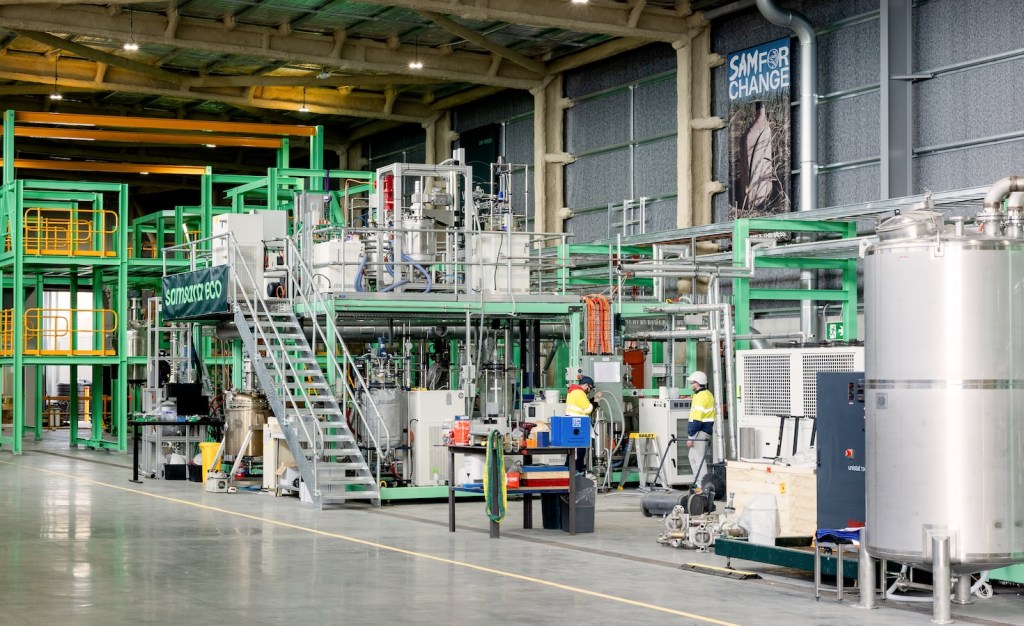
Samsara Eco made a significant deal this summer to supply Lululemon over the next decade. The startup is building a nylon recycling plant earmarked to open in the next couple of years.
Samsara Eco uses enzymes to break down nylon’s polymer chains, which are then rebuilt into new nylon. “We tap straight into the supply chain,” CEO Paul Riley told Trellis last year. “They don’t have to change their production process or equipment. We just go straight in where that fossil fuel might have gone in.”
Samsara Eco has experimented with recycling two common strains of nylon. Polyamide 6 appears in swimsuits and stockings, and it has been recycled for years from fishing nets, a major source of ocean pollution, by companies including Econyl. The rarely recycled type is Polyamide 6,6, found in performance gear, backpacks and hiking pants.
In addition, when nylon is blended, as it is with elastane to make leggings stretchy, it complicates recyclability.
“We have started to see the development of advanced recycling technologies that can break down blended fibers as a possible solution for processing these materials,” said Adam Gardiner, recycled engagement lead at Textile Exchange.
Pooling resources
Sustainability advocates praise the new nylon collective’s approach to pooling demand across brands.
“It lowers the barriers for small and mid‑size players to access high‑performance recycled nylon that matches virgin material in strength and durability,” said Bonie Shupe, founder of Rewildist, a Colorado consultancy focusing on apparel materials.
The Nylon Materials Collective takes a similar approach to Circ’s Fiber Club, which launched in January. Through that group, Circ of Danville, Virginia, aims to ensure the development of its recycled lyocell, a semi-synthetic fabric originating from trees. Partners include brands Eileen Fisher, Everlane, Zalando and Bestseller.
However, fashion has only begun to bend toward circular materials.
Numerous startups are vying to create closed-loop recycling for synthetic textiles, mostly polyester.
In the spring, Samsara joined some of those businesses — Circ, Circulose, Syre and Re&Up — in their new T2T Alliance, through which they will lobby for policies in Europe that advance textile-to-textile recycling.