P&G goes wide with a waterless, plastic-free Tide
The consumer products giant's flagship laundry product will now be available nationwide as a six-layered fiber tile packaged in a recyclable cardboard box. Read More
- P&G originally introduced Tide evo in 2024 and tested the product with Colorado consumers.
- There are 50 patents on the product, including some for manufacturing processes.
- It costs almost double per-load to wash clothes with Tide evo versus the liquid version of the detergent.
Procter & Gamble is expanding availability of the new waterless edition of its best-selling Tide laundry detergent to all national U.S. retail partners. The decision comes after test marketing in Colorado showed strong interest in the format.
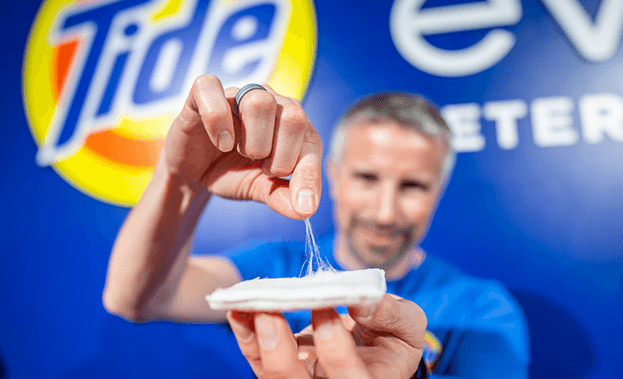
Branded as Tide evo, the detergent is concentrated into 3.5-inch square white tiles that dissolve in cold water in the washing machine.
P&G has more than 50 patents related to the product, which took a team of 15 chemists and engineers more than a decade to develop, said senior executives for Tide’s U.S. laundry business. Each tile includes 15 miles of scrubbers, stain treatments, brighteners, odor removers and other cleaning agents crammed into six layers of fiber.
P&G built a new production line in Alexandria, Louisiana, to scale manufacturing for the format; data from the Colorado test showed double the anticipated demand.
The company has invested $97 million in the Louisiana facility over the past two years but declined to specify how much of that went towards Tide evo. (P&G spends an estimated $2 billion annually on research and development but doesn’t publicly break out amounts for individual brands.)
“It’s a big investment, a big bet from us, largely because the thing that we like about this technology is it really combines the best of all the formats that we have,” said Marchoe Dill Northern, president of North America fabric care at P&G.
Tide is the leader of a U.S. laundry detergent market that generated close to $25 billion in revenue in 2024.
Portfolio approach
P&G, which frequently experiments with format, is credited with popularizing pods. Although its version, introduced in 2012, wasn’t the first to market, it now represents $2 billion in annual revenue for the company. Northern believes Tide evo could grow even faster.
The new product, packaged in cardboard boxes in quantities of 16, 42 or 66, will be merchandised alongside other Tide formats, including pods distributed in plastic bags and liquid detergent that comes in high-density plastic jugs.
The tiles will be more expensive: Liquid laundry detergent is priced at about 20 cents per load and pods at 31 cents per load. Tiles are about 48 cents per load, Northern estimated.
“I think what retailers are most interested in is category growth, at the end of the day,” she said. “And when we think about ways to drive that, what you need are products that deliver superior performance and consumer delight, and continue to drive convenience.”
P&G isn’t marketing Tide evo primarily for its sustainability features. “I think the reality of what we’ve seen in the U.S. is that just talking about sustainability alone is not sufficient to get people to try products,” she said.
That said, the new format supports the consumer products giant’s “water positive” goal, which includes a pledge to use 35 percent less water in production and to get more people washing clothes in cold water, saving on household energy consumption. P&G’s goal is for 75 percent of loads to be washed in cold water by 2030; as of 2024, it had achieved 65 percent.
Tide evo also plays into P&G’s commitments to reduce virgin plastics consumption and to sell all products in packaging that’s recyclable or reusable by 2030: Its boxes are curbside-recyclable and sourced from paper certified by the Forest Stewardship Council.
Other applications forthcoming
P&G considered other waterless formats, including sheets, before deciding on the multi-layered fiber tile, said Jennifer Ahoni, director and principal scientist for P&G fabric care.
“A lot of work was done to find the right way to stack these together in a format that was nice and compact but that also delivers superior cleaning and instant activation,” she said.
P&G also stripped out unnecessary ingredients such as dyes, although the squares do carry a fragrance.
Companies that sell laundry sheets include Church & Dwight through its Arm & Hammer brand; Seventh Generation, part of Unilever; and niche consumer products businesses such as Clean Cult, distributed by Costco.
P&G appears to be first-to-market with the fiber square design. It’s already eyeing additional applications, depending on adoption, although Northern declined to provide specific details.
“The thing that I like about it, from a detergent standpoint, is it gives us a platform to continue to be able to add different ingredients to it, to make it kind of a one-stop shop,” she said.

Subscribe to Trellis Briefing