The SBTi wants automakers to go all-electric by 2030. Sales figures suggest that’s not going to happen
A slowdown in EV adoption is raising questions about whether incumbent automakers will be able to fulfill the SBTi’s new standard. Read More
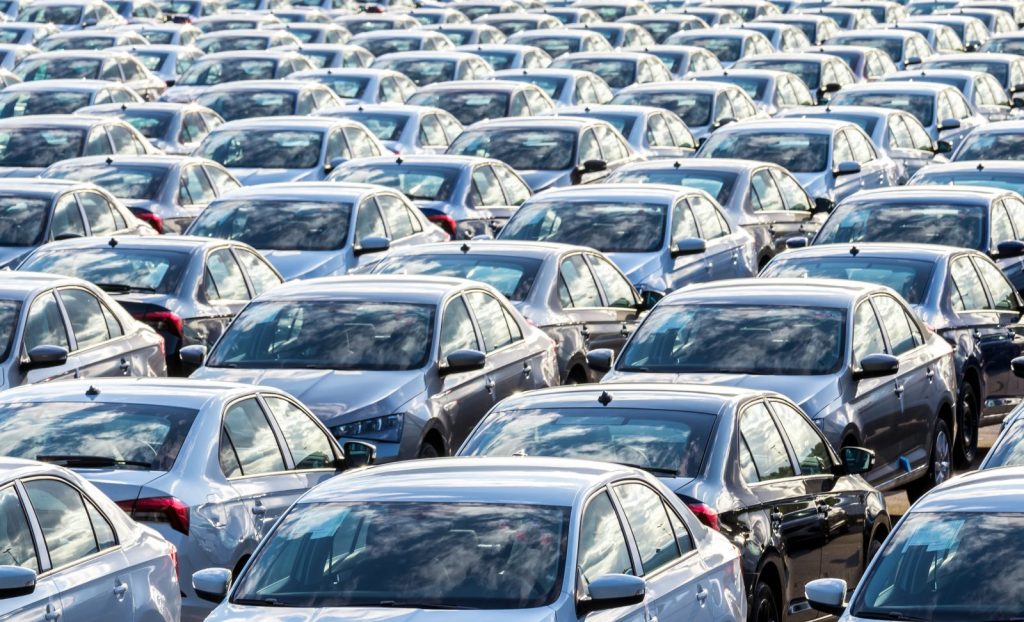
- Automakers must transition to all-EV lineups by 2030 to align with scenarios that limit warming to 1.5 degrees Celsius.
- The target date is included in the latest draft of the Science Based Target initiative’s autosector standard, released last week.
- Several major automakers, including General Motors, are required to review their targets this year.
The latest proposal for how automakers should transition to net zero has all the ingredients expected from the Science Based Targets initiative (SBTi), the influential standard-setter behind it. There’s detail on transition scenarios and instructions on how to set goals. But unstated in the 115-page document is an uncomfortable yet increasingly likely possibility: that major legacy automakers will walk away from the standard.
At the heart of the problem is a conflict between the SBTi’s guiding principles and business reality. The initiative was established a decade ago with the goal of validating corporate plans for reaching net zero by mid-century, a transition aligned with the goal of limiting global warming to 1.5 degrees Celsius. For automakers, that must include eliminating tailpipe emissions, which typically constitute 70 to 80 percent of sector footprints. But consumers aren’t adopting electric vehicles fast enough for emissions to fall as SBTi requires.
GM’s dilemma
Take the example of General Motors. The Detroit automaker’s current targets, which the SBTi validated in 2021, includes cutting per-kilometer emissions from new passenger cars 51 percent by 2035, measured against a 2018 baseline. But the most recent installment of Chasing Net Zero, Trellis’ company-by-company look at progress toward emissions goals, describes how GM’s per-kilometer emissions are up 3 percent since 2018, EV sales have slowed and the company is reevaluating its targets.
The new draft of the SBTi’s automaker standard, released last week and open for consultation until March 22, does not give GM or its rivals much room to maneuver. GM started the decade in a tough spot. Its global average across all its vehicles in 2022 was 307 grams of carbon dioxide equivalent per kilometer, considerably above the SBTi’s benchmarks of 212 gCO2e/km for passenger vehicles and 262 gCO2e/km for vans.
The standard’s benchmarks for 2030 are 22 gCO2e/km for cars and 72 gCO2e/km for vans. Achieving such a rapid reduction is all but impossible given that the Trump administration has scrapped regulation that was critical to the transition, including a $7,500 rebate for EV buyers.
The new draft of the standard adds flexibility in the form of an alternative metric: Instead of emissions intensity, manufacturers can base targets on the fraction of sales that are zero-emission vehicles. But this path also looks to be a non-starter. EV sales in the U.S., GM’s biggest market, were 6 percent of its 2025 total; SBTi’s 2030 benchmarks for advanced economies are 100 percent for passenger cars and 70 percent for vans.
Aside from all-electric competitors, such as Tesla and China’s BYD, GM’s peers are also badly off the pace. The trajectory outlined by the SBTi has zero-emission vehicles making up 43 percent of passenger-vehicle sales in 2025. In 2024, the most recent year for which it makes data available, the nonprofit International Council on Clean Transportation found that no European or U.S. legacy manufacturer achieved a share of more than 19 percent for light-duty vehicles.
Quiet resistance
Does all this mean that the SBTi’s new standard is dead on arrival? Automakers declined to state their intentions when contacted by Trellis, an understandable response given the influence of SBTi and the fact that the standard is still open for consultation. GM’s chief sustainability officer, Cassandra Garber, said only that her company’s targets were being reevaluated. Ford and Mercedes-Benz, which, like GM, are due to conduct a mandatory review of their SBTi targets, said they would assess the new standard when finalized.
Responses to a previous consultation on the standard reveal resistance, however. “The sales share targets are not operationally feasible,” wrote one automaker. (SBTi anonymized the feedback before publishing it.) “The current targets cannot be achieved by any automaker worldwide,” said another. Asked about whether they agreed with the standard’s “methodological approach to define benchmarks and compliance trajectories,” more than two-thirds of private-sector respondents said they didn’t.
To “maintain credibility,” one automaker suggested, SBTi should offer targets based on less onerous emission pathways, such as those compatible with 2 degrees Celsius of warming. “These alternatives would allow companies to transparently demonstrate their climate efforts, even under constrained framework conditions, and avoid penalizing ambition in the face of systemic limitations.”
There is some precedent for this. The SBTi allowed such targets between its launch in 2015 and 2022, after which it switched exclusively to 1.5C-compatible goals. And the International Council on Clean Transportation, which publishes annual ratings of automaker progress on EVs, benchmarks manufacturers against a scenario that sees 1.7C to 2.0C of warming, said Georg Bieker, an EV expert at the organization. Could that be the way forward?
The dangers of diluting
Many environmental organizations would say no. For starters, it’s too soon to give up on a relatively quick transition to an all-EV future, said Frederic Hans, a senior policy advisor with the NewClimate Institute, a German nonprofit. He pointed to the rapid transitions underway in a diverse range of economies, including Norway, China and Vietnam, as examples of what is possible.
Perhaps more importantly, he added, diluting a standard because some companies object undermines the rationale for setting standards in the first place. “These standards should serve the function of really identifying who are the frontrunners,” said Hans. “Who is doing these very risky steps? Because committing to 100 percent EVs, that is risky. It’s quite bold. And something like this should be rewarded and acknowledged.”

Subscribe to Trellis Briefing