The ‘wickedness’ of climate action
There's a reason low-leverage climate interventions are structurally doomed to fail. Read More
- Climate change is a structurally “wicked” problem, meaning it resists clean definition and cannot be resolved by technical expertise alone.
- Effective action requires moving past low-leverage interventions like corporate climate targets and focusing instead on changing the system’s core architecture.
- The ultimate objective isn’t to solve the problem, but to build adaptive, legitimate systems capable of governing climate change as it evolves.
The opinions expressed here by Trellis expert contributors are their own, not those of Trellis.
Regarding climate change, we keep failing to act at scale because we keep treating it as a complicated problem when it is, in the academic sense, a wicked one. And wicked problems don’t yield to the tools we’re using.
Let us explain. In 1973, academics Horst Rittel and Melvin Webber published a paper we often recommend to impact investing and sustainability students and professionals. They identified a category of problems they called “wicked” — not morally, but structurally. These are problems that resist clean formulation, have no definitive stopping point, produce no clear right or wrong answers, and where every attempted solution changes the problem itself.
Climate change is perhaps the wickedest of problems. Consider a few of Rittel and Webber’s defining characteristics:
- There is no clear definition. Climate change means something categorically different to a coastal Bangladeshi farmer, a Texas refinery worker and a sovereign wealth fund manager in Abu Dhabi. You cannot solve a problem you can’t agree on how to define.
- Solutions are only better or worse. A carbon tax, a green hydrogen mandate, a cap-and-trade scheme — none of these can be proven to be a correct course of action. They’re all just value-laden and time-dependent bets.
- Every solution is a one-shot operation. When you intervene, you change the system (for better or worse) and there’s no baseline to return to. This is the fact that makes geoengineering so sobering and emissions overshoot so costly. You can’t run the experiment twice.
- The problem is a symptom of other problems. Climate change is downstream of energy infrastructure, which is downstream of industrial capitalism, which is downstream of ideas about what progress means and who it’s for. The misclassification of climate as a problem that technical expertise can resolve has likely fostered many decades of misallocated effort.
The intervention map
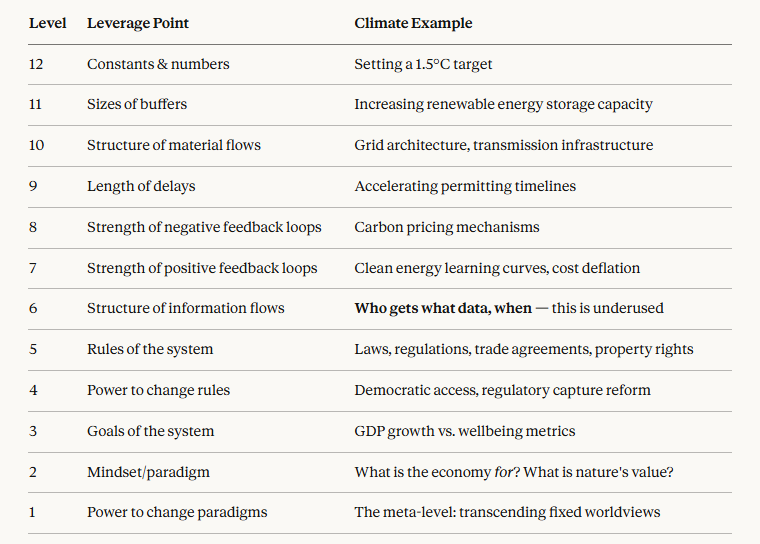
In a 1999 paper, author Donella Meadows ranked 12 types of interventions and her central insight is counterintuitive: The places we most commonly push are near the bottom of the effectiveness hierarchy.
Setting a 1.5°C target? Weak. A carbon price? Moderate. A new international treaty? Barely moves the needle. These interventions matter at the margins, but they operate at the level of constants and rules in a system whose deeper architecture is optimized for something else entirely.
The more powerful interventions sit at the top:
- Information structure. Not just what data exists, but who gets it, when, and in what form. This is Level 6 on Meadows’ hierarchy and it’s dramatically underused in climate strategy. Carbon disclosure requirements, mandatory Scope 3 emissions reporting, real-time climate risk embedded in investment platforms don’t just inform decisions, they restructure incentives. The reason ESG frameworks moved more institutional capital in the last five years than voluntary pledges moved in two is that they changed information architecture, not just sentiment.
- Rules of the system and the power to change them. Carbon pricing operates at the rules level (Level 5). But rules get diluted or reversed when the power to write and rewrite rules (Level 4) sits with actors whose core business model depends on status quo. Fossil fuel political spending isn’t irrational – it defends a Level 4 position.
- Goals of the system. This is Level 3, where the real fight is. If national governments compete on GDP as a primary organizing metric, they face structural incentives to externalize environmental costs. This isn’t bad faith; it’s systems behavior. The emergence of the Genuine Progress Indicator, Doughnut Economics, and the OECD’s Better Life Index aren’t soft ideas. They are direct interventions at the goal level of national economic systems.
- Paradigm and mindset. Meadows places these at the top: the shared assumptions that give a system its goals and rules. What is nature worth? What is the economy for? Does prosperity require growth throughput? These questions feel philosophical until you recognize their prevailing answers determine the shape of everything downstream. The current backlash against ESG is, at one level, a paradigm-level conflict being fought with Level 5 tools of legislation and regulatory rollback. Understanding that explains a lot about why the tools fail.
What this means for companies
For companies, a systems framework reframes climate risk in useful but uncomfortable ways. The TCFD architecture already gestures toward a more systemic view by distinguishing physical risks (direct impacts on assets, operations) from transition risks (the financial consequences of decarbonization). But most companies still engage this framework at the parameter level by measuring Scope 1 and 2 emissions, setting reduction targets, and reporting against them.
Scope 3 is where the system becomes visible. Upstream supply chains and downstream product use typically represent 70 to 90 percent of a company’s total emissions footprint and they exist within a web of relationships no single firm can control through linear management.
Higher-leverage corporate interventions are structural, like redesigning supply chains to build regenerative feedback loops, not merely cut emissions, engaging industry coalitions and policy forums to change the rules of the system, not just comply with them. So, if wicked problems cannot be resolved through better technical analysis alone and interventions we commonly reach for are near the bottom of the effectiveness hierarchy, what works?
A few things stand out:
- Stop expecting consensus on the problem and build consensus on the process. Climate negotiations that seek agreement on the “correct” framing before acting are structurally doomed. The alternative is procedural legitimacy – agreement on how decisions will be made, even without agreement on the right answer. The Montreal Protocol succeeded not because the science was beyond dispute, but because the process gave all parties a legitimate stake and a face-saving path to participation. Intervene on structure before pushing rules. For investors specifically, this means valuing companies that maintain robust, honest sustainability disclosure in the current anti-ESG environment because they’re revealing something important: they’ve integrated climate risk into operational strategy, not just public relations.
- Work at Level 4, not just Level 5. Effective climate investing means caring about who has the power to set and reset the rules. That means backing shareholder engagement strategies that target board accountability and recognizing that regulatory capture is a systems phenomenon. The companies best positioned for long-term climate transition are those building operational resilience to navigate when rules shift, regardless of the policy environment.
- Take goal-level interventions seriously. There is a movement toward non-GDP wellbeing metrics in national accounting and a growing cohort of investors incorporating natural capital into valuation frameworks. It’s a long-cycle with high-leverage intervention. It moves slowly and encounters fierce resistance precisely because it operates where the real architecture of the system lives.
The deeper truth
Unlike scientists who can fail and iterate with relative safety, planners whose wicked-problem solutions fail cause real harm to real people. This demands humility about technocratic confidence, including those of us who believe deeply in the urgency of climate action.Honest framing isn’t that we’ll solve climate change. It’s that we need to build systems capable of governing it — adaptive, legitimate, multi-perspectival systems that can learn faster than the problem evolves.

Subscribe to Trellis Briefing

Peter Lupoff