Renegade brands sell ‘clean’ toilet paper with audacious ads
Spots playing on health fears mark a shift in sustainability messaging towards literal potty humor. Read More
- Startups like PlantPaper and Potty Mouth are trading cutesy mascots for bleep-worthy humor and blunt health claims.
- Their ads spotlight toxic chemicals lurking in traditional toilet paper, linking them to cancer and pollution.
- The upstarts have gone viral by positioning “clean” TP as both a personal and planetary choice.
Big toilet paper brands generally avoid potty humor, but their latest challengers are embracing it.
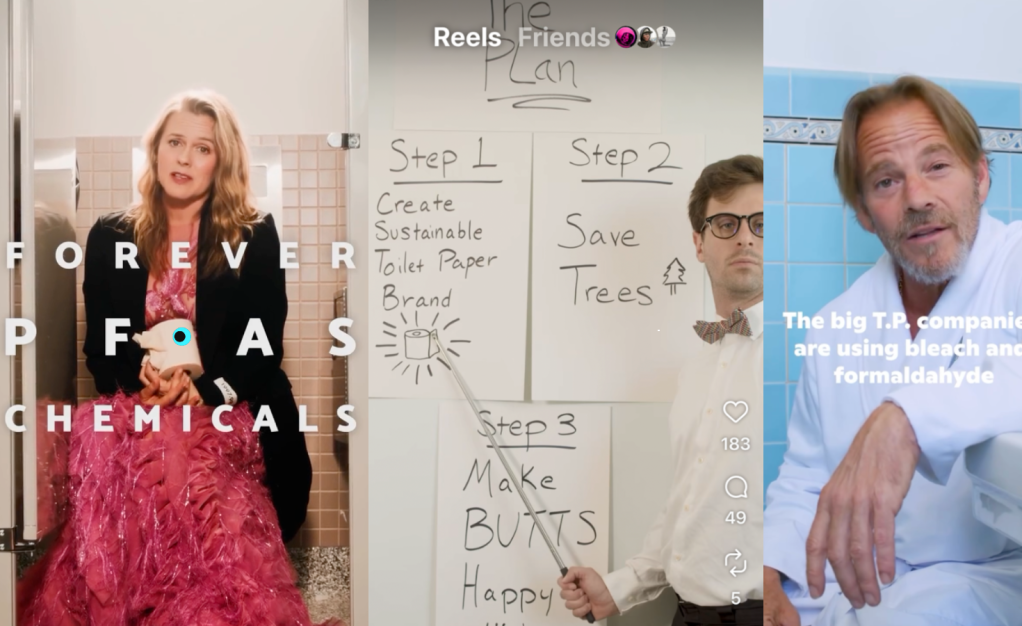
In three separate ads for PlantPaper, celebrities perch on toilet seats. Alicia Silverstone, Stephen Dorff and a breastfeeding Rumer Willis speak about the company’s “100 percent toxin free” bamboo toilet paper. “I know a thing or two about a–holes,” Dorff says. The actors warn of cancer and other health risks from chemicals detected in some mainstream toilet paper.
PlantPaper, Potty Mouth, Who Gives a Crap and other young businesses counter the soft-focus messaging of Charmin, Cottonelle and AngelSoft. They reject the cherubs, cartoon bears and other mascots that Procter & Gamble, Kimberly-Clark and Georgia-Pacific have deployed for decades.
Instead, the startups sell bamboo toilet paper via social media ads laced with bleeps and irony. The irreverence isn’t new. Seventh Generation ran a quirky yet G-rated spot in 2019 for recycled TP starring comedian Maya Rudolph crooning to “Mike the Tree.” However, the new entrants mark a shift from the old “save the trees” pitch.
“We’re talking about something that’s both inherently funny and inherently jarring,” said PlantPaper Co-founder and CEO Lee Reitelman. “After years of seeing toilet paper ads that seem like their target audience is 5- to 8-year-olds, I think it’s exciting for people to see something very different.”
The company’s Facebook, Instagram and YouTube ads have attracted millions of views. PlantPaper is profitable, pulling in nearly 40,000 orders each month. Its doorstep deliveries count 85,000 subscribers. The self-funded Brooklyn company uses three-ply bamboo sourced from China, certified by the Forest Stewardship Council. Reitelman and spouse Deeva Green have grown the team to nearly 10 since selling their first rolls in 2019.
‘Impact-native’ brands
“Awareness of the environmental impact of products has increased substantially, allowing brands to skip lectures about climate change in favor of actually talking to people in unexpected ways,” said Luke Purdy, director of sustainability at ad agency Wieden + Kennedy of Portland, Oregon. “To be relevant, you need to deliver on themes that actually matter to people and give them a reason to care.”
Humor is a natural fit for “impact-native” brands, he added.
“Eco-friendly” toilet paper will grow from less than $1 billion in sales this year to $1.25 billion in 2033, according to Market Reports World. Bamboo‑based toilet papers make up 12 percent of those sales. That’s a tiny share of the $41 billion toilet paper market, yet 68 percent of buyers show a preference for recycled or bamboo options, a report from Global Growth Insights shows.
“The best way to sell sustainability is to think selfishly — to understand why people buy your products and then use sustainability claims to reinforce, not replace, those reasons,” said Jamie Hamill, consulting director at Ogilvy in New York City.
Compare that with the “innovation jargon” of P&G, noted Joe MacLeod, communications veteran and founder of AndEnd Consulting.
“This is not the language of commonality of humans in their most intimate act,” he said. “I am wiping my bum with toilet paper. It is comedy gold. Let’s bond over the funny stuff, and then we can change the world together.”
Simon Griffiths, CEO and co-founder of the 13-year-old toilet paper brand Who Gives a Crap, sat on a toilet for 50 hours to crowdfund the startup.
The newest entry, Potty Mouth, launched two months ago after two years of research and development. Founder Luca Aldag, a stand-up comedian, posted his first TikTok video that praised going to the bathroom as an escape, reeling in 1.5 million views. Another Instagram post had 3 million views. He timed the first bulk purchase from China during a pause on U.S. tariffs. He and his best friend/co-founder unloaded the first 3,000 boxes in Oakland.
Aldag sells the product as “good for your butt, good for the planet and good for a laugh.” It’s also wrapped in paper, not plastic.
The health angle
“These ads are definitely working to tap into fears around chemical content, and I’ll bet it’s working,” said ERM Shelton Communications Senior Partner Suzanne Shelton. “We’ve also long seen what anybody who has ever watched a Super Bowl ad knows — humor works!”
PlantPaper regularly conducts third-party tests for forever chemicals, heavy metals, organic chlorine and certain plasticizer chemicals.
In 2023, researchers blamed toilet paper for up to 4 percent of U.S. and Canadian wastewater compounds that can become “forever chemicals” such as per- and polyfluoroalkyl substances (PFAS). The chemicals appeared to slip in, unplanned, through manufacturing or packaging, or through recycled pulp. (Unlike with toilet paper, however, forever chemicals are sometimes intentionally added to diapers and tissues.)
To cut toxic dioxin releases, brands now bleach TP with chlorine dioxide rather than elemental chlorine. Some use formaldehyde to increase wet-strength but public data is limited.
Watchdogs
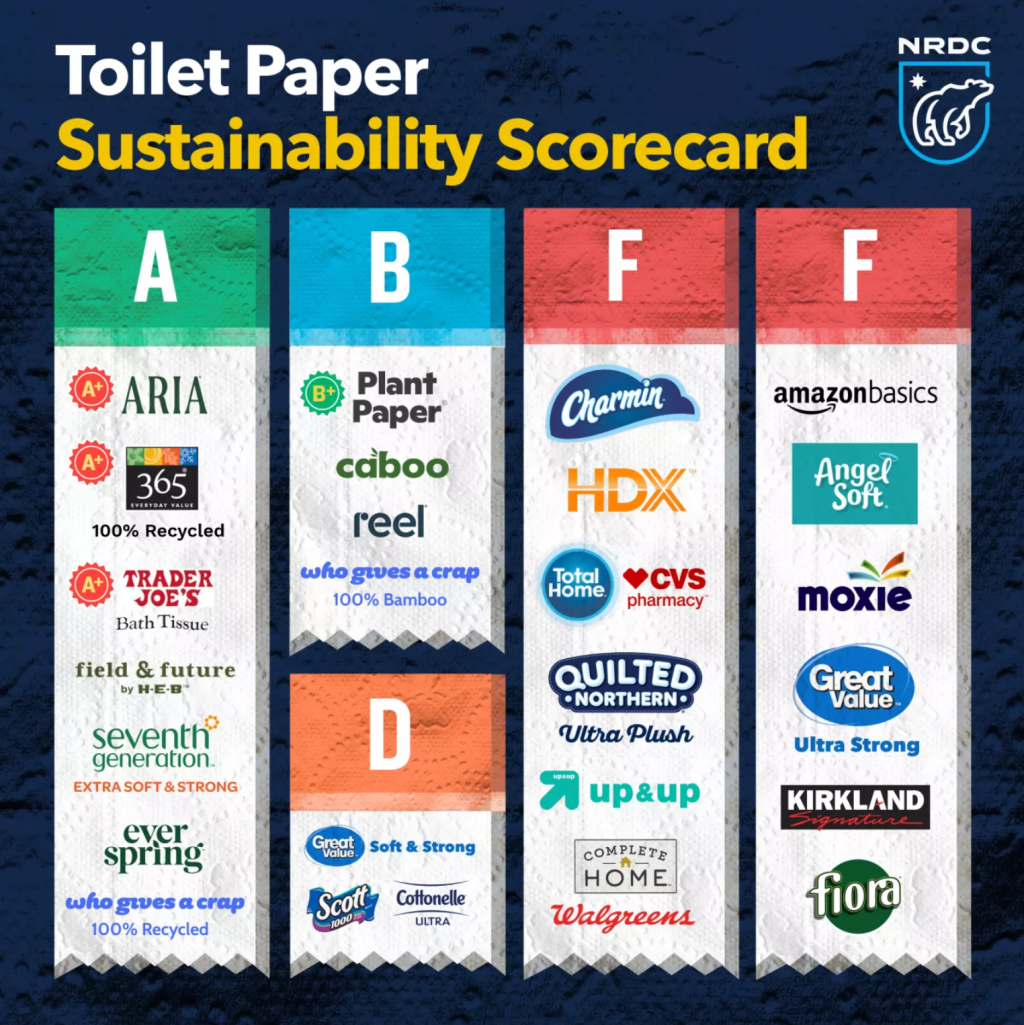
PlantPaper received a B-plus and Who Gives A Crap a B grade in the Natural Resources Defense Council’s 2024 “Issue with Tissue” rankings. Charmin, Amazon Basics and Angel Soft flunked. (Recycled-paper options from Aria, Whole Foods 365 and Trader Joe’s earned A-plus.)
“Toilet paper companies that truly prioritize health and environmental sustainability demonstrate it not only through PFAS testing and disclosure policies but also through their fiber sourcing,” said Ashley Jordan, NRDC’s boreal corporate campaign advocate.
Like the startups, consumer watchdogs are also wielding humor. As P&G faces a greenwashing lawsuit over Charmin, it’s also the target of a short, joke-laced documentary that Texan Brian Rodgers has produced, accusing the corporation of clearcutting old-growth forests.
“You’d better change because there’s a paradigm shift,” he said. “The younger generation is gonna be more active and more angry as our world changes.”
PlantPaper’s messaging is meant to connect human and environmental health, according to Reitelman. “Ecology is not something that’s happening in a pond or a forest,” he said. “Ecology is what’s happening when you flush this or that thing down your toilet.”