A global trust crisis
New data show global companies are among the least-trusted institutions. Read More

- Companies, NGOs and governments experienced notable declines in trust from 2024 to 2025.
- Although trust declined across the board, global companies remain among the lowest‑rated institutions, reinforcing ongoing public skepticism about corporate commitments and societal impact.
- Institutions rooted in direct societal benefit still lead, highlighting stronger public confidence in institutions perceived as purpose‑driven and publicly accountable.
There’s a reason trust dominated so many conversations at the World Economic Forum in Davos last month, as leaders grapple with rising public skepticism, political turbulence and ongoing questions about accountability.
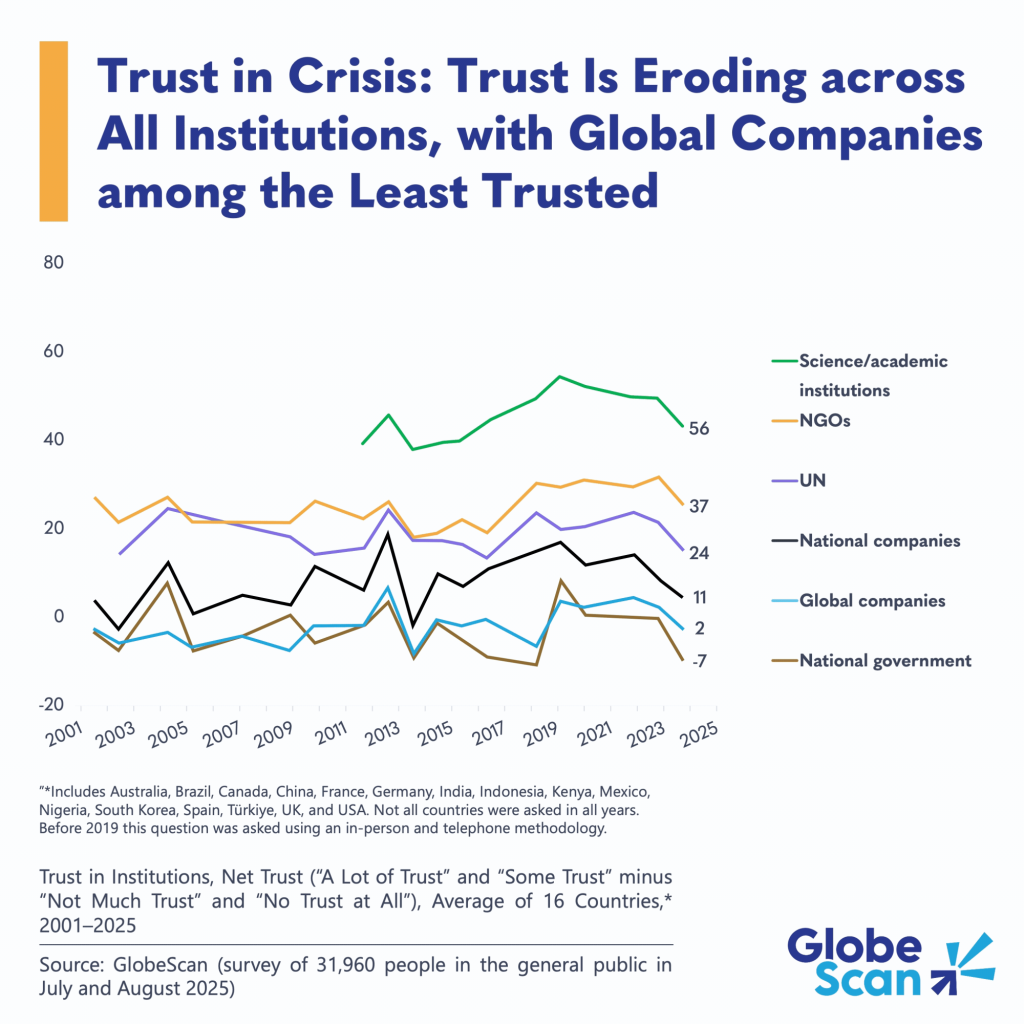
Trellis data partner GlobeScan’s long-running public opinion tracking reveals public trust is eroding across major institutions, with global companies, NGOs and government entities facing declines. Trust in national governments is approaching a historic low after peaking briefly during the pandemic. Other institutions such as science/academia and the United Nations have all seen net trust (trust minus distrust) fall, in some cases quite sharply.
The research shows that global companies remain among the least-trusted institutions, with net trust dropping close to zero across an average of 16 countries. This year’s findings also highlight that business is part of a wider trust recession, one that’s shaping political behavior, policy debates and public expectations around the world.
Recent developments in the United Kingdom, where questions around political conduct and transparency have dominated headlines, reflect how the decline in trust in one area can spill into broader public sentiment. People are increasingly alert to issues of accountability, integrity and alignment between words and actions, and institutions that fall short quickly risk losing legitimacy and visibility.
What this means
These findings point to a structural credibility challenge that cuts across institutions. In many markets, particularly in Europe and North America, more people distrust than trust most large institutions. In this environment, organizations must work harder than ever to demonstrate consistency, transparency and societal benefit. At Davos, leaders consistently cited a lack of trust as one of the biggest risks facing global progress, from AI governance to sustainability action and geopolitical stability, with broad recognition that building trust is central to navigating the complexities and rapid pace of change we face in our current context.
Building “thick trust” — a deep, resilient form of trust rooted in values, transparency, and alignment between purpose and performance — is becoming essential not only for companies but for institutions more broadly. As public expectations increase and scrutiny intensifies, those that invest in genuine engagement, openness and long‑term accountability will be better positioned to withstand uncertainty and earn lasting legitimacy.
Subscribe to Trellis Briefing