As renewable energy economics shift, smaller buyers get creative
Companies like Brown-Forman, Cardinal Health and REI are looking for simpler clean power deals located closer to their facilities. Read More

- Contract prices for many solar and wind contracts rose 9 percent in 2025.
- There were fewer unique corporate buyers in 2025, with Big Tech dominating deals.
- Small and midsize buyers are looking for simpler transactions that resonate with local communities.
Rising electricity prices, expiring incentives and interconnection backlogs are driving many small and midsize companies in the market for renewable energy to juggle priorities — emphasizing on-site installations and local suppliers.
U.S. tax credits for solar and wind are scheduled to start sunsetting in July 2026 as part of the One Big Beautiful Bill Act, even as the data center construction boom is escalating capital investments and per-megawatt costs. Meanwhile, companies are facing years-long delays for interconnection permits on the outdated power grid, and uncertainty is rising over tough new greenhouse gas accounting rules for electricity buyers.
The shifting market dynamics are already evident in buying activity for virtual power purchase agreements (vPPAs), which some companies use to match their operational electricity consumption. There were fewer corporate clean energy deals in 2025 than in any year over the past decade, with contracts of 55.9 gigawatts globally, off 10 percent from 2024, reports BloombergNEF.
“We haven’t felt this as a country since the era of electrification in the 1950s,” said Dan Keyes, director of capital markets at Clearway Energy Group, a developer with nearly 400 projects in its portfolio, pointing specifically at the U.S. grid. Keyes was one of more than a half-dozen experts participating in a GreenBiz 26 panel discussion about renewable energy strategy.
“Interconnection costs are going up and there are grid constraints even as electrification intensifies,” said fellow panelist Tyson Maulhardt, director of sales for key accounts at real estate investment trust Prologis. “Speed to power is more important than ever.”
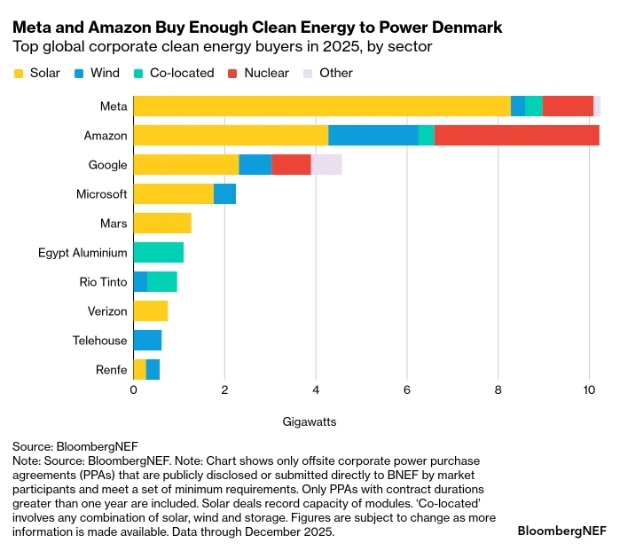
Source: BloombergNEF
Fewer corporate buyers
Prices for North American solar and wind power purchase agreements rose 9 percent during 2025, and some markets reported a 25 percent premium, according to data published by LevelTen Energy, which tracks transactions. For the PJM region, for example, home to a flurry of data center development, prices reached $81.03 per megawatt-hour.
The number of unique buyers committing to vPPAs in the U.S. fell by 50 percent in 2025, reports BloombergNEF; Amazon, Google, Meta and Microsoft accounted for close to half of the deals.
As Big Tech snaps up much of the capacity for new projects, it’s getting tougher for companies that are seeking to buy smaller amounts of renewable electricity to participate.
“Corporate clean energy buyers are operating at two different speeds,” said Nayel Brihi, corporate energy analyst at BloombergNEF, in a statement. “Large tech buyers are venturing into bigger deals and frontier technologies, while smaller companies are grappling with power market realities.”
Accelerated deal-making ahead
One of those companies is Cardinal Health, which is relatively new to renewable energy procurement. Its initial strategy, developed in 2024, combined aggressive on-site development at manufacturing and commercial sites with offsite PPAs.
Cardinal’s focus shifted after assessments eliminated a large number of potential on-site projects from consideration, and several vPPAs it was considering were snapped up by other buyers, said Megan Maltenfort, the company’s vice president of ESG.
The healthcare company is also concerned about the potential impact of the Greenhouse Gas Protocol’s proposed changes to the rules for electricity emissions accounting, and wants to add to its portfolio before those changes take effect. “We have to get as much done as possible in the next 12 months,” she said.
That means prioritizing contracts with straightforward terms and backing away from developers known for engaging in protracted, complicated negotiations, even if the economics are better. “Ease of contracting has become a huge thing,” Maltenfort said.
One way Cardinal Health seeks to accelerate its contracts is through an initiative called the Collective Healthcare Action to Reduce MedTech Emissions; one plan calls for the group to negotiate a renewable power contract on behalf of participants.
More midsize companies are reconsidering joint transactions that aggregate their renewable electricity capacity needs, said Andy Battjes, director of global environmental, health, safety and sustainability at spirits maker Brown-Forman, which distills Jack Daniels.
Smaller, simpler transactions
Outdoor products retailer REI is responding to market uncertainty by doubling down on its strategy of supporting smaller renewable projects that are located near its physical stores and that contribute positively to communities in the form of jobs or access to more affordable energy.
“We want to have things that are going to be more accessible to us,” said Jay Creech, net zero lead at REI, at GreenBiz 26. “That means it’s something that might be a simpler transaction term, it might be a shorter term length, it might be smaller volume.”
REI is evaluating U.S. regions where it currently has a weak presence and making investment decisions based on factors independent of how a particular project might be used in its emissions accounting. “We think there’s a lot of action that still needs to be taken,” he said. “There’s a lot of progress that we know we can make.”
Cardinal Health and Brown-Forman are likewise prioritizing regions with regulations, incentives and other market conditions that are more supportive of renewable energy projects.
Cardinal, for example, plans to place many of its on-site projects in Latin America, and Brown-Forman is educating local facilities teams, which control power contracts, about potential renewable energy options.
“Your local and state policy is everything right now,” Battjes said. “People are starting to have more localized plans that lean into the policy and where the load is applicable.”

Subscribe to Trellis Briefing