Former Nike insider challenges activewear’s plastic playbook
Tim Gobet's Äktiiv brand pitches plant-based, certified nontoxic leggings. Read More

- The former Nike exec is betting that he can find the winning formula for nontoxic, sustainable leggings before big brands dare to try.
- Äktiiv double-tests its materials, both yarns and the finished fabric after knitting, dyeing and finishing.
- The company’s proprietary textile combines plant-derived and faster-degrading nylons with the only Cradle to Cradle Gold elastane for stretch.
Fears that activewear sheds plastics that penetrate the skin are giving people new reason to sweat over working out. Responsive entrepreneurs now advertise leggings, tanks and sports bras as “nontoxic,” “clean” and “safe.” They tout gym- and trail-ready garments made of merino wool, cotton, mulberry silk, bamboo and hemp.
However, these materials alone can’t smooth curves or hug muscles through squats and sun salutations; only synthetics achieve that coveted stretch factor. So companies quietly blend natural fibers with elastane (also known as spandex), nylon or polyester.
Activewear brands find themselves in a paradox: touting images of fresh-air lifestyles while they produce clothes from petrochemicals that feed the climate crisis and pollute the planet.
Changing that requires formulating stretchy materials with proven performance, sustainable origins and lower end-of-life impacts. It’s a big challenge, said Marcian Lee, an analyst with Lux Research: “I don’t think we have a perfect solution that satisfies all three of these considerations,” he said.
Enter Äktiiv
One Nike veteran is determined to clean up athletic wear with his Äktiiv brand. Tim Gobet spends about $27 to make a pair of $100 leggings — not a high enough margin for larger brands, he said. The materials are certified nontoxic, mixing plant fibers and fewer oil-based inputs than standard fare.
Portland-based Äktiiv is in a pre-profit growth phase. It has raised under a million dollars including early capital from former Nike co-worker Jeffrey Jordan — son of NBA legend Michael.
Gobet manages suppliers, designs garments and juggles ads on Meta while his wife, Paulina, handles fulfillment. And their kids help move inventory through their Beaverton, Oregon, garage. In the past 90 days, customers spent an average of $152, and two-thirds returned to buy more. Gross revenues are at six figures each month.
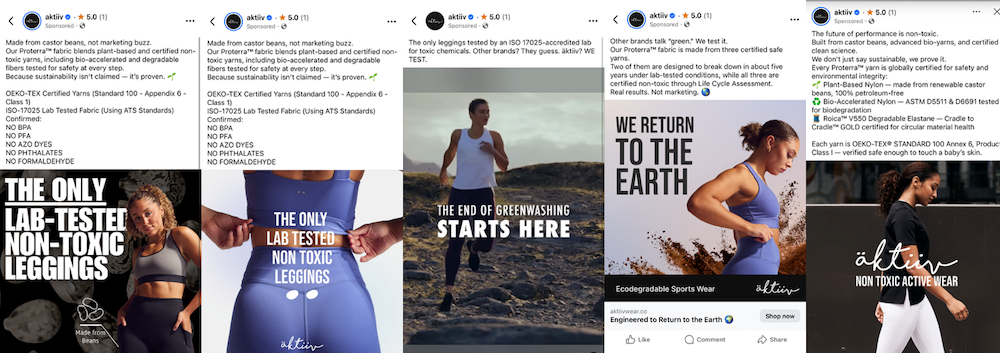
Äktiiv ads
How it started
Gobet’s 15-year career at Nike included leading the Jordan Brand, which topped $3 billion in sales when he left in 2017. He helped the corporation launch its first recycled polyester-spandex base layers for pro athletes for the 2016 Rio Olympics.
Yet Gobet was troubled by the industry’s hunger for virgin petroleum fabrics. “My materials developers started bringing alternatives: ‘Hey, this is made from recycled plastic.’ ‘Hey, this is made from corn input,’” he said. “My mind was like, ‘Why aren’t we using this anyway?’”
He soon caught entrepreneurial fever. “I quickly realized, we need to zig while everyone else is zagging,” Gobet said. “My goal was to create truly high performance, buttery-soft fabric that feels and looks like what is toxic but is good for the planet and good for health.”
First, he co-launched Zenkai Apparel with former NHL player Doug Lynch. Then Gobet moved on to start Äktiiv in 2020, hitting early snags with COVID-19 shutdowns and technical challenges.
“For two years, not a single supplier could get it right,” Gobet said. Then a former Nike materials developer quickly figured out how to blend Äktiiv’s proprietary Proterra fabric from three types of yarn.
Gobet found a partner in Sabrina Fashion Industrial. The Taipei company, which also serves major brands, knits and dyes Äktiiv’s material, then cuts and sews styles in Cambodia.
A Kickstarter campaign in 2022 raised $27,026 for Äktiiv, which made its first sale in 2023.
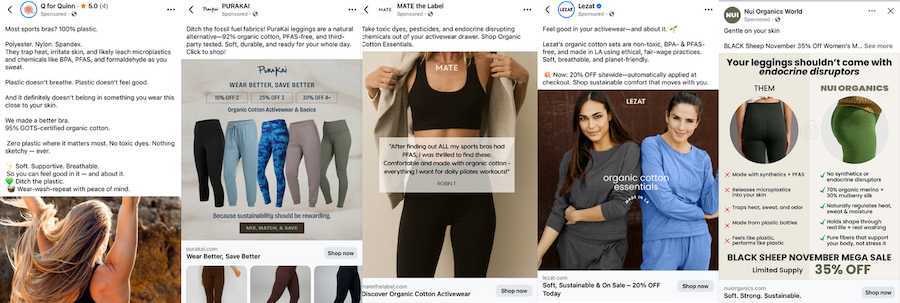
Other anti-plastic activewear
What’s in the fabric
Äktiiv’s Proterra fabric combines 42 percent petroleum-free nylon from castor beans or corn. Forty percent comes from a nylon 6,6 strain that biodegrades faster than traditional nylon. The final 18 percent is Roica V550 yarn, the only Cradle to Cradle Gold elastane.
All of Äktiiv’s yarns are OEKO-TEX 100 certified for “baby-safe” toxicity limits. Äktiiv tests the finished fabric, a step that other brands skip, according to Gobet. The company advertises clothes free of bisphenol A, per- and polyfluoroalkyl “forever chemicals,” azo dyes, phthalates or formaldehyde.
The tradeoffs
Äktiiv’s solution isn’t perfect: One yarn is fossil-fuel-free but doesn’t biodegrade. The other two may degrade quickly in landfills or oceans but are petroleum-based.
Gobet still dreams of finding a “holy grail” of biodegradable, plant-based activewear. “Both halves of the equation already exist,” he said.
Meanwhile, he is thinking about how to help the industry complete that calculation, possibly by sharing learnings or launching an industry collaboration.
Every alternative to regular elastane comes with trade-offs on performance, price, scalability and recyclability, according to Bonie Shupe, founder of Rewildist, a sustainable apparel consultancy in Colorado. “Transparency is essential as the industry transitions.”
Äktiiv faces a circularity dilemma, too: As yet, mainstream technologies can’t recycle textile blends such as Proterra, even as startups compete to change that.
Toxic matters
Äktiiv is seizing on increasingly popular consumer suspicions, based on recent science, that tight, plastic-fiber clothes hurt their health.
Studies show that skin can absorb certain plastics, but it’s unclear if that’s even harmful or if clothing is a culprit. Plastic in arteries is associated with a higher heart attack risk, but does plastic easily migrate into the bloodstream from the skin?
For Gobet, Äktiiv’s chemical-safety certifications provide a competitive advantage and peace of mind. “I’m still not comfortable putting untested synthetic fabrics on people’s skin for hours a day, during workouts when pores are open and sweat glands are active,” he said.
Gobet worries that mainstream brands selling synthetics will face new risks if future research confirms consumers’ fears. “If it turns out we were overly cautious? Great.”