Greenhouse Gas Protocol mulls dramatic expansion of emissions accounting
The protocol’s proposal builds on new guidelines, released this week, for how companies can claim benefits for investments in supply-chain decarbonization. Read More

- Carbon credits, insets and other climate action would be including in emissions reports under ideas floated by the Greenhouse Gas Protocol.
- Guidelines for claiming emissions savings from supply-chain investment have been released by Advanced and Indirect Mitigation Platform.
- The changes are prompted in part by demand from companies for more flexibility in working toward emissions goals.
The past two years have seen the launch of multiple approaches to emissions accounting and target-setting, in part because existing rules are deemed by some companies to be too inflexible. But businesses — not to mention their auditors — generally prefer to follow a single common set of rules. Is one on the horizon?
It’s too early to be sure, but two recent moves point toward a future in which at least some of the competing approaches could be unified.
One development with immediate implications is the release of a standard for a process sometimes known as “insetting.” Businesses following the approach can claim the emissions savings associated with projects they support within a region or other supplier grouping, even if those projects do not fall into their direct supply chains.
The accounting rules for these interventions have been clarified by the Advanced and Indirect Mitigation (AIM) Platform, which this week launched Version 1 of its standard and guidance document. The team behind the guidance, which has been piloted by Patagonia, Schneider Electric and some 30 other companies since the project launched in 2023, say the level of detail in the rules will allow companies to invest in supply-chain projects and be confident that the associated savings can be included in emissions accounts.
Supply-chain projects tested by the piloting companies included electrification of fossil fuel-based industrial equipment, capture and use of on-farm methane emissions and switching to low or zero carbon transportation. AIM is a joint project of three nonprofits: The Center for Climate and Energy Solutions, Center for Green Market Activation and Gold Standard.
Integrating the rules
The AIM guidelines sit outside of the Greenhouse Gas Protocol, the dominant framework for emissions accounting. But probably not for long. Kim Carnahan, the Center for Green Market Activation’s CEO, describes the AIM standard as an interim measure designed to free up climate finance while the protocol considers how to integrate the approach into its rules. And suggestions as to what that might look like emerged late last month when the protocol released a white paper summarizing how supply-chain interventions and related activity could be accounted for by companies.
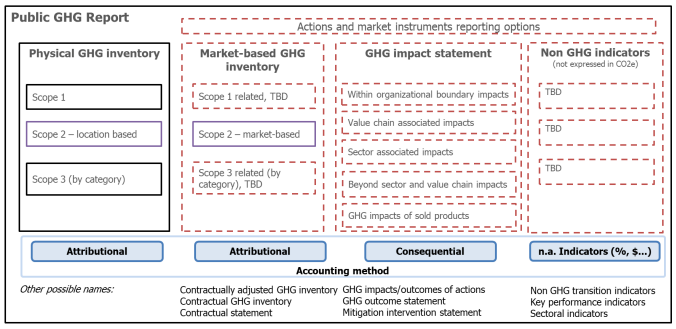
At the heart of the protocol’s proposal is an expansion of the existing system, which covers emissions from a company’s Scopes 1, 2 and 3 sources, to one that encompasses other types of emissions, including carbon credits and the sale of low-carbon products. Non-emissions metrics, such as the amount spent on low-carbon parts or ingredients, can also be accounted for. The reporting would be split across four “statements,” each of which captures different attributes of the company’s emissions and activities.
The proposal amounts to a dramatically broader vision for how emissions accounting could operate. As well as bringing in ideas from the AIM Platform, it builds on recent guidelines from the Task Force for Corporation Action Transparency, the Climate Solutions Framework and other initiatives.
Reporting statements in the Greenhouse Gas Protocol’s white paper
Next steps
The paper was designed to cover a wide range of different options, some of which may be trimmed as the ideas are developed into a standard, noted Carnahan, who is a member of the working group that developed it. The paper is open for stakeholder feedback until the end of May, with a draft standard expected to go out for consultation next year. Experts from the International Organization for Standardization are contributing to the process following the two organizations’ decision to harmonize their frameworks.

Subscribe to Trellis Briefing