Health, well-being lead the global shift to more sustainable diets
There's ample agreement around the desire to eat less processed food. Read More

- There’s strong personal motivation to eat a healthier, more sustainable diets, with four in ten people strongly agreeing they care about having a diet that supports both personal health and sustainability.
- Motivation to change is strongest where benefits feel personal and immediate.
- Environmental impact is widely acknowledged but held with weaker conviction, suggesting sustainability is often understood in principle rather than experienced as a primary driver of everyday decisions.
There’s a strong appetite for dietary change.
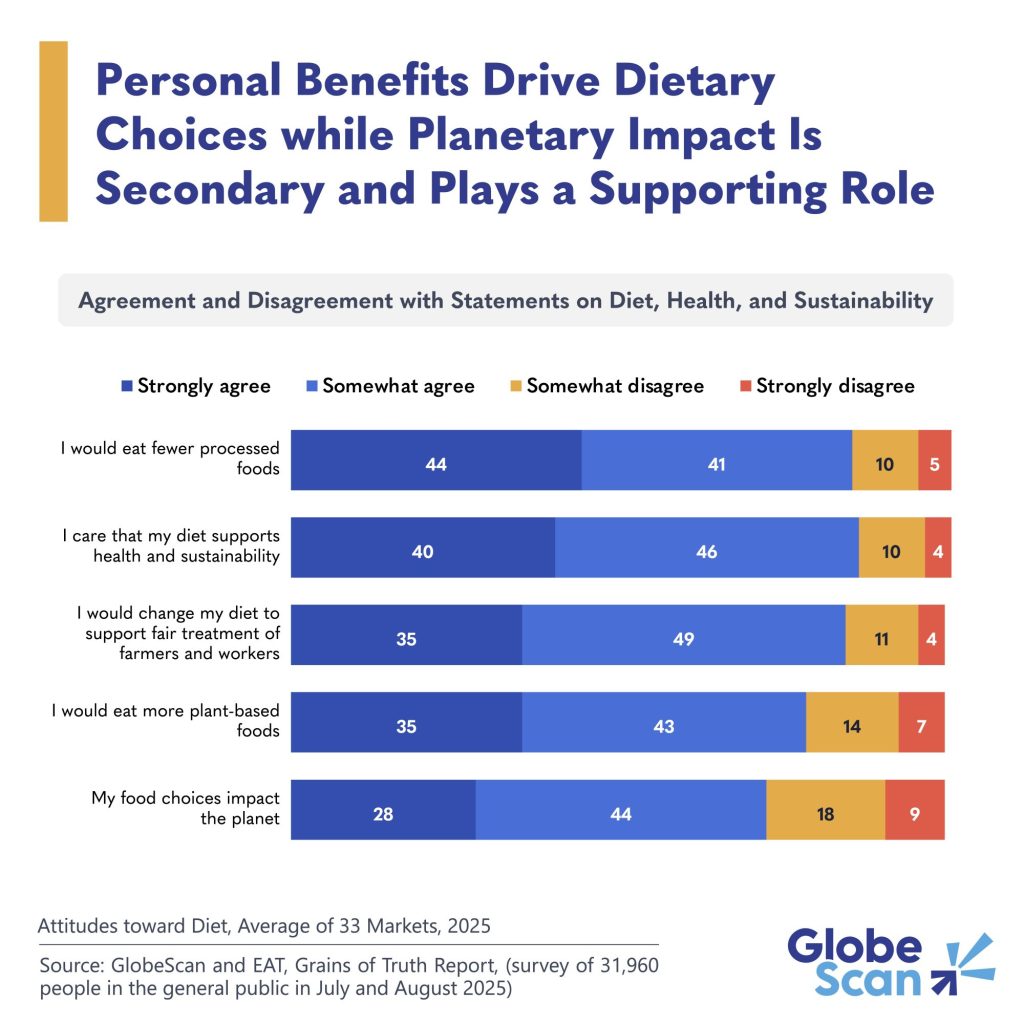
Research from Trellis data partner GlobeScan in collaboration with EAT, show people are willing to eat more sustainable diets when the benefits are framed around health. When asked to agree or disagree on various aspects of diet, health and sustainability, 44 percent of respondents strongly agreed that they would eat fewer processed foods, and a further 41 percent somewhat agreed. Similarly, four in 10 strongly agreed that they care about having a diet that supports both health and sustainability, with nearly half somewhat agreeing.
Support is softer when it comes to more specific shifts. Around one‑third of respondents strongly agreed they would eat more plant‑based foods or change their diet to support fair treatment of farmers and workers, with many more expressing moderate agreement. These findings suggest openness to change but also indicate that these behaviors may be less accessible or constrained by availability, price or habit.
Interestingly, the weakest point of conviction related to environmental impact. While a solid majority at least somewhat agreed that their food choices affect the planet (72 percent), only 28 percent strongly agreed, and nearly three in ten expressed some level of disagreement. This gap highlights how people broadly accept the idea that food and climate are linked, but for many, this understanding may be incomplete. Taken together, the pattern points to a gradient of motivation from strong, health‑driven intent at the personal level to softer, more conditional concern when impacts feel distant, systemic or harder to influence individually.
What this means
The research shows that people overwhelmingly want diets that are healthy and sustainable, and most recognize that food choices play a role in shaping environmental outcomes. However, motivations aren’t equally weighted. Personal health remains the most powerful entry point for change, while sustainability, particularly when framed in planetary or systemic terms, tends to act as a secondary or reinforcing benefit rather than a primary driver.
This has important implications for how sustainable diets are promoted and enabled. Accelerating dietary change requires anchoring sustainability more firmly in what people already care about most — their health, their families and their quality of life. Making the environmental benefits of food choices more tangible and clearly linked to personal outcomes is critical to bridging the gap between awareness and action.
Based on a survey of nearly 32,000 people across 33 markets conducted July — August 2025.

Subscribe to Trellis Briefing