How Jabil uses AI and robotics to bolster its decarbonization agenda
The contract manufacturer for Apple, Amazon and others is overhauling its systems for the sake of efficiency and emissions reductions. Read More
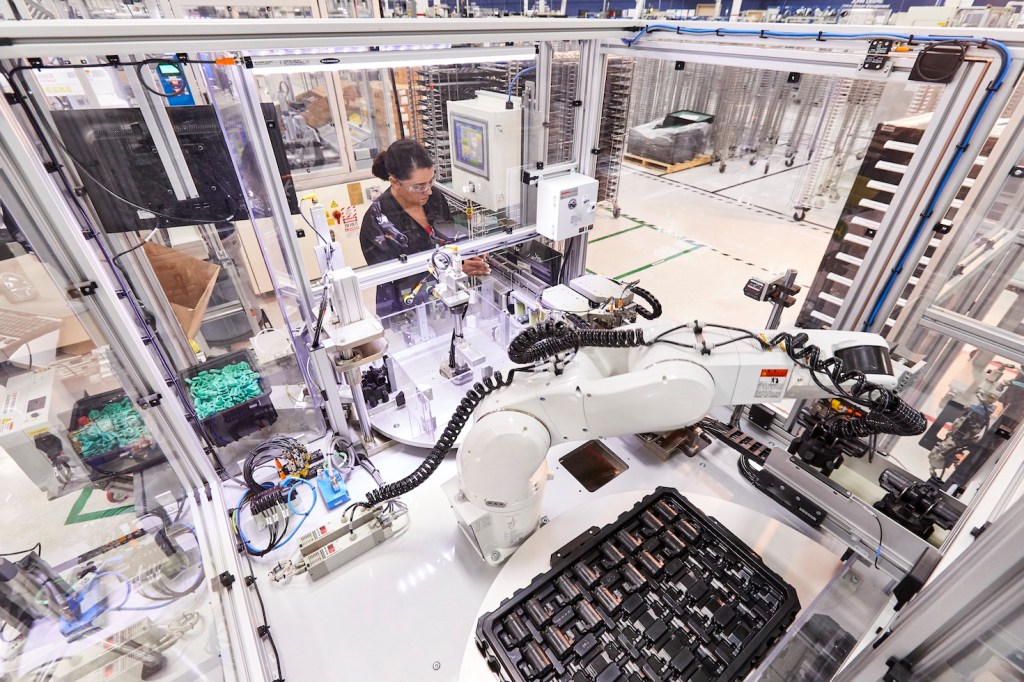
- Jabil holds an annual employee competition to identify projects that can be scaled across its 100-plus facilities.
- The $30 billion company prioritizes practices such as materials recovery and reuse that reduce waste as well as greenhouse gas.
- What it’s learning is being used to create new revenue opportunities.
Jabil, which manufactures products for companies including Apple and Amazon, is increasingly using energy efficiency and waste management measures guided by robotics and artificial intelligence to cut its carbon footprint.
Jabil committed $500 million in 2025 to an overhaul of its factory systems that includes an investment in AI company Arch Systems, which uses analytics to draw insights from existing equipment. It’s part of the $30 billion company’s larger plan to support the AI boom with bespoke equipment for data centers.
Early AI projects and other process changes, particularly those related to materials recovery and reuse, have already reduced Jabil’s operational emissions by 47 percent since 2019 — well on track to meet the contract manufacturer’s commitment to halve those emissions by 2030.
Jabil’s sustainability team reports to the compliance operation, but the company’s goals were inspired by customer demand and climate-related regulations taking effect across the globe, said Linda Weber, director of global compliance at Jabil.
“I imagine that other companies that have not undertaken these sustainability initiatives voluntarily in the past are probably scrambling now to prepare for compliance,” she said.
Innovation from within
Alongside its strategic investments, Jabil holds an annual competition, Deliver Best Practices, to identify technology, process changes and investments that can improve operations across its 100-plus manufacturing plants and factories.
The initiative, introduced in 2009, includes categories for process changes, social and environmental projects, and technology and innovation. There are multiple local and regional rounds, with finalists invited to pitch at a global event televised from Jabil’s headquarters in St. Petersburg, Florida.
“One of the criteria for winning is scalability across the organization,” Weber said.
Many of the latest ideas rely on robotics and artificial intelligence, including:
- An AI-enabled optical inspection system developed in Malaysia that consumes far less energy than traditional equipment — just 3 to 4 watts, compared with at least 10 times that amount.
- Robots that handle quality control, such as inspecting air-conditioning units to make sure screws and labels are installed properly, reducing waste and process-related emissions.
- A redesign for the pneumatic modules in robotic arms that makes them less prone to failure, first introduced in Suzhou, China, and now being introduced across Asia. The changes reduce energy consumption for this equipment by 80 percent.
New revenue opportunities
Jabil’s employee-led initiatives related to manufacturing efficiencies and materials reuse have also inspired new sales opportunities.
One example is Jabil’s service in Minnesota that recovers and refurbishes used medical equipment and devices on behalf of healthcare customers. Many are subject to strict regulations for processing, sterilization and disposal; Jabil helps reduce the cost of compliance.
“When you have this business, this activity, that is beneficial for the environment in terms of reducing impact, you’re saving on costs,” Weber said. “The hospital business is saving on disposal costs, and maybe on the cost of new materials. Jabil is generating a revenue stream out of it. To me, that’s the pinnacle of a sustainability success story, when you’re accomplishing all three at the same time.”
Jabil’s acquisition in 2023 of Retronix, which specializes in electronic component recovery, scaled its ability to recover and refurbish computers, networking gear, medical systems and other information technology. Jabil collected more than 70 million devices through 2025, reclaiming more than $250 million in “value” for its clients.
One client, for example, recovered 500,000 components from merchandise returns, saving nearly $10 million, according to Jabil’s 2025 sustainability progress report.

Subscribe to Trellis Briefing