Why the music industry offers sustainability’s biggest untapped lever
Few institutions understand cultural scale better than music. Read More
At last month’s GreenBiz 26 conference, one of the most revealing sustainability conversations didn’t come from heavy industry, finance or tech. It came from pop music.
Recorded live before a conference audience, our “Two Steps Forward” podcast featured Dylan Siegler, head of sustainability at Universal Music Group (UMG) — and a former Trellis colleague — exploring an idea that feels increasingly central to the next phase of corporate sustainability: Influence may matter as much as emissions.
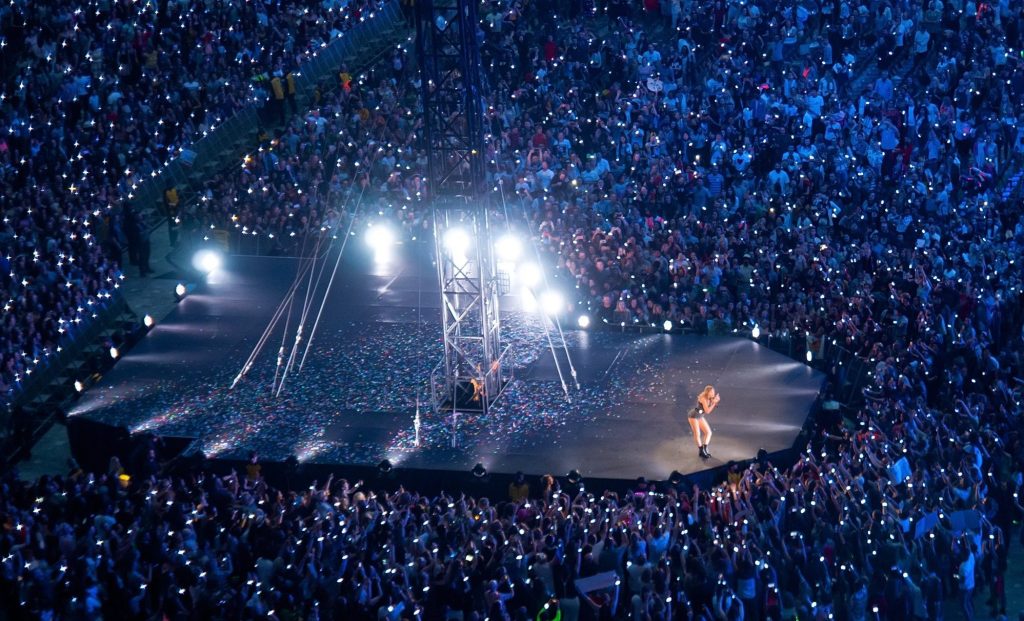
UMG, the world’s largest music company, is an unusual sustainability case. By Siegler’s own description, the company has a relatively small operational footprint compared with manufacturers or energy companies. But its cultural footprint — its “handprint,” as she called it — is enormous. The company works with artists ranging from Taylor Swift and Kendrick Lamar to Olivia Rodrigo and Billie Eilish, reaching billions of fans worldwide.
That distinction reframes a familiar sustainability question. Instead of asking only how companies reduce harm, Siegler argues we should also ask how they accelerate positive change through the audiences they already influence.
To be clear, the music industry’s emissions challenges are real — particularly merchandise production, physical media and touring supply chains. UMG is experimenting with lower-impact materials, recycled textiles and circular merch models, including projects that transform unsold tour apparel into new garments. These efforts matter, but they are not the whole story.
The superpower of superfans
The bigger opportunity lies in fandom.
Superfans — deeply engaged audiences who regularly attend their favorite artists’ concerts, buy lots of their merchandise and follow them religiously on social platforms — represent a powerful but largely untapped channel for behavior change. Siegler described sustainability not as a corporate messaging exercise but as a form of belonging: something embedded authentically into an artist’s world, rather than delivered as a lecture.
That insight reflects a broader shift underway across sustainability communications. Traditional approaches often relied on information and persuasion. But culture moves differently. Fans respond to identity, narrative and shared experience — forces that businesses rarely measure but increasingly recognize as material.
This creates both opportunity and tension. Artists operate in a hyper-polarized media environment where speaking out carries reputational risk. Siegler emphasized that UMG “pushes on open doors,” working with artists whose existing passions align naturally with impact issues, rather than forcing advocacy. Authenticity, not amplification, determines success.
How do you measure culture?
Measurement remains the unresolved challenge. Companies can quantify carbon reductions, but how do you measure influence? Siegler compared sustainability’s cultural impact to marketing investments: The connection between action and outcome is often a dotted line rather than a solid one. New approaches — borrowing from public health and behavior-change research — may help bridge that gap.
The conversation also highlighted a deeper evolution in the sustainability profession itself. For decades, practitioners focused on operational efficiency and risk reduction. Today, the frontier increasingly includes storytelling, engagement and social norms — areas historically owned by marketing or culture industries.
In that sense, music may offer a preview of sustainability’s next chapter. If heavy industry represents the challenge of decarbonization, cultural industries represent the challenge of mobilization.
As Siegler told the GreenBiz audience, the real task is scale — not just of solutions but of participation. Individual actions matter, but cultural movements change behavior faster than policies or spreadsheets alone.
And few institutions understand cultural scale better than music.
The Two Steps Forward podcast is available on Spotify, Apple Podcasts, YouTube and other platforms — and, of course, via Trellis. Episodes publish every other Tuesday.
Subscribe to Trellis Briefing