‘Regenerative ranching’ startup reaches 1.9M tons of removed carbon
Long seen as despoilers of the environment, cattle ranchers now have a chance to be part of the solution. Read More
- Nearly 7,000 acres of native grassland are lost in the U.S. every day.
- Grassroots Carbon employs both state-of-the-art soil core testing and traditional practices followed by herders for millennia.
- The company says it can improve soil health, store large amounts of carbon and help ranchers supplement their incomes.
Exploring a new frontier for soil carbon credits, San Antonio-based startup Grassroots Carbon said today that it has reached 1.9 million tons in carbon removal and storage, and more than 1.5 million in retired credits.
Founded in 2021, Grassroots Carbon works with ranchers to improve soil health via sampling, regenerative practices that include rotating paddocks with mobile fencing, software tools such as PastureMap and what it calls “the largest privately collected soil carbon dataset in the U.S.”
Selling the credits to corporate buyers including Nestlé, Microsoft and Chevron, the company shares the revenue with ranchers, providing supplemental income to landowners who are struggling with overseas competition, high debt loads, reduced appetites for beef in developed countries and low prices driven by corporate mega-ranches that use environmentally destructive, carbon-intensive practices to raise and slaughter cattle.
There’s no upfront cost to participate — Grassroots provides soil testing, education in regenerative practices, access to PastureMap and its proprietary dataset, and credit marketing for free — and the company says it has made $40 million in direct payments to ranchers for carbon sequestered in soil.
“We’re not only storing carbon but helping provide cleaner water and money for locals, turning what might be thought of as a compliance checkbox into a positive story and a net benefit for communities,” said Grassroots Vice President of Carbon Solutions Katie Pearson during a panel discussion at Trellis Impact 25. (Grassroots Carbon paid to exhibit at the event.)
The Great Plains carbon sink
Covering more than 650 million acres, America’s Great Plains are one of the greatest carbon sinks on the planet. Much of this land has been degraded by development, drought and overgrazing; nearly 7,000 acres of native grassland are lost in the U.S. every day, according to the National Beef Grasslands Initiative.
These trends are being accelerated by urbanization and the increasing demand for cheap land for giant, water-thirsty data centers. In Texas alone — where open range is abundant and power is cheap — more than 1,000 acres a day are paved over with concrete, said Chad Ellis, CEO of the Texas Agricultural Land Trust, during the TI25 session: “It’s the ‘Oh, shit’ moment.”
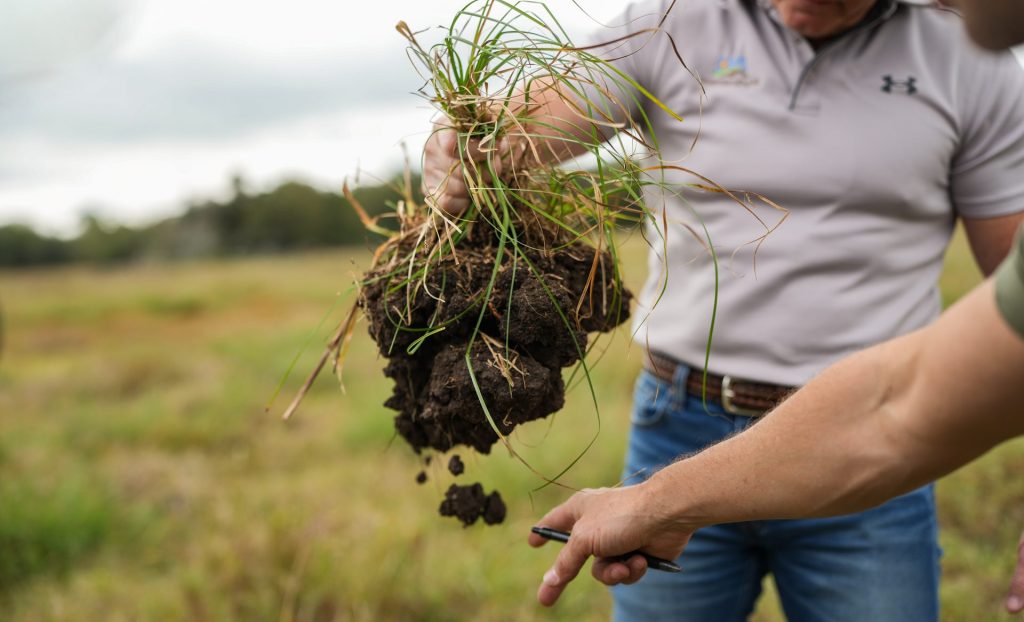
Overgrazing and heavy water consumption by industrial-scale ranching, which generated more than $260 billion in revenue in 2024, contributes to the destruction of grasslands. Grassroots’ model incorporates not only state-of-the-art soil core testing down to one meter in depth and sophisticated mapping tools, but also traditional practices followed by herders for millennia — including rotational grazing, in which cattle are moved from one contained paddock to another so native grasses and shrubs, and the soil in which they grow, can recover.
Containing herds on smaller pastures, as opposed to conventional open-range ranching, actually helps soil health; as cows trample organic matter into soil, it increases carbon capture and storage.
The Grassroots Carbon model is “all about moving carbon from the atmosphere to the soil,” said Lars Dryud, CEO of EarthOptics, during the TI25 session. EarthOptics developed the first remote-sensing method for precisely measuring soil carbon and is working with Grassroots, .
Promise and challenges
The promise of soil carbon sequestration is huge — worldwide, the top meter of soil stores more carbon than the atmosphere and total biomass on Earth combined — but questions and uncertainties remain.
One is about additionality — the requirement that credits must be generated from carbon removed or reduced from newly adopted practices. The carbon removal benefits of returning the soil to health are difficult to measure, and there is no universal standard for verifying soil carbon credits.
Another is scale: Simply put, it takes a lot of land to generate sufficient credits to make carbon credit programs profitable for farmers and ranchers. “A 1,000-acre farm would generate around 200 credits/year on average, and if valued at $40/credit, the farmer would earn only about $6,000/year of additional income for conducting a soil carbon project,” according to an analysis from S&P Global.
Grassroots Carbon addresses these challenges by aggregating credits across multiple ranches, adhering to accepted verification frameworks such as The Regenerative Standard from the Applied Ecological Institute, and paying ranchers market rates. While the company declines to give precise pricing numbers, it says its credits sell above the California Carbon Allowance’s 2025 floor price of $25.87 per ton.
The issued credits are verified by multiple third parties, said CEO Brad Tipper in an email: “EarthOptics executes field sampling, PatternAg performs third-party laboratory analysis, Comite Resources verifies project implementation and results, and the Applied Ecological Institute reviews and certifies each credit before issuance.”
The company has also actively supported the development of the Climate Action Reserve’s Soil Enrichment Protocol version 2.0, as a member of the working group that is finalizing the new version.
“Grassroots Carbon was built to prove that regenerative ranching can be the most profitable and productive form of ranching,” said Tipper. “We focus on unlocking financial opportunity for ranchers in ways that were previously inaccessible through soil carbon outcomes.”