The top industries earning public trust
Even the highest-rated sectors only achieved modest positivity scores. Read More

- Societal reputation is strongest in sectors seen as essential to human needs, such as agriculture, healthcare and technology.
- A small group of sectors, such as mining and alcohol producers, face pronounced skepticism across markets.
- Even the highest-rated sectors achieve modest positivity scores, showing public opinion is often conditional and easily eroded rather than being deeply rooted.
In an era when trust in almost every institution has collapsed, one group has quietly held its ground: farmers.
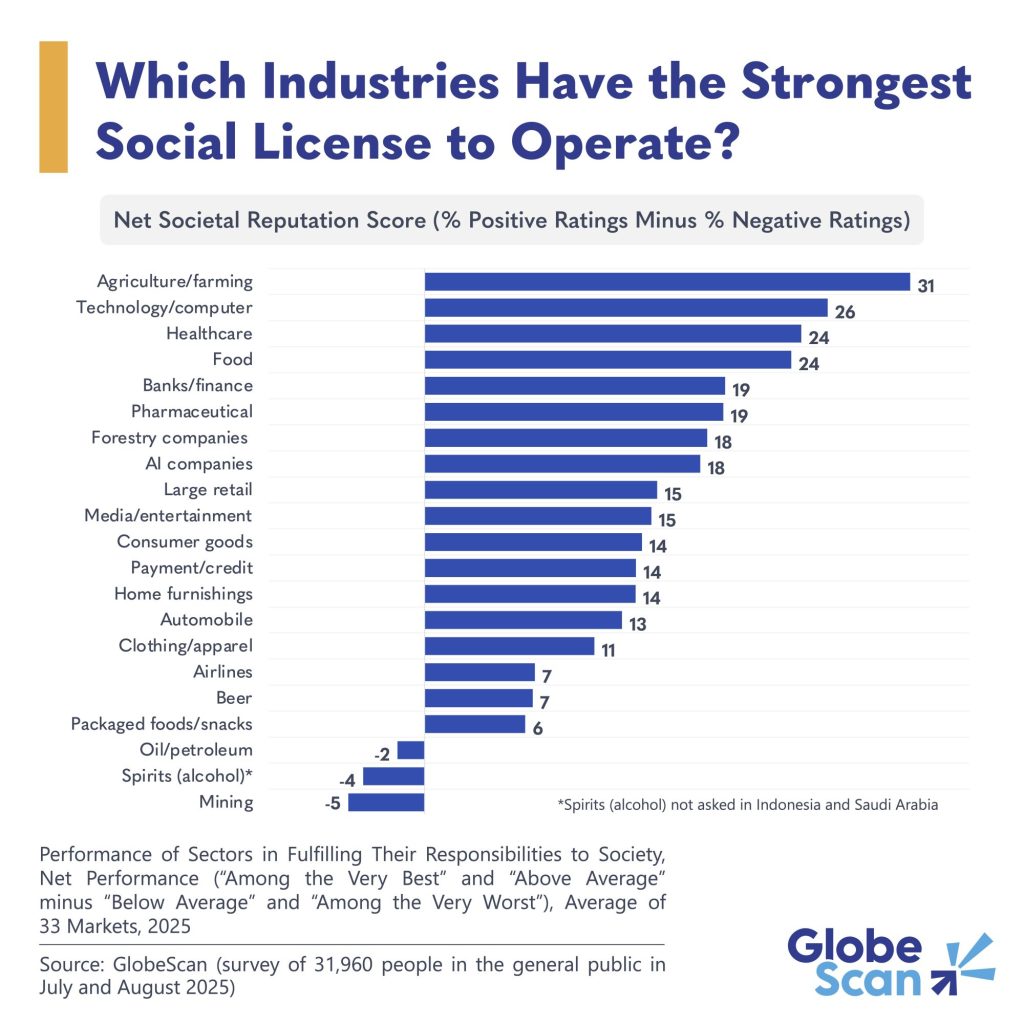
Research from Trellis data partner GlobeScan shows that the farming and agriculture sector is rated highest worldwide for fulfilling their responsibilities to society. Other sectors seen as fulfilling their responsibilities to society and attracting positive assessments from the public include:
- Technology
- Healthcare
- Food
At the other end of the spectrum, the mining sector has the worst net societal reputation score of all industries, followed by spirits/alcohol producers and the oil/petroleum industry. In these industries, the share of people who rate company social performance as “below average” or “among the very worst” is roughly equal to the share who rate them positively, resulting in a slightly net negative public perception.
While the overall pattern of societal reputation scores is consistent across countries, national context still matters. In markets as diverse as Brazil, China, Germany, India and the U.S., sectors associated with essential needs and innovation, such as food, healthcare and technology, tend to outperform others on societal reputation.
At the same time, mid‑ranking sectors show significant variation across countries, reflecting differences in economic structures, regulatory environments and lived experiences. For example, sectors linked to natural resources may be viewed more favorably in resource‑dependent or emerging economies while attracting deeper skepticism in Western markets.
These differences reinforce that societal reputation is shaped by what sectors do globally and their local impact. Most industries sit in this middle range, where small shifts in behavior, visibility or controversy can meaningfully change public perceptions. This concentration around the midpoint highlights how societal reputation is inherently fragile for most sectors, not only those at the bottom.
What this means
Public trust in business remains uneven and fragile across industries. While sectors associated with essential needs earn relatively stronger reputations, even the highest‑rated industries achieve only modest positive scores. Most sectors operate on a thin margin of public trust and are vulnerable to rapid erosion of legitimacy, while a small group faces entrenched skepticism that continues to limit their social license to operate. For business, the implication is clear: social license is fragile, not given and needs to be continually earned through credible societal performance.
Based on a survey of more than 30,000 people across 33 markets conducted July — August 2025.
Subscribe to Trellis Briefing