Urban mining enters the supply-chain risk conversation
The Circular Supply Chain Coalition is seeking to build e-waste recycling nerve centers in North America, Europe and Asia. Read More
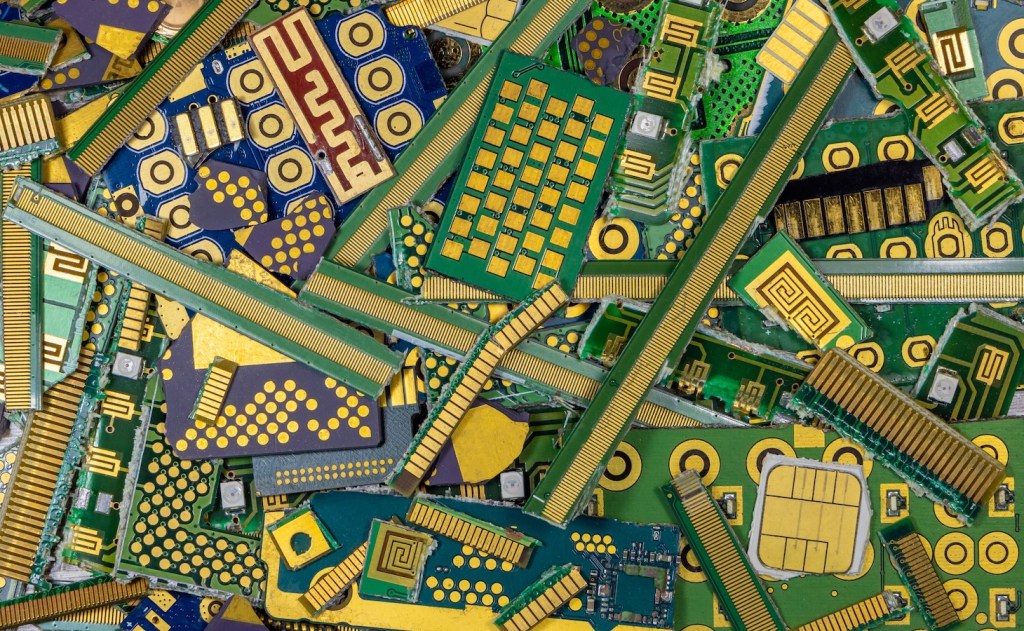
- The CSCC is pioneering a system to recover critical minerals from e-waste.
- A FedEx tech-collection pilot showed that households and small businesses will ship e-waste when the process is simple.
- For regional recycling hubs to attract corporate investment, the coalition must demonstrate tangible business value and facilitate closed-loop supply chains.
The Circular Supply Chain Coalition (CSCC) is laying the foundation for a global network of regional recycling nerve centers that would “mine” critical minerals from e-waste.
It is pitching the effort as industrial risk management that sidesteps extractive mining. Tariffs, geopolitical pressures and anxiety over access to valuable metals and rare earths have accelerated business’s interest in mainstreaming an infrastructure for urban mining.
Since announcing itself nearly two years ago, the CSCC has been sketching blueprints for resource recovery hubs that draw from a pilot project with FedEx. It has also secured interest among potential corporate materials buyers and logistics operators. The organizer, the Washington, D.C., nonprofit Pyxera Global, has partnered so far with Cummins, American Battery Technology Company and Cyclic Materials.
“Urban mining is an additive business model,” said John Holm, Pyxera senior vice president of product development. The circular economy is not about recycling but rather mitigating risk, he explained.
“Remanufacturing and local supply chains are just smart business, period,” Holm said. For instance, what if a company could locally source a portion of the critical minerals it uses instead of having to get them out of a conflict zone? “That would give it a mitigated supply chain and access to material flows before its competitors, while also supporting local community investment and growth,” he said.
The volume of e-waste
The world generated about 62 million metric tons of electronic waste in 2022, according to the Global e-Waste Monitor. About 2.1 million tons of that, or 3.4 percent, was copper, but there is more to be gleaned: aluminum (which can then be reused in electronics and renewable infrastructure); nickel (for lithium‑ion EV batteries); and rare-earth elements like neodymium (for magnets in wind turbines and EV motors).
In theory, critical minerals shouldn’t need to be stripped from the earth when they’re already so abundant in discarded electronics, industrial machines and batteries. In practice, though, there’s nothing simple about building closed-loop critical mineral supply chains from scattered sources.
“The problem is not the quantity of feedstock,” Holm said. “It’s the fractured supply chains to procure it and the lack of economic support to do so in a thoughtful way.”
For now, the CSCC is focusing on materials that can be recycled more than once. Copper is an early target but, said Holm,“Critical minerals have a geopolitical play, but once you start peeling that out, there are other materials like steel and aluminum that also can be recycled in perpetuity.”
FedEx pilot program
Rather than rely on existing resource recovery systems for larger businesses, the CSCC is targeting materials recovery from consumers and small organizations.
To that end, Pyxera worked with FedEx on a five-month experiment that tracked, logged and sorted electronics. Between September 2023 and January 2024, participants shipped laptops, phones and peripherals with prepaid labels to a sorting center in Lebanon, Tennessee. From there, FedEx ferried the gear to certified processors or manufacturers’ take-back streams. A local nonprofit employed adults with disabilities to run device diagnostics.
“We learned some interesting things from what folks consider to be laptops and tablets,” joked Brandon Tidwell, FedEx global citizenship communications principal.
That said, the pilot proved that people will ship e-waste if it’s easy and free. And it offered a framework for how circular logistics can tap into existing shipping systems.
“One of the discoveries coming out of the blueprint is that the process that you have to set up needs to be hyper local,” Tidwell said.
The CSCC is looking to local entities to support the hubs it is creating across the globe. In North America, a flagship site in New Mexico would benefit from railroad and truck access. A Maryland-to-Florida recovery corridor that taps into the area’s manufacturing density and port access would benefit from harnessing state climate and economic development tools.
In the EU, the Port of Rotterdam could serve as an important entry and exit point for critical minerals shipments. The coalition is also considering India and Singapore.
Can it scale?
Critics of the coalition’s vision argue that it has little chance to gain long-term traction. Existing materials flows involving IT asset disposition companies are better poised to advance circularity, according to Peter Evans, co-founder and managing partner of the advisory firm All Things Circular in Denver.
Grayson Shor, CEO of AI startup Buckstop, is more optimistic, suggesting that the coalition needs to achieve buy-in from businesses. “What they’re trying to do is good for people and planet,” he said. “I think that, ultimately, it can be good for profit too.” Buckstop uses machine learning to assess the value of used solar panels and components, which it could eventually apply to other products, such as batteries and electronics.
Shor, who used to lead Amazon’s circular economy and battery sustainability work, added that the coalition also needs to nail down a revenue structure that is attractive to companies. “That’s going to bring the large corporates along, which is what’s needed,” he said.