When employees engage in impact work, loyalty and motivation rise
New GlobeScan and Ashoka research also reveals a related increase in workers' purpose and meaning. Read More

- Some 87 percent of respondents agree that employee agency yields these positive outcomes.
- Organizations best positioned for long-term success are those that treat employee agency as a foundational driver of adaptability, retention and performance.
- Unlocking employee agency offers a dual opportunity to strengthen business performance while mobilizing a largely untapped workforce capability to address social and environmental challenges.
As organizations confront today’s more volatile operating environment, future readiness is often defined in terms of technology adoption, digital capability and technical reskilling. But GlobeScan’s latest research suggests that this view is incomplete. The GlobeScan and Ashoka report Building Human Change Capability in Times of Disruption argues that future-ready organizations are built not only through stronger technical systems, but also through stronger human change capability — in other words, the confidence, agency and participation that employees need to help their organizations adapt and create value. Drawing on the voices of 8,865 corporate employees across 33 countries, the report explores how embedding participation into everyday work strengthens organizational readiness.
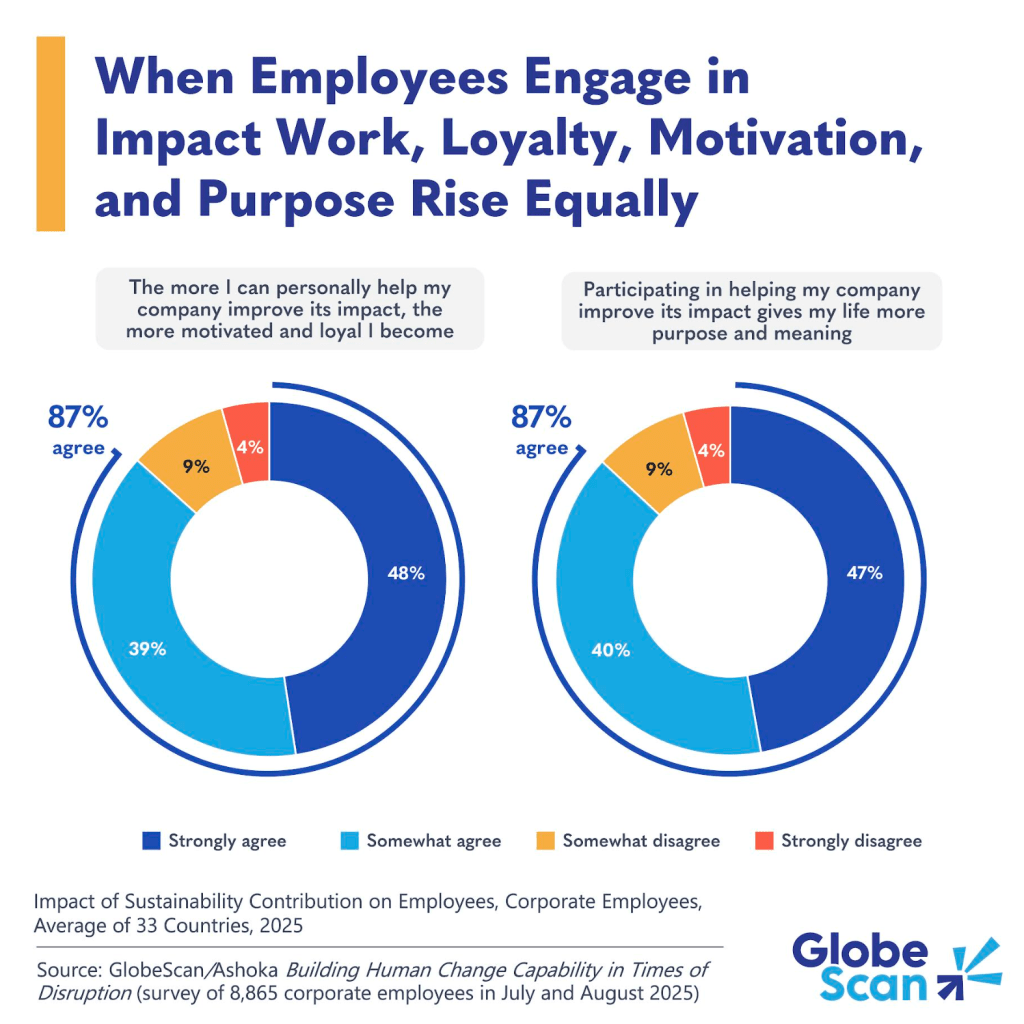
The research shows that globally, 87 percent of employees agree that when they can personally help their company improve its impact on society and the environment, they become more motivated and more loyal. The same proportion agrees that such participation gives their life more purpose and meaning. This alignment suggests that the practical outcomes that organizations care about, such as loyalty and commitment, are intertwined with a deeper employee expectation that work should provide meaningful avenues for contribution. The same impulse may help explain growing interest in employee influence over areas such as workplace retirement plans, where workers can have an impact beyond their immediate role. In a business environment increasingly defined by disruption, opportunities for meaningful participation can be a significant differentiator.
What does this mean?
The business case for employee agency, in terms of both business performance and societal impact, is strong. Yet in many organizations, this potential remains underused because impact is not embedded in day-to-day work. Leaders should prioritize moving beyond purpose statements to create practical opportunities for employees to contribute. Doing so strengthens motivation and retention while unlocking workforce capacity to address complex social and environmental challenges.
This analysis draws on the voices of more than 8,800 corporate employees as part of a larger survey of more than 30,000 people across 33 markets.

Subscribe to Trellis Briefing