

Saying less but doing more
Since 2010, Trellis has assessed the State of the Sustainability Profession every two years, charting the attitudes and actions of business leaders engaged in addressing climate change.
The latest trends
- Sustainability staffing and budgets
- Salaries and total pay – plus outlook for 2026
- The critical role the CEO plays
- The largest ($10B+ revenue) companies vs. mid-size ones
- How professionals cope with shifting priorities
In 2022 and 2024, the vast majority of companies devoted more resources to sustainability, but this year, we wanted to see if that trend reversed in the face of the Trump administration’s effort to dismantle U.S. climate policy.
It didn’t.
Though the pace of investment has slowed and priorities have shifted, most large businesses are staying the course, according to our survey of more than 500 sustainability professionals at firms with at least $1 billion in revenue.
3 major findings
1. Most companies continue to invest in sustainability, but a significant minority are now pulling back.
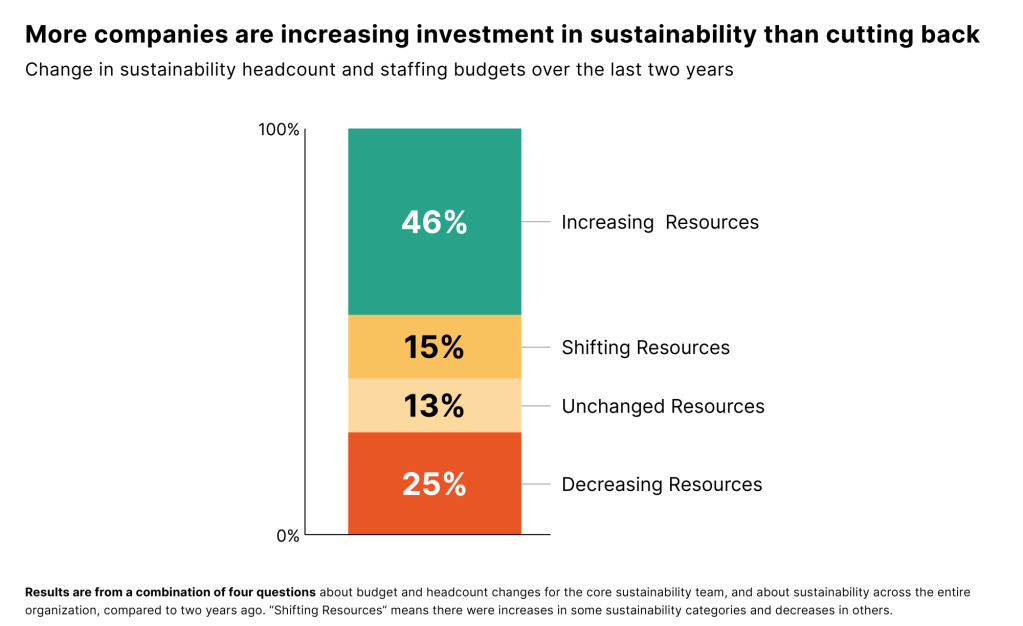
- Resources: 46 percent of companies have increased sustainability headcount and budgets over the last two years. 25 percent have cut them. The rest are keeping sustainability roughly unchanged.
- Public commitments: Of companies that have announced sustainability targets, 57 percent say they have maintained them, 24 percent have strengthened them, and 16 percent have weakened or abandoned them.
2. Business sustainability initiatives are less public than in the past, with increasing focus on regulatory compliance and risk management.
- Communications: 63 percent of companies have scaled back their communications about sustainability or rethought how they talk about it.
- Priorities: 58 percent of companies are putting a higher priority on sustainability compliance, while 53 percent say social issues are less important.
3. Sustainability professionals are under growing stress, often finding their jobs more difficult and less fulfilling.
- Job satisfaction: 44 percent of professionals say their jobs are less fulfilling than they were two years ago; 33 percent say their roles are more fulfilling.
- Career plans: Only 47 percent of professionals think corporate sustainability offers the most attractive career path in the next five to 10 years.
- Stalling pay: Total compensation for professionals in the U.S. grew more slowly over the past two years than the preceding period. Pay packages of the most senior employees fell slightly.
A case for optimism
While the professionals we surveyed often said they find the field discouraging and confusing, many also said they remain determined to keep working, pushing forward their objectives, expecting the pendulum of public opinion to swing again.
Perhaps the most telling indicator of the state of the sustainability profession in 2026 was that twice as many respondents said they were optimistic as pessimistic.
About the State of the Sustainability Profession
The Trellis State of the Sustainability Profession survey is the oldest and most established study of its kind, attracting well over 1,000 respondents, more than 500 of whom are in qualified positions at companies with revenue over $1 billion. Most of the participants were recruited from the readers and clients of the Trellis Group, the leading media and events company for sustainability professionals.

