The future of supply chains starts in the ocean

Regenerative kelp farming in Alaska is emerging as a resilient, eco-friendly ingredient source for food, beauty, and agriculture industries. Read More
As corporate sustainability and supply chain leaders confront mounting pressure to secure resilient ingredient sources, the ocean is emerging as a key part of the solution. Regenerative kelp farming—particularly in Alaska’s pristine waters—offers a scalable, climate-positive source that can serve agriculture, food and beauty supply chains while improving marine ecosystems.
For decades, companies have focused their sustainability efforts on land-based agriculture. As climate change, soil degradation and geopolitical volatility continue to pressure traditional agriculture, the conversation is shifting. Whereas once sustainability was a “nice-to-have,” today supply chain resilience is a business imperative.
To meet future ingredient demand, corporations must expand their sourcing lens beyond land. The ocean — covering more than 70 percent of the planet — is one of the most underutilized regenerative production systems available today, and a growing network of kelp farmers in Alaska are ready to access it as a reliable domestic source.

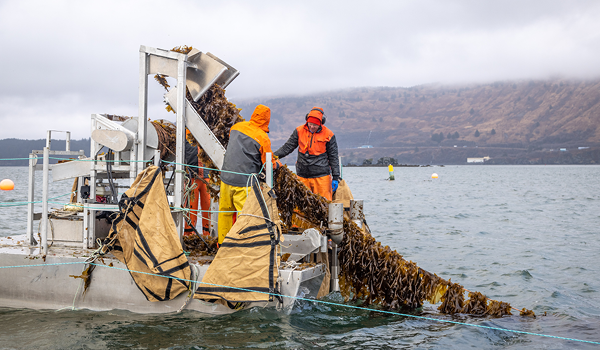
Sugar kelp harvested at Noble Ocean Farms, Prince William Sound, Alaska
Source: Alaska Mariculture Cluster
Kelp: A regenerative crop requiring no land, freshwater or fertilizer
Regenerative ocean farming grows species — from seaweed to shellfish — that require no freshwater, fertilizer or feed inputs, making it one of the lowest-impact forms of input production.
Beyond low inputs, kelp farming restores ecosystems: Seaweed absorbs carbon dioxide, nitrogen and phosphorus from the water, helping combat ocean acidification and nutrient pollution while improving water quality and biodiversity. The potential scale is enormous. A mature 20-acre regenerative ocean farm can produce up to 60 tons of kelp annually, improving water quality and generating economic opportunities for coastal communities.
Alaska’s commercial kelp industry is young and expanding. It harvested more than 344,000 pounds in 2025, and strong growth is projected. Growing kelp in the state’s clean, nutrient-rich waters ensures high-quality product. Cool temperatures and ample summer sunlight support robust kelp forests, and Alaska’s regulatory oversight ensures that cultivated kelp meets safety standards and is sustainably managed.
The Alaska Mariculture Cluster (AMC) grant coalition is working to catalyze a viable and sustainable mariculture industry in Alaska. The investments and activities of the coalition are expected to lead to an $100 million industry, inclusive of kelp and shellfish, in 10 years — and a $325 million industry in 20 years.
“With coordinated investment and a clear growth strategy, Alaska is building one of the most promising kelp supply chains in the world,” explains Jason Lessard, executive director of the Alaska Mariculture Alliance (AMA), a member of the AMC coalition. “It is designed to meet increasing commercial demand across food, agriculture, and consumer products.”
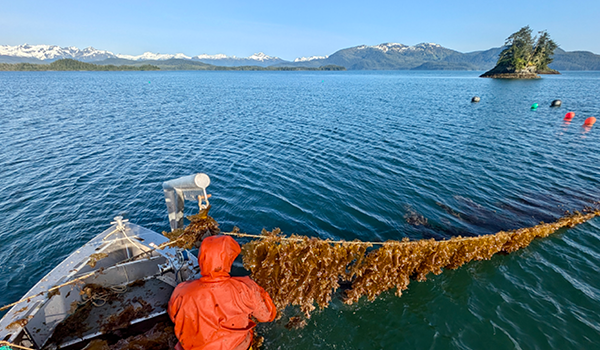
Sean Den Adel harvests sugar kelp at Noble Ocean Farms in Prince William Sound, Alaska
Source: Alaska Mariculture Cluster
Multi-industry applications: food, beauty and materials
What makes kelp a particularly attractive addition to corporate supply chains is its versatility. Among other end uses, farmed kelp can be processed into:
- Food ingredients and texture agents such as alginates
- Agricultural biostimulants and livestock feed additives
- Cosmetic bioactives for hydration and skin barrier support
- Bioplastics and packaging alternatives
In fact, companies such as Macro Oceans are transforming farmed Alaska kelp into high-performance biomaterials for use in a variety of consumer products, leveraging kelp, a regenerative feedstock, as a replacement for petrochemical-derived materials. Not only is kelp a zero-input crop, but Macro Oceans employs a “no-kelp- left-behind” philosophy in its proprietary processes, ensuring that value is created from every component of the kelp.
The green chemistry process used by Macro Oceans creates three streams that are turned into performance ingredients used in skin care, hair care and food products:
- Bioactives for skincare, which delivers clinically tested hydration benefits
- Cellulose biopolymer that is a 100-percent natural way to create suspensions and textures in beauty without the harmful synthetic microplastics
- Next-generation alginates are used for thickening, gelling and stabilization in food products from bakery items to pet food.
Kelp Innovation CoLab, a program powered by GreenWave, works to connect this emerging supply with real-world product development — bringing together brands, product experts and processors to accelerate the use of kelp-based ingredients in commercial formulations.
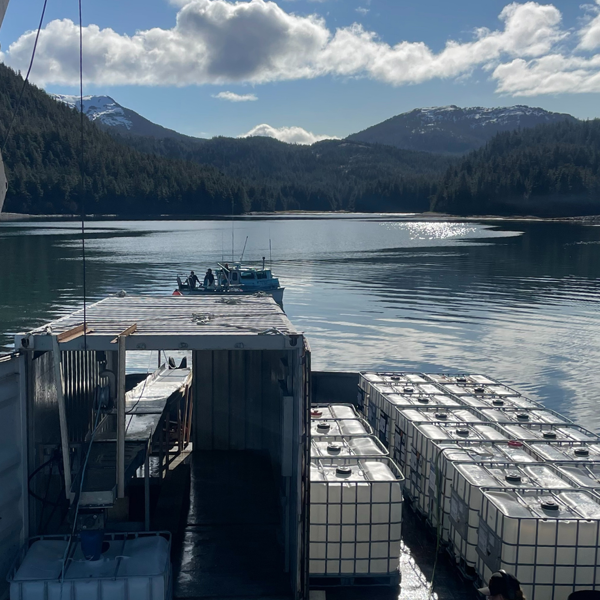
Kelp harvest in Cordova, Alaska, May 2025
Source: Cascadia Seaweed
From ocean to soil: kelp as a regenerative agricultural input
Kelp’s value extends beyond consumer goods. Companies like Cascadia Seaweed, Pacific Kelp Co. and Kachemak Kelp are converting farmed kelp into liquid solutions that improve the performance of land crops.
Liquid kelp extracts help crops use nitrogen, phosphorus and potassium (NPK) fertilizers more efficiently. These extracts contain bioactive compounds that enhance nutrient uptake, increase stress tolerance and improve crop yields — all while reducing reliance on synthetic fertilizers.
Field trials conducted by Cascadia Seaweed and Pacific Kelp Co. have shown yield improvements of more than 20 percent in certain applications, highlighting the potential of ocean-grown inputs to support crop performance in a range of conditions, while contributing to improved on-farm economics.
Cascadia Seaweed has undertaken a series of trials to evaluate outcomes for growers. In a controlled environment study involving strawberries under simulated drought conditions, Cascadia’s liquid kelp extracts were associated with yield retention while maintaining fruit quality. In separate broadacre trials on wheat, barley and canola, results indicated higher yields alongside reduced fertilizer application rates, suggesting improved nutrient-use efficiency and the potential for positive return on investment.
This sea-to-soil loop illustrates the circular potential of marine ingredients: Kelp grown in the ocean can regenerate soils, support food systems and help agriculture adapt to climate stress.
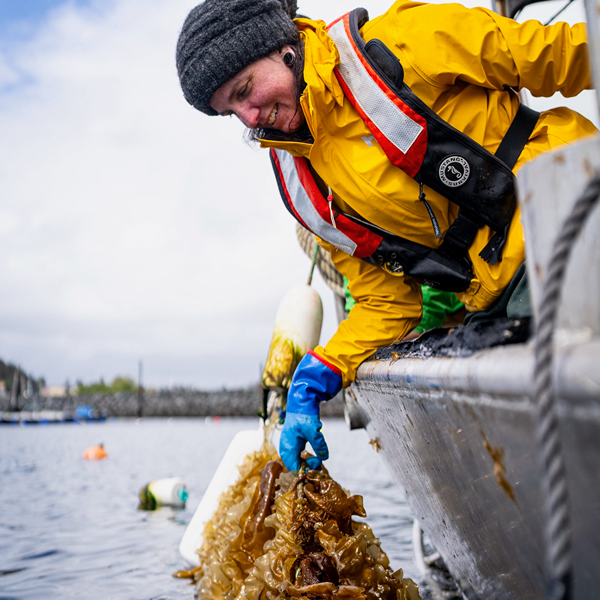
Angela Bowers, from the University Alaska Southeast,
inspects split kelp at the UAS teaching/research farm in Crescent Bay, Sitka, Alaska
Source: Alaska Mariculture Cluster
A strategic opportunity for sustainability leaders
For brand sustainability and procurement teams, marine ingredients represent a strategic opportunity to diversify supply chains while advancing climate goals.
For corporate buyers seeking stable, transparent sourcing, Alaska is emerging as a global hub of kelp cultivation. Cold, nutrient-rich waters produce high-quality seaweed while supporting traceable, domestic supply chains. In addition, the vast Alaska shoreline, existing maritime infrastructure and marine labor skills, suggest a relatively easy path to expedite scaling.
Unlike many sustainability initiatives that require reducing consumption or altering consumer behavior, kelp farming offers additional production capacity while restoring ecosystems — a rare alignment of environmental and economic value. The benefits of mariculture — e.g., providing functional ingredients, supporting coastal communities and creating safe havens for marine life — tell a compelling story to values-forward consumers.
As climate change and soil degradation increasingly constrain land-based agriculture, the ocean is likely to become one of the most important sources of regenerative raw materials in the 21st century. Corporate supply chains that begin integrating marine ingredients today — such as sustainably farmed kelp from Alaska — will be better positioned to secure resilient, climate-positive ingredient pipelines in the decades ahead.