Why Starbucks is giving away climate-tolerant coffee trees
More than half of the land used to grow Arabica beans for the world’s largest coffeehouse could be unusable by 2050. Read More
- Starbucks buys more than 5 million bags of green coffee beans annually, about 3 percent of global production.
- The coffeehouse has distributed more than 100 million trees that can tolerate hotter climates with unpredictable water supplies.
- It’s also trying to reduce water used in milling, which can require 10 to 20 liters per kilogram of beans.
Starbucks, the world’s largest coffeehouse brand, faces an existential risk: the threat to farms across the global “coffee belt” posed by climate change. The company has responded by investing hundreds of millions of dollars to prepare for the hotter, drier future.
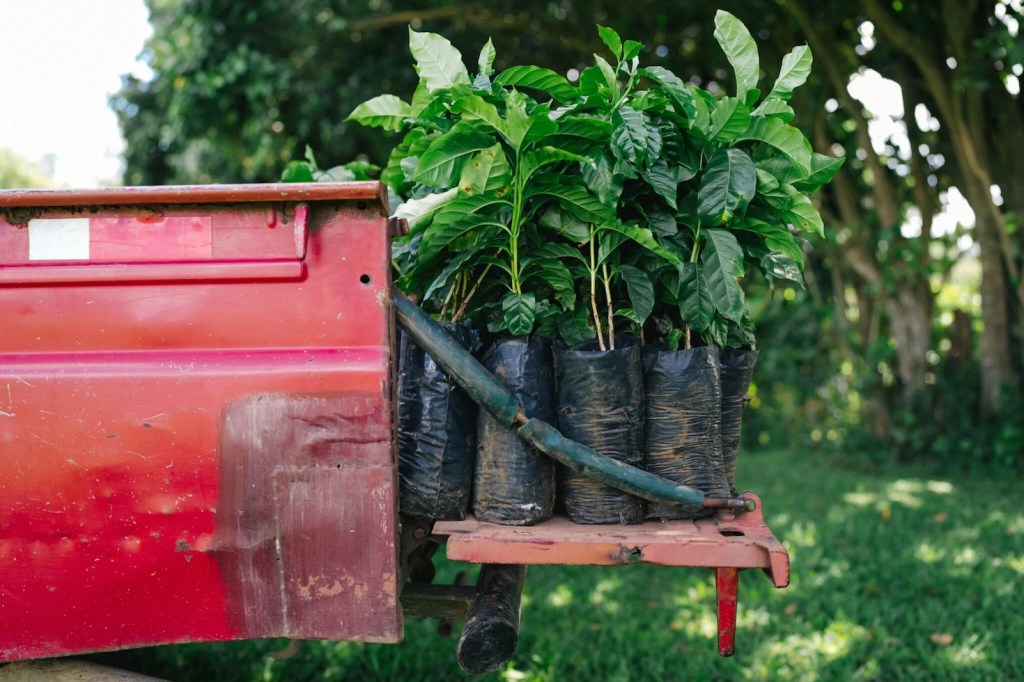
Over the past nine years, Starbucks has donated more than 100 million climate-resilient trees to farmers in El Salvador, Guatemala and Mexico. It announced that milestone on March 26.
“The future of coffee depends on action,” said Ricardo Arias-Nath, senior vice president of global coffee and tea at Starbucks, and president of the company’s Latin America and Caribbean operation. “We are investing in farmers, protecting coffee landscapes and scaling solutions that help strengthen resilience across our supply chain.”
Starbucks plans to distribute another 50 million trees, this time to farms in Ethiopia, Rwanda, Tanzania and Colombia. It did not disclose a timeline for meeting that mark.
Trouble Brewing
Uncertain future supply
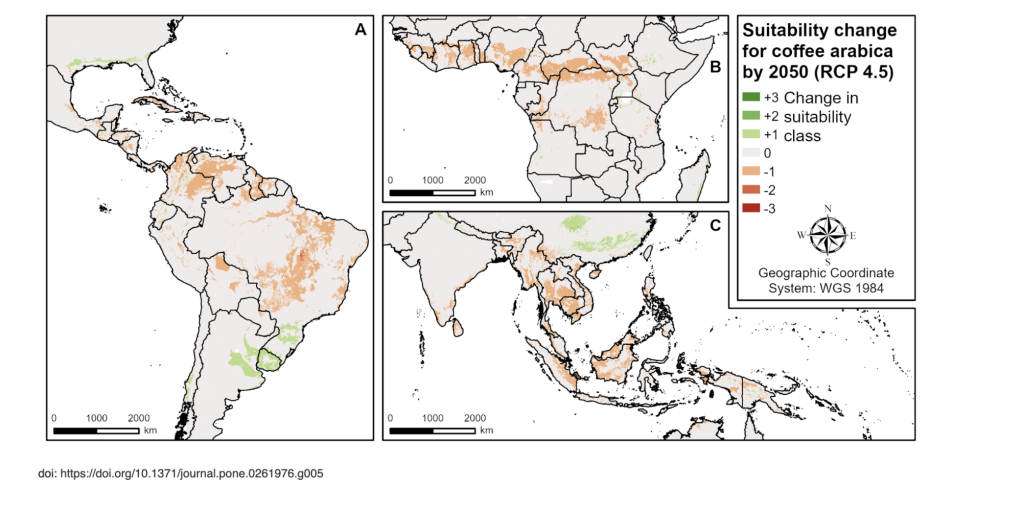
More than half of the land used to cultivate the Arabica beans featured on Starbucks menus could become unusable by 2050 as soil degrades, temperatures rise and water supplies dry up in the prime growing regions of South America, Africa and Indonesia, according to projections by the Intergovernmental Panel on Climate Change.
“Farmers have felt the impact of climate change for some time,” said Raina Lang, senior director of sustainable coffee at Conservation International, which has collaborated with Starbucks on its strategy for 25 years.
Starbucks buys an estimated 5 million bags of Arabica green coffee beans annually from more than 400,000 farms — about 3 percent of global production. Many coffee belt countries on its list are particularly vulnerable to the changing climate, notably Brazil, Colombia, Costa Rica, Ethiopia, Honduras, Indonesia, Nicaragua and Vietnam.
Arabica trees typically grow in cool mountain climates, 2,000 to 6,500 feet above sea level. Up to 2,500 liters of water are needed to produce one kilogram of green coffee beans. Harvesting accounts for an appreciable portion of that.
With temperatures rising, coffee farmers are being forced to shift production to higher elevations. That, in turn, comes with its own consequences, such as deforestation. Meanwhile, not making the move increases the risk of infestation from pests such as coffee borer beetles, which spread more quickly in warmer climates.
Increasingly unpredictable weather patterns are being priced into commodities markets. Average coffee prices rose sharply in 2025 to more than $8.30 per kilogram, compared with $2.88 in 2019. One major factor: droughts and erratic rainfall in Brazil and Vietnam.
Emissions reductions and resilience
Coffee cultivation accounted for 12 percent of Starbucks’ carbon footprint in 2024, the last year for which data is available. That makes it a focus of the company’s goal to cut greenhouse gas emissions, water consumption and waste in half by 2030. Those efforts to cut emissions can positively impact the long-term resilience of the world’s coffee crop, agricultural experts said.
Starbucks has invested millions of dollars to educate farmers about regenerative agricultural practices such as planting other crops alongside their trees, reducing fertilizer use and disposing of waste generated through pruning and harvesting by turning it into biochar that can improve soil health and promote water retention.
Those techniques are supported by an updated version of the Coffee and Farmer Equity (CAFE) Practices standard that Starbucks has used to verify suppliers since 2004. The company pays a premium above market price for CAFE-certified beans, giving farms a financial incentive to participate in the program.
100 million climate-tolerant trees
At an agronomic research hub called Hacienda Alsacia in Costa Rica, Starbucks researchers test climate-resistant strains of the 600 varieties in its core coffee collection. The company then encourages farmers to plant these new trees, which have been bred to handle higher temperatures and drier conditions.
Coffee growers also receive training at Starbucks’ network of 10 Farmer Support Centers and 70 model farms located in key growing regions. Close to 37,000 people had completed such courses by the end of 2024.
At one point, farmers also received money from a $100 million loan fund that Starbucks created in 2000 to aid with on-farm improvements and advisory services, such as business management and financial planning. The fund was depleted in May 2025.
In addition to the 100 million trees it has donated in Guatemala, El Salvador and Mexico, Starbucks distributed 55 million seedlings in Colombia through 2024. It has also agreed to distribute 2 million seeds and seedlings across Indonesia, where it is testing a biological pest control approach for thwarting the destructive coffee borer beetle.
More water-efficient mills
Starbucks is also pushing the adoption of new, less-thirsty systems for the water-intensive task of milling coffee cherries.
Mills, which remove pulp and parchment, can require 10 to 20 liters of water per kilogram of beans. Starbucks is installing new equipment that it says can save up to 80 percent of that amount.
More than 1,600 of these systems were contracted on behalf of Starbucks farmers by the end of 2024. Mills are often used by multiple farms; one installed at a cooperative three years ago in Mexico, for example, serves 9,600 growers.
Starbucks plans to install another 20 “ecomills” across Indonesia as part of its recent agreement, but it hasn’t disclosed how many it will deploy in all across its 440,000-farm supply chain.
Compliance alone won’t cut it
Nespresso, owned by Nestlé, has also been investing heavily in new cultivation techniques and coffee strains. Currently, it employs 400 agronomists who work with 110,000 farmers in 14 countries. Like Starbucks, Nespresso pays farmers a premium to transition to regenerative agriculture. Another player to watch: JDE Peet’s, which was acquired on April 1 by Keurig Dr. Pepper. The combined organization intends to spin off a public company focused entirely on coffee.
Convincing farmers to leave behind cultivation processes that have been used for generations will require sustained encouragement and financial incentives, but that will pay off in the long term, said David Linich, partner at consulting firm PwC. “It actually creates more resilience,” he said.
“We are really encouraging companies to move beyond just compliance,” Conservation International’s Lang said. “Making these additional investments is really where that will start paying off in terms of building resilience into the supply chain.”

Subscribe to Trellis Briefing