AMD, NVIDIA raise bar on AI energy efficiency
With energy-hungry data centers under scrutiny by communities across the U.S., the two powerful chipmakers are focusing on powering more AI training and inference with fewer server racks. Read More
Key takeaways
- AMD’s high-level pledge is to provide a 20x increase in rack-scale efficiency for AI training and inference by 2030.
- Companies would need far less physical infrastructure, which also means a reduction in product materials emissions.
- NVIDIA’s latest generation of AI infrastructure is 10 times more energy efficient than the previous one.
Advanced Micro Devices (AMD) plans major progress in the energy efficiency of the computing infrastructure it makes for artificial intelligence data centers.
By 2030, the company predicts it will take just two AMD-configured server racks to run tasks that would have required 570 in 2024. Put another way, AMD’s infrastructure will use 20 times less electricity, the company said in an Aug. 18 blog, and its technology will be 28 times less carbon-intensive.
The future advances will be made possible by server rack-level updates that are part of AMD’s long-time product development roadmap, according to senior executives. “The next wave of AI efficiency will depend on tighter co-optimization across compute silicon, memory, interconnects, software and rack-scale system design,” said Sam Naffziger, senior vice president and corporate fellow at AMD.
AMD has already delivered a fourfold increase in energy efficiency between 2024 and 2026 by prioritizing this approach, according to its blog. The company’s efficiency calculations include the impact of rack-level cooling technologies, but not the electricity or water that might be needed to remove heat from the rest of a data center. But its disclosures are notable, said Jonathan Koomey, an analyst who has published extensive research on data center energy and water use.
“AMD is being very transparent about what it will take, and it is known for being rigorous,” he said. “The systems-level view is very appropriate.”
AI infrastructure battleground
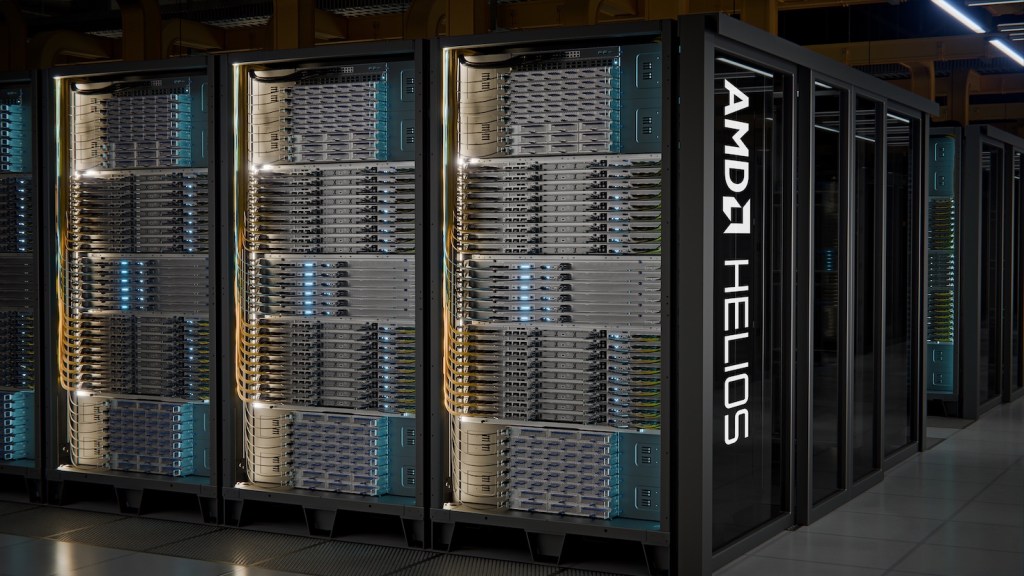
AMD has become a market leader in AI computing infrastructure over the past two years. Its sales grew more than 50 percent to $11.5 billion in the second quarter, with data center products accounting for 58 percent of that total. Its big bet is Helios, an integrated rack system used by Meta, Microsoft, OpenAI and Oracle for training large-scale AI models and for delivering rapid prompt responses.
Both AMD and rival NVIDIA wield energy efficiency as a key selling point for their products, especially when they’re pitching companies that have made greenhouse gas (GHG) emissions reduction commitments and that are concerned about skyrocketing electricity demand and the addition of enormous new natural gas plants to deliver AI services.
AMD’s high-level pledge is to provide a 20-fold increase in rack-scale efficiency for AI training and inference by 2030, from a 2024 base year — that goal is three times faster than the historical industry averages. Based on its reported progress in the past two years, AMD is on pace to meet that commitment.
The focus is practical. Most of AMD’s GHG emissions, an estimated 85 percent, come from use of its data center products, according to AMD’s 2025-2026 corporate responsibility report published Aug. 18.
“Our biggest impact and opportunity is the energy efficiency of our products,” AMD Chief Sustainability Officer Justin Murrill told Trellis.
Every AMD team has efficiency-per-watt targets to meet for new products, and progress is tied to the companywide bonus, he said.
NVIDIA’s most explicit pledge is to reduce the emissions intensity from use of its products by 75 percent per PetaFLOP, or one quadrillion floating-point operations per second, by fiscal year 2030.
The company doesn’t disclose progress against that goal in the NVIDIA 2026 sustainability report, published in mid-June. Rather, it touts a 10-fold improvement in energy efficiency for Vera Rubin, its latest product generation, compared with Blackwell, the previous architecture.
NVIDIA declined to respond on the record for this article.
Other climate goals
Energy efficiency metrics and claims don’t tell the full story of chipmakers’ environmental and climate commitment, said Giovanna Eichner, shareholder advocate at Green Century, which uses ESG factors to guide investments.
“Energy efficiency doesn’t always translate to emissions reduction if you’re continuing to crank out products at a higher rate, and so that’s why transparency is really important,” she said.
Both AMD and NVIDIA have pledged to cut direct emissions (Scope 1) and those from purchased electricity (Scope 2) by 50 percent by 2030, a small sliver of their overall GHG emissions.
AMD has so far achieved a 30 percent cut for Scopes 1 and 2. NVIDIA’s market-based emissions inventory for these two scopes increased 13 percent between 2025 and 2026, but the cumulative reduction since 2024 has been about 80 percent, based on the data in the NVIDIA 2026 sustainability report.
Both companies are “fabless,” meaning they rely on partners to manufacture their technology, part of the Scope 3 emissions category. AMD’s goal is to reduce the carbon intensity of its supply chain by 25 percent between 2024 and 2030. So far it has managed an 8 percent reduction, in part by encouraging suppliers to embrace renewable electricity. As of 2025, AMD had convinced all of them to set GHG emissions reduction targets, Murrill said.
AMD’s estimated Scope 3 emissions decreased about 2 percent between 2025 and 2024 to 24.1 million metric tons of carbon dioxide equivalent (mt of CO2e). The vast majority of that amount, about 85 percent, came from use of sold products, according to AMD’s most recent disclosure.
AMD published its first climate transition plan in 2025, motivated by Green Century.
NVIDIA has not published a specific target for its Scope 3 emissions, which grew about 54 percent between the 2025 and 2026 fiscal years to about 10.7 mt of CO2e. That total excludes emissions related to use of NVIDIA products, a glaring omission for investors, said Eichner.
Green Century filed a shareholder resolution, along with Mercy Investment Services, requesting those disclosures. The proposal received 18 percent support, and the firm will continue to advocate for more transparency from NVIDIA and for a detailed climate transition plan.
“They have an energy efficiency commitment, which is great,” she said. “But that’s not telling us the full story.”

Subscribe to Trellis Briefing