Why industrial-scale food waste processing is booming
Multiple facilities that feed natural gas into regional grids are planned or in operation. Read More
- Waste-to-gas facilities cut greenhouse gas emissions by diverting food from landfill and displacing fossil fuels.
- State regulation and the pressure to reduce emissions are helping grow the industry.
- Critics say the approach risks prolonging the life of fossil fuel energy systems.
Data from a new facility for generating renewable natural gas shows how industrial-scale processing of food waste is experiencing a growth spurt.
The Turlock, California, facility is a recent addition to a portfolio of 14 maintained by Divert, a food-waste processor founded in 2007. Multiple new facilities deploying similar approaches have opened around the U.S. as state mandates, cost pressures and emissions reduction goals prompt companies to look for alternatives to landfill disposal.
One company that sends expired or otherwise unwanted food to Turlock is United States Cold Storage (USCS), which operates 40 warehouses around the country. The two companies said this week that Divert had processed 2.5 million pounds of unsold food and beverages from seven USCS warehouses in California over the past 15 months.
Partnerships like that helped the Turlock facility and Divert’s other operations generate enough natural gas to heat close to 3,000 homes for a year and avoid the emissions of more than 140,000 metric tons of carbon dioxide equivalent in 2025.
Cost savings
Paying Divert to process unsold food makes sense purely from a cost perspective because the company’s fees are lower than those of haulers, said Henry Lewis, a sustainability specialist at USCS. Because Divert’s processing avoids methane release from landfills and displaces production of fossil natural gas, USCS and its food-industry customers also lower their Scope 3 emissions.
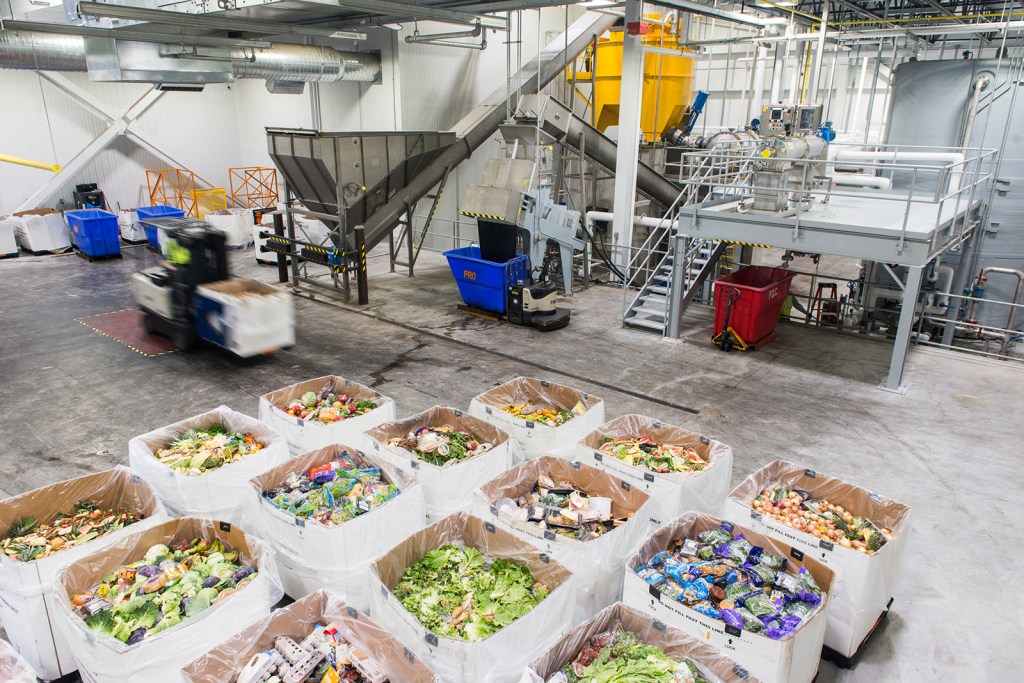
When the pallets of food reach Turlock, Divert’s depackaging machinery breaks open any containers and separates packaging waste. The organic slurry that remains is sent to a digester, which uses bacteria to break it down into fertilizer and natural gas, which is piped into the regional grid.
The technology is well established, but multiple forces have been driving its proliferation. These include organic diversion mandates in California and other states, which require businesses to help keep organic waste out of landfills. (Although researchers have contested the impact of such regulation.)
In addition to the emissions savings, new business models are also playing a part: Divert’s customers, including Kroger and other large retailers, benefit from a vertically integrated process that generates valuable data on where waste originates. “We have thousands of bins that are coming into our facilities every day,” said Ben Kuethe Oaks, senior vice president for commercial at Divert. Each bin has an RFID label on it, he adds, so the company can track how much comes from a particular store.
Industry growth
Divert is adding two more grid-connected natural gas facilities this year, and its competitors are also growing. These include Denali, which processed just over 1 million tons of food waste in 2024, up from 850,000 tons the year prior. Unlike its rival, Denali focuses on collection and processing; natural gas production is handled by its partners. Another notable competitor, Vanguard Renewables, originally focused on anaerobic digesters but is now expanding into waste collection.
The use of large-scale food waste processing is backed by food waste advocacy groups such as ReFED. But industry observers also raise questions about the approach. Processing of waste falls below prevention in hierarchies for waste management, for instance. Critics also note that adding natural gas to the grid could prolong the use of the fossil fuel.
Large centralized facilities can also make waste processing systems more brittle and prone to disruption, which can occur when plastic packaging contaminates digesters. “When you build facilities that can take 100,000-200,000 tons a year of food waste feedstock, you are putting all your eggs in one basket,” said Nora Goldstein, editorial chairperson of Biocycle, an industry publication. “There’s a vulnerability to that aggregation.”

Subscribe to Trellis Briefing