Corporate affairs teams feel unprepared for deepfake and AI threats
New GlobeScan data reveals that corporate affairs teams lack confidence in their readiness to manage deepfake and AI-driven misinformation incidents, even as AI usage rises among top global business risks. Read More

- Corporate affairs teams globally show low readiness for AI-driven misinformation incidents, with fewer than one in five saying they are prepared.
- Confidence in preparedness is weakest in Europe and Africa, and strongest in Latin America, while responses in North America cluster around moderate levels of confidence.
- Sector differences are pronounced, with ICT and media entertainment teams reporting the highest confidence, and consumer products and retail emerging as the least prepared sectors.
GlobeScan’s 2026 corporate affairs research points to a widening gap between the growing prominence of AI-related risks and organizational readiness to manage them. Forty-four percent of practitioners worldwide now cite the impact of AI and technology as one of the biggest risks facing global business over the next two years, up sharply from 17 percent in 2025. Yet confidence in managing deepfakes — one of the most immediate AI-driven threats — and AI-generated misinformation remains low.
Globally, just 18 percent of practitioners say their corporate affairs function is prepared to manage a deepfake or AI-driven misinformation incident, while 43 percent say it is not very prepared. A further 30 percent describe themselves as somewhat prepared, suggesting that many organizations have partial plans or early-stage capabilities rather than fully embedded and tested response mechanisms. As AI accelerates the credibility, speed and reach of false content, this gap represents a growing reputational risk.
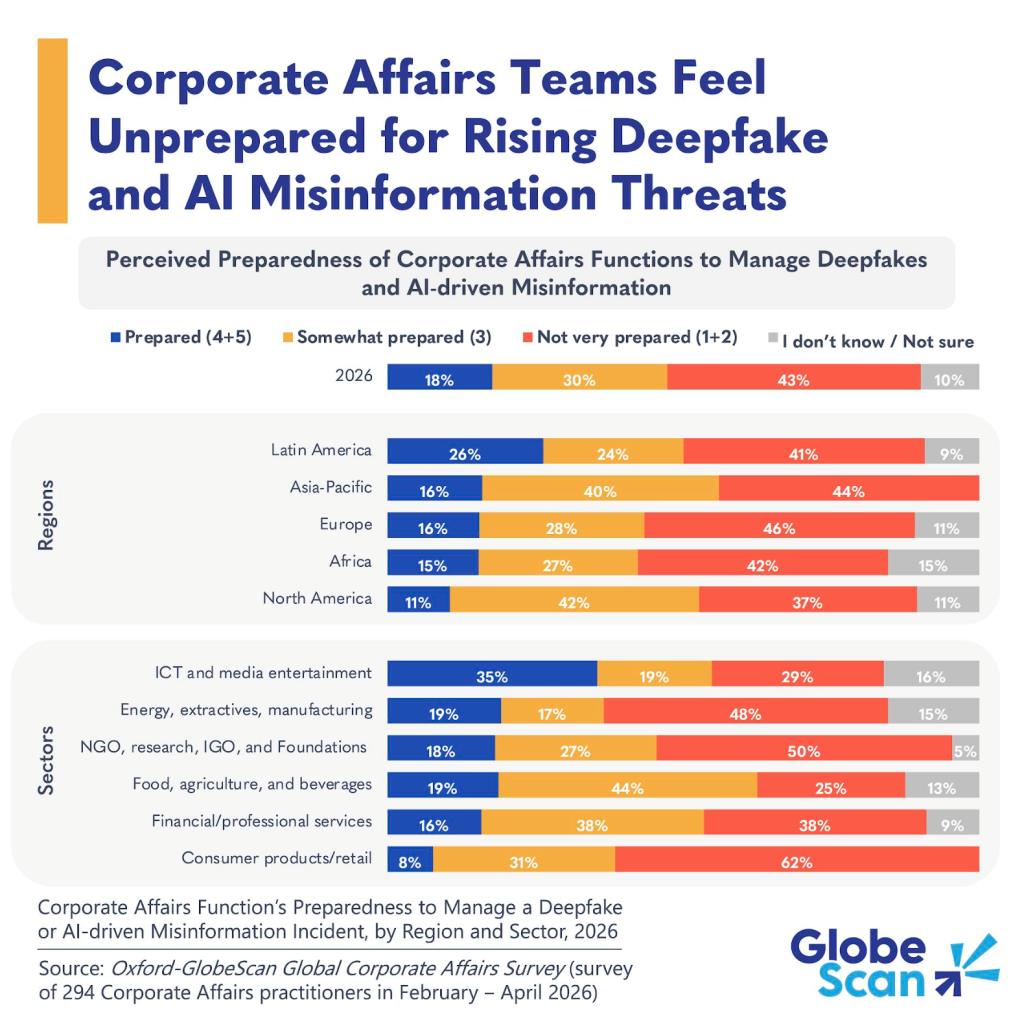
Regional patterns reveal important nuances. Europe stands out for particularly low confidence, with 46 percent of respondents saying their corporate affairs function is not prepared and another 11 percent unable to answer. In Africa, more than half of respondents also fall into these two categories (42 percent and 15 percent, respectively). In North America, just 11 percent of practitioners claim to be fully ready, while 42 percent place themselves in the somewhat prepared category, reflecting a cautious assessment of the complexity involved in managing AI-driven misinformation. At the other end of the spectrum, respondents in Latin America report the strongest confidence in feeling prepared, which some might venture reflects an optimistic underestimation of the threat ahead.
Sector results reinforce that exposure and readiness do not always align. Corporate affairs practitioners in the ICT and media entertainment sector are comparatively more confident, with around one-third saying their function is prepared, consistent with closer proximity to digital platforms and AI-related risks. In contrast, consumer products and retail sectors show the weakest readiness profile, with 62 percent of respondents saying they are not very prepared and just 8 percent saying they are. This is a notable vulnerability for a sector that relies heavily on brand trust and rapid, high-visibility communications. Food, agriculture and beverage companies sit closer to the middle, with many reporting being somewhat prepared but relatively few expressing strong confidence.
What does this mean?
For corporate affairs leaders, the findings underline that AI‑driven misinformation has become a core reputational risk that is advancing faster than organizational readiness. The gap between being somewhat prepared and truly prepared matters, as deepfake‑driven incidents compress decision timelines and amplify exposure before facts are fully established. Closing this gap requires moving from confidence to capability, with clear escalation protocols, defined decision rights and tested response playbooks that extend beyond communications teams to legal, cybersecurity and senior leadership. Taken together, this elevates the management of AI‑driven misinformation into a foundational corporate affairs capability.
Based on a survey of nearly 300 senior corporate affairs practitioners across regions and sectors.

Subscribe to Trellis Briefing