How, and why, to stress test your business case
An important element of every investment proposal is knowing the answer to this question: What happens if the assumptions fail? Read More
- The return on investment for sustainability initiatives often includes variables outside their control, such as commodity prices or carbon policy.
- Get familiar with assumptions that affect the business case, and run simulations to understand what could happen if things don’t go as expected.
- To earn credibility, sustainability professionals should acknowledge what could go wrong and have the data to support their argument.
The opinions expressed by Trellis expert contributors are their own, not those of Trellis.
2027 budget season is here, and it’s a tight one. In a Q4 2026 survey of 131 CEOs by the Conference Board think tank, 41 percent expected economic conditions to worsen, up from 19 percent the quarter before. CEO confidence fell into negative territory, and most CEOs have no plans to raise capital spending.
That leads to a familiar problem, one that hits sustainability leaders especially hard: more good requests than money to fund them.
When EY surveyed 1,000 finance leaders in 2023, ESG was the investment area most vulnerable to cuts: 37 percent planned to reduce or pause that spending within a year, even while calling it a long-term priority. And many CFOs still see these projects as costs first: In Kearney’s 2025 survey of 500 CFOs, 61 percent said they view sustainable investments through a cost-focused lens.
Given that it’s so difficult to get funding, sustainability professionals need to make sure that their business case is rock solid. A critical element that most people overlook: What happens when assumptions are wrong?
The uncertainty penalty
The return on investment (ROI) for sustainability initiatives often depends on things that are uncertain, such as commodity prices, carbon rules and customer demand. That’s a problem, because of what economists call “ambiguity aversion,” the fact that most people prefer known odds to unknown ones.
This is especially visible when it comes to whether investments pay off. In a Dutch study of investors and non-investors by Wharton School risk management professor Olivia Mitchell and colleagues, most participants were ambiguity averse, and people who saw less ambiguity in an asset were more likely to invest in it.
A business case with untested assumptions is that kind of unknown. The reviewer can’t tell whether the results will survive a price drop or a slow rollout, so they treat the case as risky. To avoid that penalty, a sustainability business case needs to show what happens to its ROI if its assumptions are wrong.
But most business cases don’t.
The element most cases skip
Showing what could go wrong is one of the six elements of a complete business case. Here is my list of what’s required, adapted from the HBR Guide to Building Your Business Case and HM Treasury’s business case guidance:
- A specific actor and goal. Your company, and what it needs to achieve.
- An action. A project someone can approve, fund and start.
- A net financial result. Benefits minus costs, in money, for your company.
- A concrete link from action to result. How the action produces the money, such as changes to margin, growth or cost.
- A comparison with alternatives. Including business as usual, because doing nothing is an option, and it may have costs too.
- A look at what could go wrong. How the case’s own numbers change if its key assumptions fail.
The sixth element, a look at what could go wrong, is often missing. Far too frequently, in fact. To understand what people are hearing about building a business case for sustainability, Valutus has an ongoing project analyzing the strengths and weaknesses of articles on the topic. For the 2026 edition, Valutus gathered 1,587 sustainability business-case writeups published in 2025 and 2026 and selected a random sample of 300 split evenly between six source types:
- Academic papers
- Consultancy articles
- Vendor and company cases
- Trade press pieces
- Business school cases
- NGO, government and industry writeups
The result: Only about 8 percent of the 300 publications included the sixth required element, what happens when assumptions are wrong. Because business case reviewers expect to see that, having over 90 percent leave it out is a big problem.
But it’s an avoidable one.
How to take that step
- State the base case and every assumption behind it. Prices, volumes, adoption, costs and timing. Write down each number and where it came from.
- Find the assumptions that drive the result. Change each one on its own and watch how far the answer moves. Two or three criteria usually matter far more than the rest.
- Rerun the case with almost everything going wrong at once. Set each driver to a value you’d be uncomfortable defending as too low. Not the worst imaginable outcome, but a bad year.
- Report both results. Provide the expected and pessimistic scenarios, side by side, describing the assumptions behind each.
- If you have the tools, go further. A Monte Carlo simulation can rerun the model thousands of times, varying every assumption at once, and show the spread of outcomes.
Here’s a specific example of what this process looks like. It’s drawn from one of my consulting projects, but I’ve disguised the numbers to protect confidentiality.
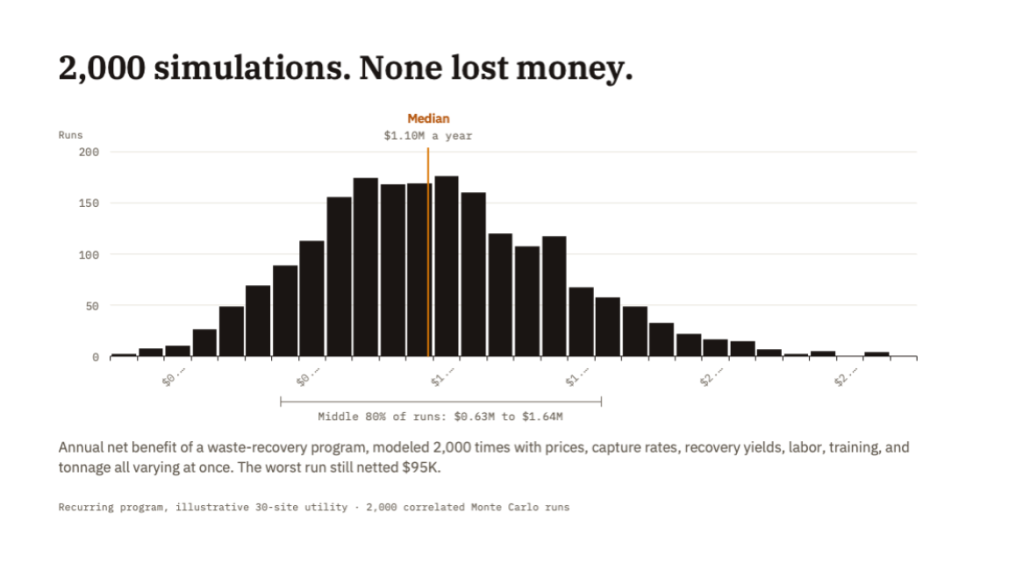
The client was a multi-billion dollar U.S. company. Analyzing a large waste stream from dozens of sites, we found that a lot of what was being sent to landfill was actually valuable material such as copper, aluminum and steel. That meant it was possible to recover what was valuable and sell it. This meant the amount sent to landfill could be cut in half, cutting disposal costs. Adding revenue from the recovered metals meant that what had been a cost could become an income stream.
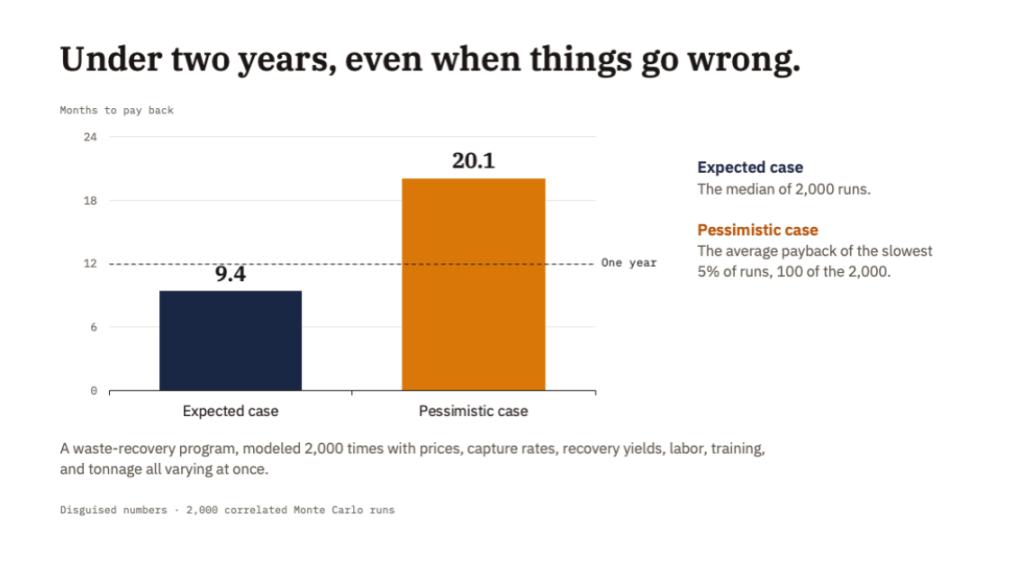
The financial case looked attractive, and it was. But it needed to be rigorously tested to make sure it would hold up if things changed. To do that, Valutus calculated the financial benefit of the changes 2,000 different times, varying sale prices, material capture rates, recovery yields, labor costs, training requirements and other factors.
To build credibility, we made sure to test even unusually pessimistic changes in key variables. For example, since 1967 there have been only 2 drops in copper price as steep as the one we modeled.
Across all 2,000 scenarios, the median result was a benefit of $1.10 million a year and a payback period of 9.4 months. In none of the 2,000 scenarios did the program lose money, and in the most pessimistic 5 percent of cases, the payback period averaged under two years (20.1 months).
Executives are used to hearing statements like “we expect payback in under a year.” But that claim lands differently when you say, “Payback is expected to be under a year. When we ran 2,000 simulations about what might happen, it still averaged under two years in the most pessimistic 5 percent of them.”
What changes
When you show where your numbers might be wrong, you make your business case easier to approve. You also identify your weakest assumption before the finance team finds it. If the pessimistic case still pays, say so. If it doesn’t, you know what to fix.
You’re also communicating something important about the sustainability team. A team that has run its own business case through a series of pessimistic scenarios knows where the project could slip and what it would do about it. That makes a reviewer more confident it will deliver, and more likely to approve it.
This budget season, the finance department will wonder about every request: What happens if the numbers are wrong? Give them the answer before they ask.

Subscribe to Trellis Briefing