How the conflict in Iran is an accidental ‘green swan’
The war may accomplish what climate science couldn't: the global clean energy transition. Read More
- The conflict in Iran and the resulting Strait of Hormuz disruption is a consequential catalyst for the global clean energy transition.
- Oil dependency is fundamentally a sovereignty problem, not an energy one, forcing nations to delegate their economic fate to uncontrollable geographies.
- Renewables are the only path to true energy independence, reframing the green transition as an urgent national security imperative instead of a moral one.
The opinions expressed here by Trellis expert contributors are their own, not those of Trellis.
The single event most likely to accelerate the global clean energy transition isn’t a breakthrough in battery storage, nor a new international climate accord. It’s a war. The conflict in Iran — with its disruption of the Strait of Hormuz, its crude price shock, and its demonstration of how fragile the global energy architecture truly is – may prove to be the most consequential forcing function for sovereign energy independence the modern world has encountered.
This isn’t an environmental argument but one based in economic reality. The nations most exposed to the Hormuz disruption are staring at a structural vulnerability demonstrating economic and existential threats not within their control. The gateway to global climate progress may run not through Stockholm or Davos, but through the Strait of Hormuz.
The structural trap of oil dependency
Oil dependency isn’t, at its core, an energy problem. It’s a sovereignty problem. Every nation that imports oil is delegating a portion of its economic fate to a geography it doesn’t control, through shipping lanes it cannot fully defend, across a geopolitical chessboard populated by actors whose interests often diverge violently from its own.
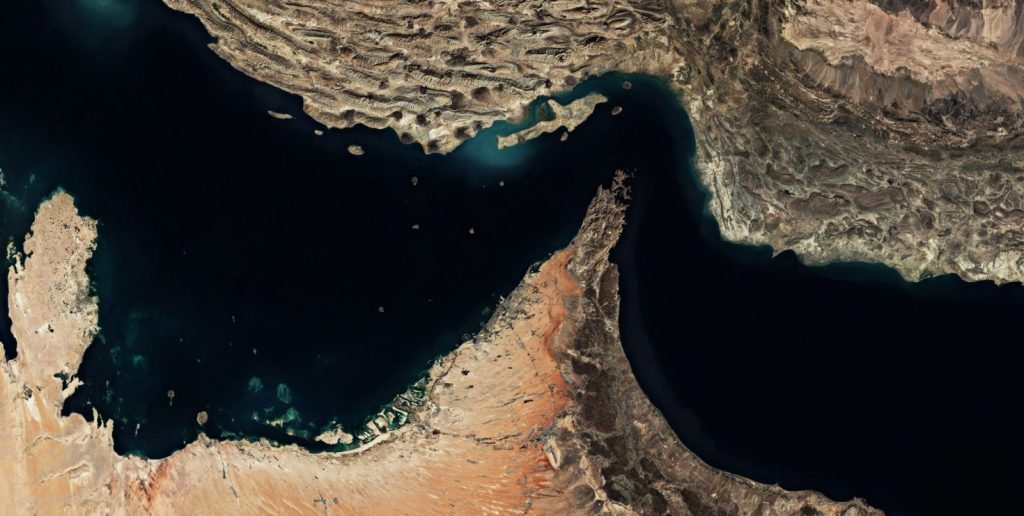
In 2025, approximately 20 million barrels of crude oil and petroleum products transited the Strait of Hormuz every day, representing roughly 20 percent of total global oil consumption and 34 percent of all seaborne crude oil trade. A single waterway, 21 miles wide at its narrowest point, mediates between the world and roughly a third of its tradable crude supply. Most of it goes to Asia: China, India, Japan and South Korea together absorbed 69 percent of Hormuz crude flows in 2024. China received approximately one-third of its entire oil supply through this passage. No nation can rationally accept indefinite dependence on supply chains it cannot protect.
The Iran conflict as clarifying event
There is a meaningful difference between knowing a risk and feeling it. Financial markets understand this well: systemic risks are priced imperfectly until they are suddenly, viscerally real. The Iran conflict crossed that threshold with remarkable speed. Brent crude surpassed $100 per barrel on March 8, 2026 for the first time in four years — and tanker traffic through the Strait of Hormuz collapsed by roughly 87 percent by March 15 before falling to near zero. Major container shipping firms, including Maersk and Hapag-Lloyd, suspended transits entirely.
What the conflict revealed wasn’t new information, but a new felt experience: the tanker insurance market seizure, the central bank emergency sessions, the defense ministries suddenly convened over spreadsheets about crude imports. Abstract systemic risk had become a concrete, political, budgetary crisis for dozens of governments in the span of days. Crisis may be the only mechanism that can promptly and reliably convert abstract systemic risk into political will.
The rational actor’s green conclusion
If the goal is energy security — not decarbonization, not emissions reduction, simply the ability to keep the lights on without existential geopolitical exposure — what are the options?
Nuclear power offers low-carbon baseload generation, but carries lead times measured in decades, political resistance in most democracies and meaningful proliferation risk if deployed at scale across multiple sovereign states. Diversified LNG supply chains reduce single-country exposure but leave nations trading one commodity dependency for another, still subject to geopolitical pricing and maritime chokepoint risk. Modest gains, not structural resolution.
Renewables — wind, solar, geothermal and increasingly grid-scale storage are the only option that severs the dependency chain entirely. Sunlight and wind are domestically abundant in virtually every nation on earth and cannot be sanctioned. They don’t go through the Strait of Hormuz. They aren’t subject to OPEC quotas or Islamic Revolutionary Guard Corps interdiction. A nation that generates its energy domestically from renewables has, by definition, achieved energy independence. There is an irony worth acknowledging: the green transition, when framed as a national security imperative rather than a moral one, commands the attention of people who have resisted it for 30 years. The audience for that argument isn’t Greenpeace. It’s defense ministries, central banks and sovereign wealth funds.
It’s worth being precise and unsentimental here: the obstacle was never climate science. The science has been clear, largely consistent and increasingly alarming for decades. The barrier was motivation — specifically, the structural mismatch between the costs of action and the distribution of its benefits.
The climate movement, to its credit, was correct. It was asking people to act against their immediate self-interest for the benefit of the commons and the future. That’s not innate to human coding and has a very low historical success rate, measured not in good intentions but in megatons of CO₂.
The Iran shock removes that burden entirely. It doesn’t ask leaders to sacrifice for the future. It asks them to respond to a present emergency.
The sovereign energy independence doctrine
The policy framework emerging from this moment isn’t being written in the language of climate, but in the language of national security. Europe has already demonstrated what this looks like in practice. Following Russia’s weaponization of natural gas after the invasion of Ukraine, the EU’s REPowerEU plan drove Russian gas imports from 45 percent of EU supply in 2021 to 13 percent by 2025. By last year, wind and solar generated more electricity in the EU than fossil fuels for the first time in history — a milestone driven not primarily by climate commitment but by the urgent need to build energy that cannot be switched off by a foreign government.
Critically, this doctrine doesn’t require international consensus — no new climate treaty, no reformed UN process — just that sovereign actors behave in their own rational self-interest, which they will when the alternative is $100+ crude and idle tankers. For capital markets, the signal is unmistakable: renewables are no longer competing in the arena of ESG mandates. They likely will be competing, and winning, in the arena of national security spending. That is a different, larger and more durable pool of capital.
It’s a striking and uncomfortable fact that civilizations often require crisis to accomplish what reason, evidence and moral argument can’t. One need not romanticize this to recognize its historical regularity. The question is not whether the catalyst was noble. The question is whether it is sufficient.
What is emerging from the Iran conflict is perhaps the first moment in modern history where civilizational self-preservation and ecological survival are structurally identical choices.
This isn’t cause for celebration. It required war, an oil shock, stranded tankers and the economic disruption of dozens of nations to arrive here. The costs — human, financial, geopolitical — are real and ongoing. But it’s cause for clear-eyed optimism of a particular kind: the machinery of capital, defense and statecraft is now pointed, however imperfectly and however self-interestedly, in the right direction.

Subscribe to Trellis Briefing