Hyperscaler emissions expected to jump 60 percent in 2026
Company footprints can be forecast as soon as financial data is available, says the economist behind the approach. Read More
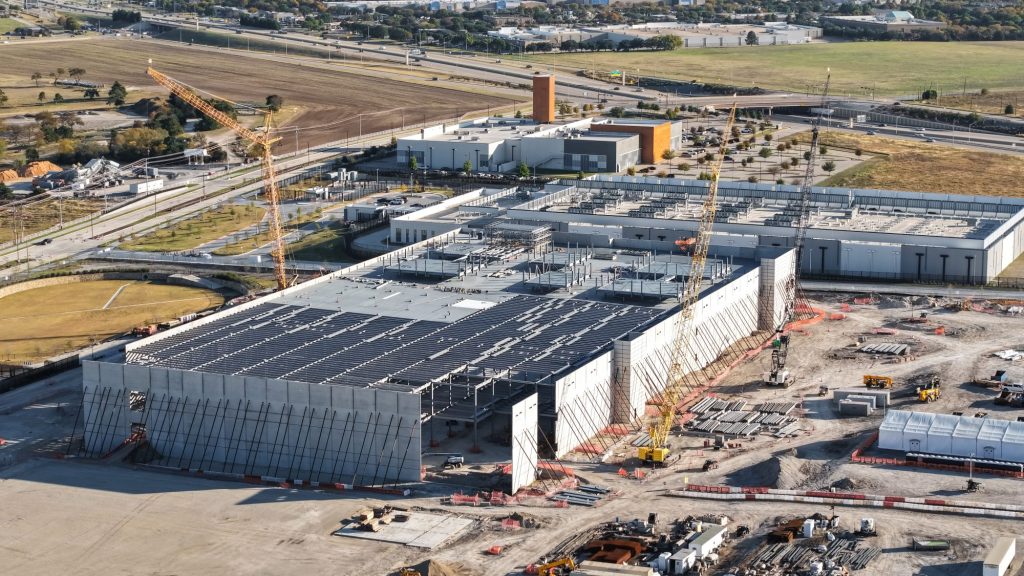
- The combined 2026 emissions of five hyperscalers are forecast to exceed those of many industrialized nations.
- The forecast is based on historical data on capital expenditures and emissions.
- The approach may help sustainability professionals tackle future emissions more rapidly.
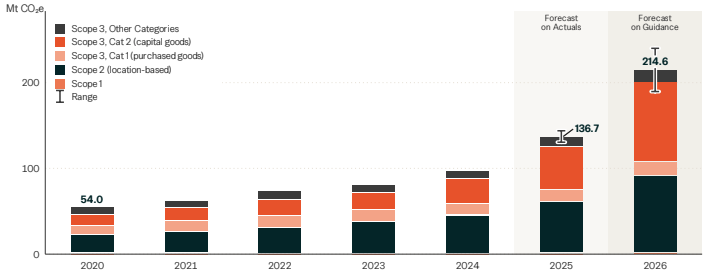
The emissions of five of the largest hyperscalers will grow by almost 60 percent this calendar year, according to the first application of a new method for forecasting corporate carbon footprints.
The forecast pegs the combined 2026 emissions of Alphabet, Amazon Web Services (AWS), Meta, Microsoft and Oracle at 215 million metric tons of carbon dioxide equivalent (tCO2e), a number that surpasses the national footprint of a large majority of countries.
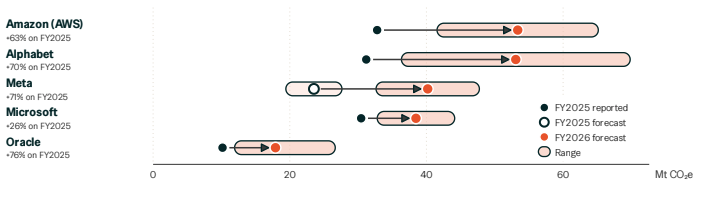
The increase is almost entirely driven by emissions associated with building, equipping and powering new data centers. The five companies’ capital expenditures across 2025 and 2026 are expected to exceed $1 trillion, according to Bricola Group, the startup that generated the estimates. AWS and Alphabet are forecast to be the largest emitters in 2026, with the footprints of both companies totaling just over 53 million tCO2e each.
After deducting renewable energy certificates and other instruments purchashed by the companies, the total falls to 140 million tCO2e, up from 87 million tCO2 in calendar year 2025..
Bricola built its forecast model by comparing the companies’ historical data on capital expenditure with emissions. Capex numbers are released by companies in annual financial results, with emissions estimates following months later in sustainability reports. But since changes in future emissions are driven in large part by data-center spending, Bricola founder Jimmy Gillan was able to develop a model that estimates footprint numbers as soon as companies release data on expected or actual capex.
Each company’s forecast is presented as a range of values determined in part by the available financial data. Oracle and Microsoft, for example, operate on fiscal years that end in May and June, respectively. That allowed Gillan to use confirmed capex numbers for those companies; for the other three, whose fiscal years end in December, he worked with recent guidance.
Forecast hyperscaler emissions increases
The combined footprint of the five businesses is forecast to grow 57 percent this year, the largest increase since the race to develop artificial intelligence products triggered a surge in emissions that has upended progress toward climate targets at Microsoft, Alphabet and other members of the group.
Combined footprint of the “Hyper 5”
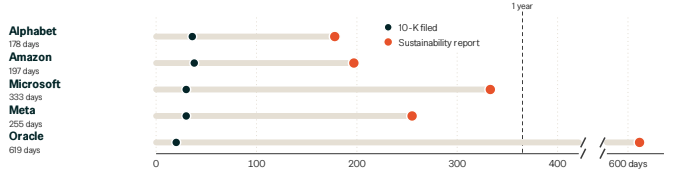
Gillan, a former Amazon economist, developed his model to help sustainability teams, industry groups and others move more quickly to tackle emissions. The hyperscalers’ sustainability reports typically arrive five to nine months after the companies publish their 10-Ks, the forms that contain annual financial results.
Delay in publication of sustainability data for financial year 2024
“My hope is to accelerate what we think is going to come out of the disclosure process so that we can identify the areas where decarbonization is most needed,” Gillan said. That way, he added, resources can be mobilized rapidly and teams are “not waiting for a number to come in.”

Subscribe to Trellis Briefing