More chief sustainability officers are taking on risk management, survey finds
Identifying regulatory, supply chain and climate vulnerabilities takes a front seat to two other top priorities for the CSO role: cost savings and customer acquisition. Read More

- Sustainability is increasingly driven by business uncertainty, along with regulatory pressures, according to a biennial survey by recruiting firm Weinreb Group.
- Fewer CSOs report directly to CSOs, while more are accountable to the legal department.
- The number of CSOs at U.S. public companies declined 10 percent over the past year.
Risk mitigation trumps cost savings as the top way for sustainability teams to create business value for their organizations, according to the 8th biennial survey of chief sustainability officers (CSOs) at publicly traded U.S. companies.
More than 62 percent of the respondents said their ability to identify and offer strategies to address regulatory, supply chain and climate risks resonated with other members of the C-suite.
Exhibit A: Spirits company Suntory in January 2025 appointed its chief sustainability officer, Kim Marotta, to head risk management. “What enterprise risk management has given me is the opportunity to see the big picture,” she told Trellis during a Climate Pioneers interview in February. “Instead of just having environmental risks, they’re business risks.”
Two other ways that CSOs can provide business value are through cost savings related to improved energy, waste management and operational efficiency (52 percent); and initiatives that support customer acquisition and retention (38 percent).
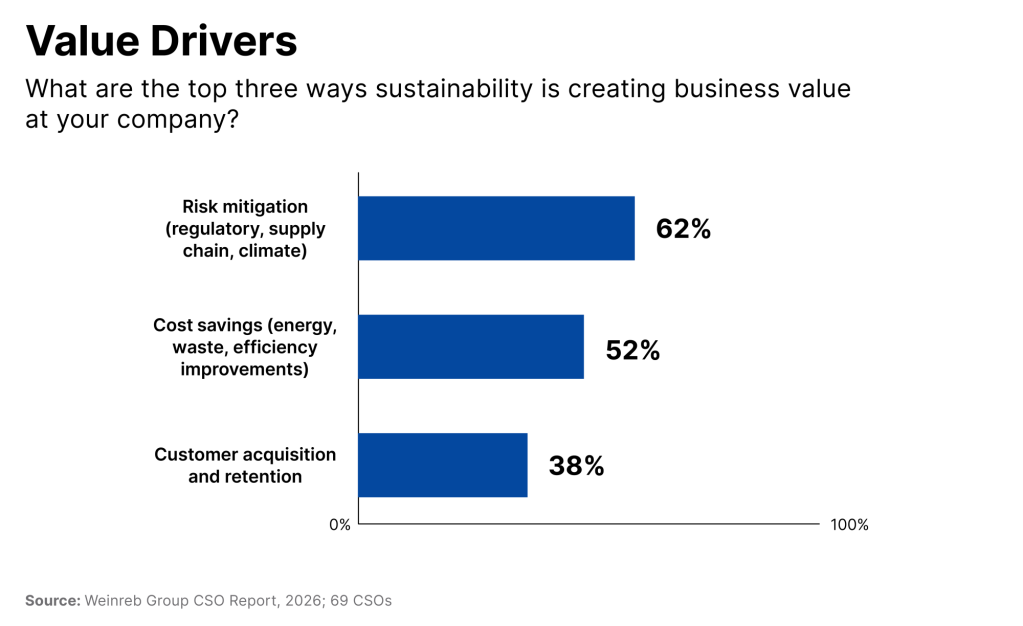
The responses come from the 8th biennial CSO insights report from recruiter Weinreb Group. They reflect the opinions of 69 CSOs at U.S. public companies, approximately one-third of the 193 executives who held that title as of July 1. That’s a smaller universe than in 2025, when there were 216 individuals with the title at U.S. public companies.
“CSOs are the futurists of the corporate context,” said International Paper CSO Sophie Beckham, a respondent. “My mandate is to see around corners, build resilience into our business model and create value that will help my company not just navigate but thrive when facing emerging risks and opportunities.”
What’s shaping sustainability
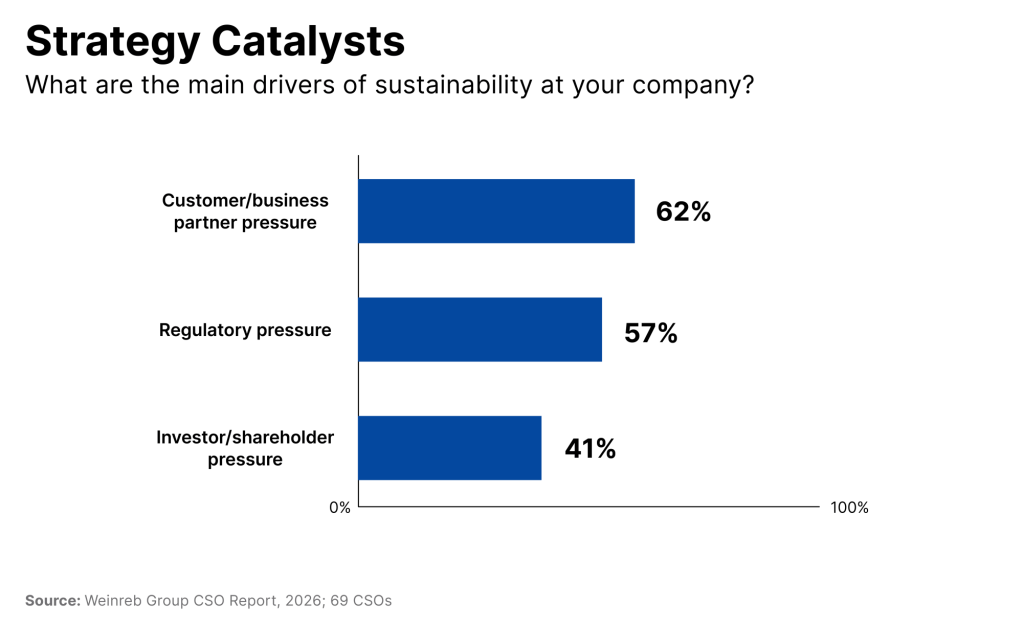
Customer and business partner pressure is the chief driver of sustainability strategy, according to 62 percent of the CSOs that responded to the survey. Other top drivers are regulatory pressure (57 percent) and investor/shareholder pressure (41 percent).
The top challenges CSOs face today: market and economic uncertainty (62 percent), followed by regulatory requirements (57 percent) — a view that respondents said they share with other top executives within their organization.
Approximately 42 percent of the respondents reported that their responsibilities had broadened in the past year.
“We are reaching a tipping point where ‘sustainable business’ is simply ‘smart business,’ ” said one respondent, who chose to remain anonymous.
That shift is evidenced by the increase in sustainability headcount that is happening outside central teams: 42 percent of the respondents reported that more individuals were hired to add that perspective to other units.
Reporting lines for CSOs are also shifting, a finding mirrored in the latest Trellis State of the Sustainability Profession research published in May, a broader survey of more than 500 sustainability professionals.
One-quarter of the Weinreb respondents said reporting lines in their organization have changed since January 2025: Just 14 percent are directly accountable to their company’s CEO, compared with 33 percent 18 months ago, while a growing number report to the legal department.
“After tracking the CSO role for so many years, what heartens me the most is the resilience of the people who hold this title,” said Weinreb Group CEO Ellen Weinreb. “There’s rarely a playbook for what they do, yet they negotiate every new challenge with grace and determination.”

Subscribe to Trellis Briefing