How cruise control and book-and-claim can decarbonize US railroads
Though Norfolk Southern is tracking slightly behind its SBTi goal, it remains confident about hitting the target. Read More
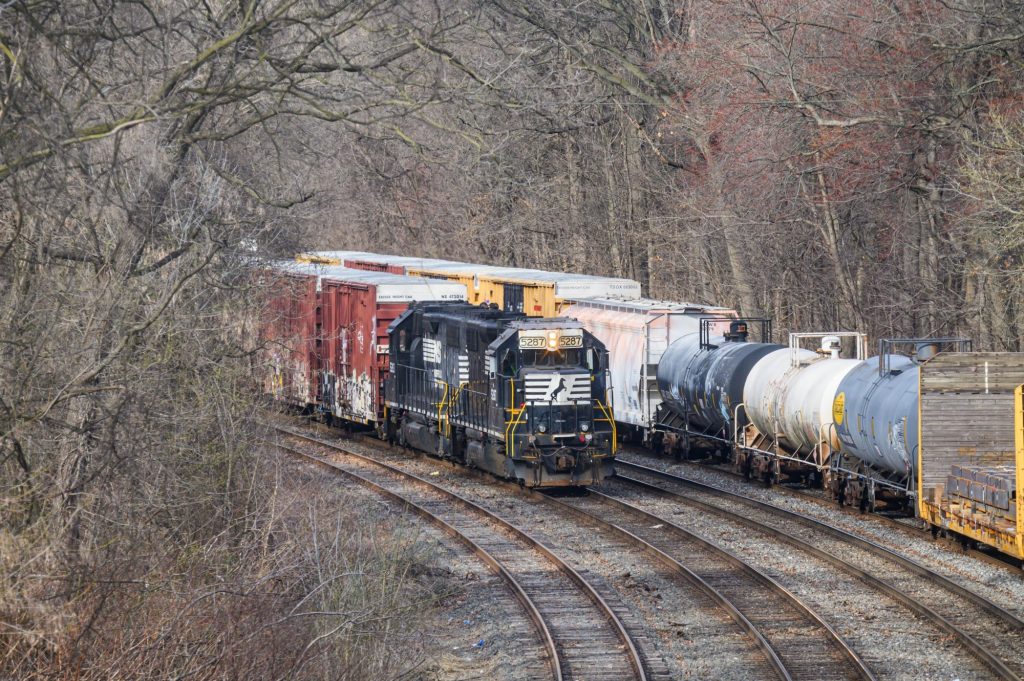
- Norfolk Southern has cut its combined Scope 1 and 2 emissions by 12 percent since 2019.
- The company’s goal of a 42 percent cut by 2034 rests on use of plant-based fuel and efficiency gains.
- Critics warn a proposed merger with Union Pacific could lead to higher prices and poorer service.
Shifting freight from road to rail could avoid the release of millions of tons of carbon dioxide and help companies cut shipping emissions. That’s largely a function of increased efficiency: 1 gallon of fuel can move 1 ton of cargo around 150 miles by truck — but more than 400 miles by rail.
To fully realize the benefits of rail, though, the major carriers also need to decarbonize their own operations. Trellis checked in with Norfolk Southern, one of six large “Class I” railroads in the U.S., for an update as the company approaches the halfway point of its journey to its near-term goal.
What is Norfolk Southern targeting?
Southern’s roughly 3,000 locomotives operate over more than 19,000 miles of track in the eastern U.S., earning the company $12 billion in revenue in 2025 and generating 5.8 million tons of carbon dioxide equivalent emissions (tCO2e).
More than two-thirds of those emissions are generated by the locomotives and fall into the company’s Scope 1 inventory. The railroad’s goal, which was validated by the Science Based Targets initiative (SBTi) in 2021, is to cut both its Scope 1 and 2 emission intensity — the latter contributes a relative sliver to the total — by 42 percent between 2019 and 2034.
Progress has been steady: Norfolk Southern’s latest sustainability report, released late last month, shows a 12 percent decline in tCO2e per million ton-miles traveled. That leaves the company with more than two-thirds of its targeted reduction still to be achieved as it approaches the midpoint between its baseline and target years. But Joshua Raglin, the railroad’s chief sustainability officer, points out that the existing gains have been made since the target was approved in 2021, putting the company on track to hit its goal.
Is the goal still achievable?
Absolutely, said Raglin.
That’s partly because he’s bullish on the prospects for replacing fossil diesel. To date, Norfolk Southern has focused on using biodiesel, a plant-based alternative that can displace up to 20 percent fossil diesel. The focus going forward will be on renewable diesel, a different plant-based fuel with the potential to completely replace fossil diesel without needing to modify existing locomotives. “We’ve had a lot more suppliers reaching out to us, specifically related to renewable diesel,” said Raglin.
The railroad is also making good progress on fuel efficiency, which improved by 5 percent in 2025. All of Norfolk Southern’s active fleet is now fitted with energy management equipment — essentially cruise control for locomotives. The system kicks in once the train hits around 10 miles per hour, then operates for the majority of the rest of the trip.
“That’s been a huge lever for us,” said Raglin. “Just using energy management alone versus an engineer operating the train can improve fuel efficiency 6 to 8 percent.”
Do the economics work?
Fuel efficiency work pays for itself, but outside of California, where state subsidies ensure price parity, renewable diesel is around 20 percent more expensive than fossil diesel.
Norfolk Southern has customers willing to pay a premium in return for emissions savings, but matching specific cargo loads to low-carbon diesel supplies is impractical. Instead, the company last year launched a “book and claim” scheme, under which environmental attribute certificates (EACs) for the emissions savings are sold independently of the freight transport.
The future of that scheme is looking bright thanks to the SBTi’s decision in June to allow EACs to be used to meet Scope 3 targets, said Raglin. Customers had been sitting on the sidelines, uncertain of where the SBTi would land. But with the picture clearer, more are expressing interest in the 40,000 certificates, each representing a ton of emissions saved, that Norfolk Southern has available.
And the impact of that merger?
Norfolk Southern’s proposed merger with Union Pacific, which is currently being scrutinized by regulators, would create a single trans-America network that the railroads say would incentivize more companies to choose rail over road. If they’re right, that could mean further emissions savings. Raglin said the combined railroad is projected to convert 2.1 million truckloads of freight from road to rail annually, avoiding the emissions of 3.8 million tCO2.
Critics, though, aren’t so sure. Some labor unions and railroad customers, including the chemical industry, worry that the merger would lead to poorer service and higher prices — making trucks more attractive to shippers and sending emissions in the other direction.

Subscribe to Trellis Briefing