PwC says more companies are on track to hit emissions goals
But though the data points to progress, conclusions are compromised by a lack of agreement over what constitutes acceptable ambition. Read More

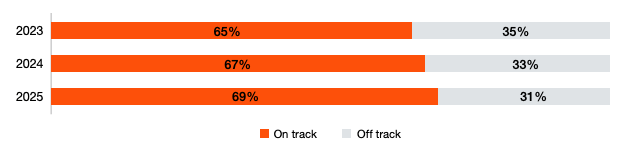
- More than two-thirds of companies are on track to hit Scope 1 and 2 targets.
- The result runs counter to a recent spate of media stories documenting company decisions to water down targets.
- The survey of data from more than 3,500 companies also highlights differences in how progress is defined.
Are businesses struggling to stay on track to hit emissions goals?
A sampling of media coverage would suggest they are. Last month, Delta Air Lines downgraded plans to reach net zero by 2050 from a “goal” to an “aspiration.” The AI boom is causing companies throughout the tech sector to report emissions increases. Automotive targets are imperiled by slow electric vehicle sales. In apparel, Under Armour said last fall that it won’t seek to have the Science Based Targets initiative (SBTi) re-validate its goals.
Yet, analyses of business sectors and larger groups of companies can reach rosier conclusions. One example is PwC’s State of Decarbonization Report, now in its third year. The most recent edition, published last month, looked at emissions data disclosed by just over 3,500 companies to CDP. Extrapolating from the data, PwC’s researchers classified companies as either on- or off-track to hit targets.
For Scopes 1 and 2, the numbers revealed a steady year-on-year increase in the proportion of companies that remain on track:
Progress toward Scope 1 and 2 goals
Scope 3 is a tougher nut to crack, but still the PwC team found that the fraction of on-track companies is increasing:
Progress toward Scope 3
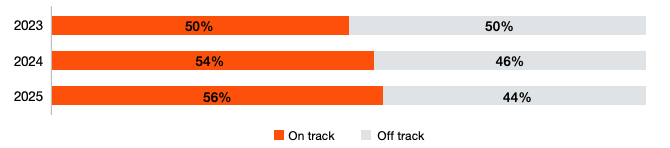
(Note: The comparison between 2025 and earlier years is hindered by a change in the sample: The PwC team excluded financial and professional services from the most recent data. When these firms are added back, the results are unchanged for Scope 3 and show a single percentage-point increase in on-track companies for Scopes 1 and 2.)
One reason for the discrepancy could be that anecdotes are not data. Media coverage tends to focus disproportionately on consumer-facing companies in tech, food and other sectors. Many of them have earned a reputation for ambitious sustainability programs, making it more noticeable when they falter. Individual setbacks, however prominent, though, do not necessarily herald sector-wide problems. Indeed, the PwC team found that, in tech at least, companies are, on average, ahead of where they need to be.
Lack of common goals
That said, suggesting that the private sector is making better progress toward climate goals than the coverage implies might overstate things.
Yes, the PwC data is both encouraging and a useful reminder that many lower-profile companies are holding the line. But it combines a wide range of target types into a single dataset. Only a third or so of the roughly 500 North American companies in the sample have had their targets validated by the SBTi. The majority of the remaining targets are described as science-based or aligned, but that can mean more than one thing. The SBTi requires Scope 3 to be included in net-zero targets, for example, but some companies that set targets without the initiative opt to exclude these emissions.
One alternative to tracking progress toward company targets is to benchmark against a scientific goal, regardless of whether individual businesses are striving to hit it. Late last year, researchers at Accenture asked whether the world’s 4,000 largest public and private companies by revenue were on track to reach net zero across Scopes 1 and 2 by 2050, one component of the IPCC’s recommendations for limiting global warming to no more than 1.5 degrees Celsius. Just 16 percent were. And as those companies tend to be lower emitters, they constituted only 4 percent of the total emissions from the 4,000 companies.
These results aren’t contradictory; each looks at a different group of companies and defines targets in different ways. That diversity of approaches may well further our knowledge. But it’s also a reminder that as researchers, journalists and others increasingly attempt to assess corporate progress on climate, there remains no universally agreed-upon understanding of what “on track” means.

Subscribe to Trellis Briefing