Why the inner work of sustainability is a key to professional success
A new book and practice offer sustainability professionals a path from burnout and overwhelm to clarity, connection and purpose. Read More

- Sustainability professionals need designated space to grieve, rage and process this moment — not as a detour from the work, but as a prerequisite for it.
- Community building isn’t a morale strategy; it’s a structural response to a down-wave, because nodes of possibility are, by definition, connected.
- The climate movement has chronically under-invested in the quieter, human infrastructure of social change — and this fallow period is the time to fix that.
There’s a moment in our latest episode of our Two Steps Forward podcast that I keep returning to.
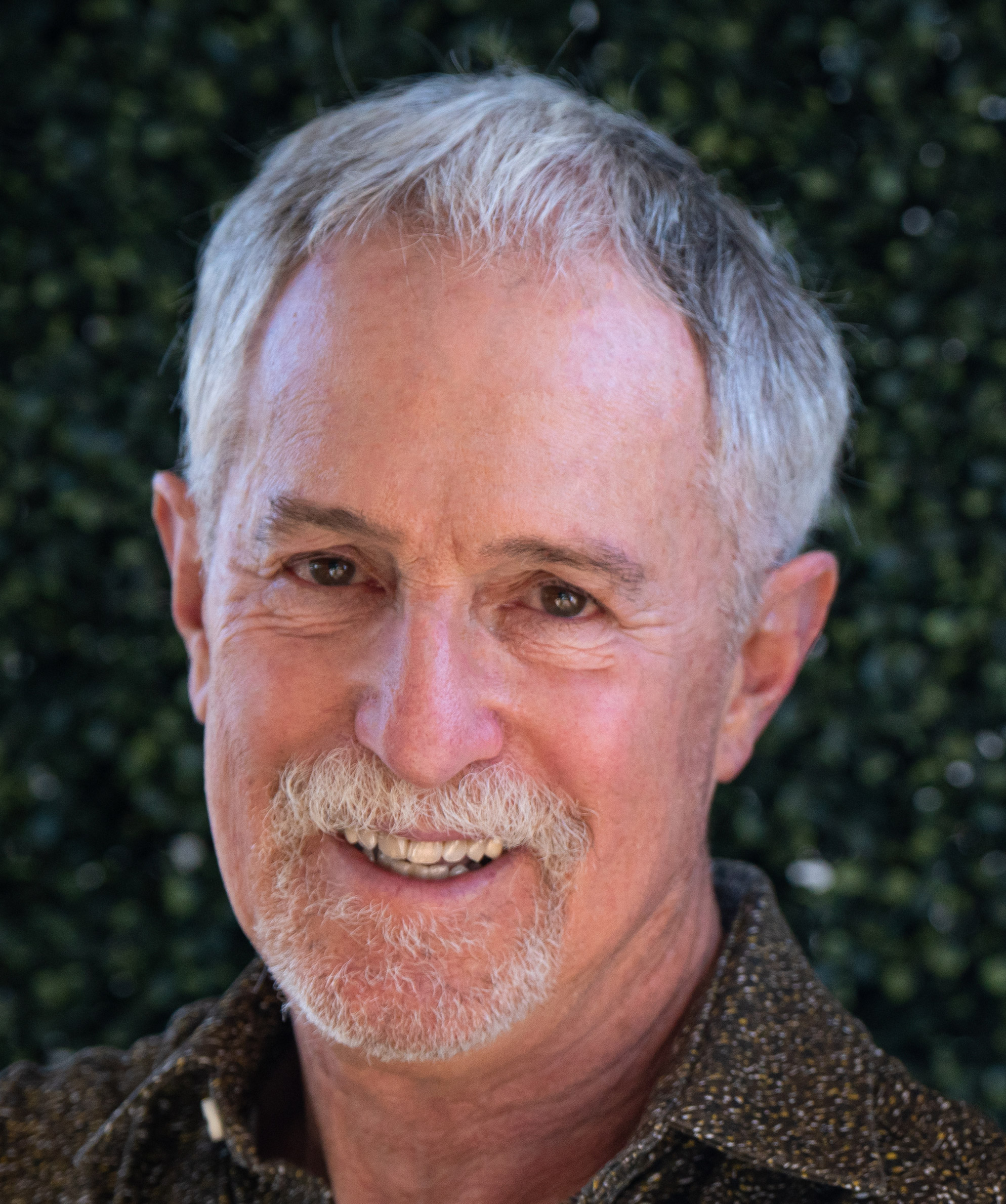
Katharine Wilkinson — author, climate activist and executive director of the All We Can Save Project — described facilitating a workshop for sustainability professionals during her book tour. She’d expected to lead a discussion about using “climate wayfinding” practices inside organizations, about building culture and cultivating leadership.
Instead, she said, “The room needed to cry. They needed to hold hands and sing and cry. And that is what we did.”
That’s where we are right now.
It’s not a comfortable place to be, especially for a community that prides itself on data, targets and measurable outcomes — not to mention unrelenting optimism. But it’s real, and Wilkinson’s new book, Climate Wayfinding: Healing Ourselves and the Planet We Call Home, meets this moment in a way that’s both deeply human and surprisingly practical.
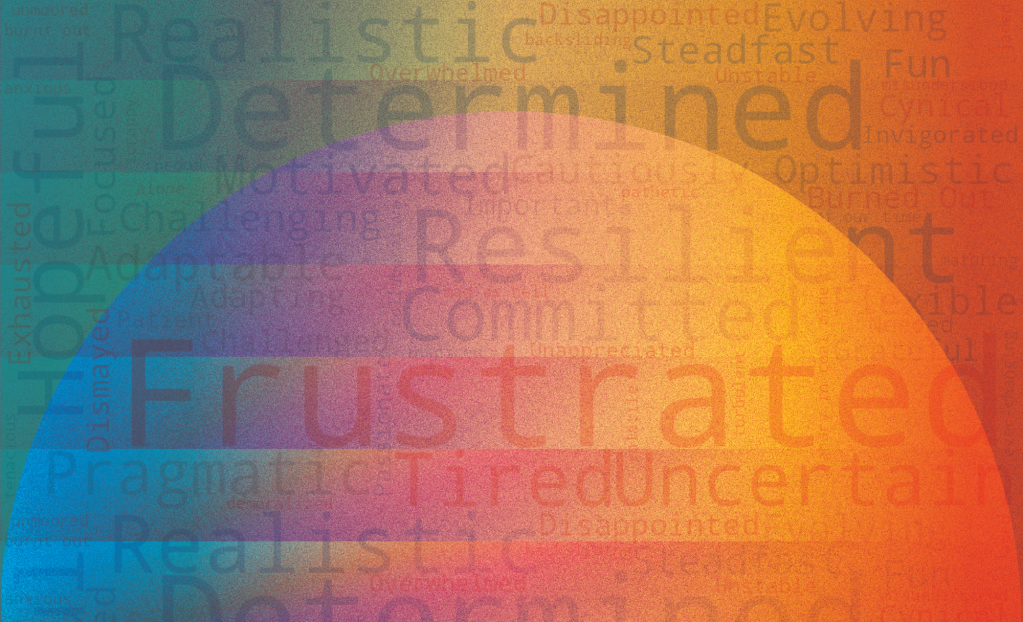
The timing of our conversation was apt. My co-host Solitaire Townsend and I had just been discussing Trellis Group’s new State of the Sustainability Profession report, a biennial snapshot of where the field stands. The picture isn’t at all catastrophic, but it’s sobering. About a quarter of companies have pulled back on sustainability budgets and headcount. Fewer sustainability teams report directly to the CEO than two years ago — down from 30 percent to 18 percent — with more now reporting into finance or legal. The work has become, as Soli put it, more “mechanistic and managerial,” more compliance-based, less visionary.
Into that context, enter Katharine Wilkinson.
Her climate wayfinding program — which preceded the book and has now reached 75 colleges and universities through trained facilitators — grew from her own experience hitting walls within the climate space, seeking places for sense-making and orientation and largely not finding them. What she built was part therapy, part organizational development, part social movement theory. The book distills that into something anyone with a library card can access.
Care, curiosity, courage
At the heart of it is a deceptively simple framework: Look inward with care, outward with curiosity and forward with courage. From that, she argues, we move from overwhelm, isolation and burnout into clarity, connection and purpose. Not through denial or toxic positivity, but through a kind of rigorous emotional honesty that the climate and sustainability communities have generally been too busy — or too professional — to practice.
Wilkinson described the concept of being a “node of possibility.” For a sustainability professional hemmed in by organizational politics, budget cycles and a CEO who has seemingly moved on, what does that even mean?
Her answer: Nodes are, by their nature, connected. There’s no such thing as a solo node. Community building, she argues, is itself a solution — not just a morale booster, but a structural response to the moment.
This isn’t soft stuff. Katharine draws a direct line from the consciousness-raising circles of second-wave feminism to the Quaker meeting houses of the abolitionist movement to the role of the Black church in civil rights. Big, visible victories — legislation, marches, court decisions — always rest on a quieter, more invisible infrastructure of human connection and shared meaning. Her argument is that the climate and sustainability movement has systematically underinvested in that infrastructure, and that the movement’s current down-wave is the time to fix that.
Start with the compass
The challenge, of course, is that most of corporate sustainability runs on fixed maps — targets, timetables, quarterly reviews. Wilkinson’s wayfinding philosophy is explicitly about navigating without a fixed map. Is there a reconciliation there? Her answer is yes — but only if we start with the compass, not the coordinates. Vision and true north come before tactics.
My colleague John Davies, in the latest State of the Sustainability Profession report, wrote that “irritation turns sand into pearls and pressure turns coal into diamonds.” It’s a lovely metaphor for this moment. Katharine Wilkinson is offering something related but distinct: not just resilience, but reimagination. A way to use the fallow time — when fewer people are watching, when the pressure to perform publicly is lower — to do the deeper work that the hectic nature of up-waves never allow.
Head, heart, hands, in that order. One leads to the other.
The Two Steps Forward podcast is available on Spotify, Apple Podcasts, YouTube and other platforms — and via Trellis. Episodes publish every other Tuesday.
Subscribe to Trellis Briefing