Apple’s recycled materials push bears fruit
The company’s switch to low-carbon materials helped it avoid 6 million metric tons in greenhouse gas emissions in 2025. Read More
- Close to a third of the materials in Apple products come from recycled sources.
- The enclosures to Apple Watch Series 11, iPad and MacBook Air rely entirely on recycled aluminum.
- Apple has created several robots to help disassemble its devices and recover rare earth elements, titanium and other materials.
Apple connects its ability to reduce manufacturing emissions with its transition to recycled and renewable materials in its products, and in 2025 it hit a new milestone: More than 30 percent of the components in its mobile phones, computers and devices came from recycled sources, an increase of 6 percent from the prior year.
One of its newest laptops, the MacBook Neo, contains double that amount: 90 percent of the aluminum and 100 percent of the cobalt in its battery come from recycled sources, according to Apple’s 2026 Environmental Progress Report.
For certain materials, including cobalt in Apple-designed batteries and rare earth elements in its magnets, Apple has reached 100 percent recycled content.
The enclosures for Apple Watch Series 11, iPad and MacBook Air rely entirely on recycled aluminum.
Apple has also eliminated plastic from its packaging; all of it now comes from various certified and recycled fiber sources. That move has cut an estimated 15,000 metric tons of plastic.
Apple’s aspirational goal — with no defined end date — is to use 100 percent renewable or recycled materials for all products.
Emissions reduction impact
Apple estimates that the switchover to low-carbon materials, which includes the recycled content, helped the company avoid 6 million metric tons in greenhouse gas (GHG) emissions during 2025.
For context, the company’s overall footprint was 14.5 million metric tons, and 53 percent of that amount came from manufacturing activities. Apple has reduced its overall emissions by more than 60 percent since 2015, holding steady compared with 2024, despite growing its sales.
“Apple is making important progress towards its 2030 carbon neutrality goal, while its revenue has grown by 78 percent over the last decade, a clear message that being environmentally friendly does not impact the bottom line in any way,” said Francisco Jeronimo, vice president with technology research firm IDC.
That’s literally by design. “These incredible results were made possible by years of engineering, design and close collaboration across Apple and our supply chain,” said Sarah Chandler, vice president of environment and supply chain innovation at Apple, in the company’s report.
That work began under Apple’s former environmental lead, Lisa Jackson, who retired in late January after 13 years. Chandler has led that work for the past decade; her team now reports to Apple Chief Operating Officer Sabih Khan.
Robotic assistants
Apple developed its own robotics technology to recover materials from products it collects through its consumer takeback programs.
The “Daisy” robot, introduced in 2018, can disassemble 36 different iPhone models and up to 1.2 million phones annually. The technology is part of Apple’s materials recovery lab in Austin, Texas.
“Dave,” located in China, was created to pull apart the taptic engine in iPhones — the component that makes the devices vibrate — which uses a great deal of rare earth magnets, tungsten and steel.
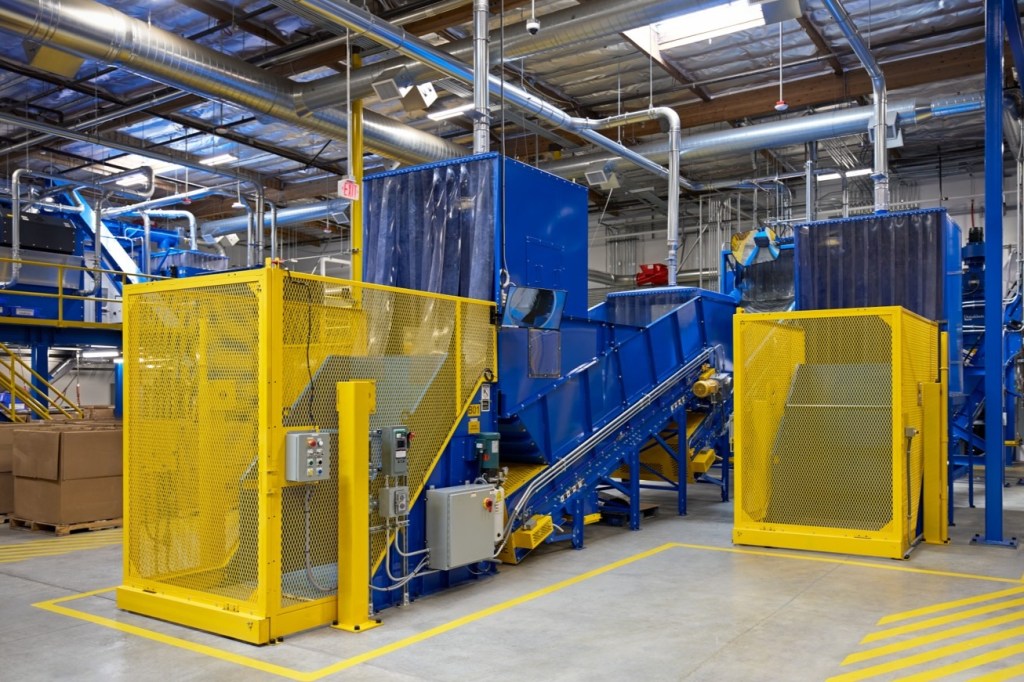
Apple’s latest robot is “Cora,” which is part of an electronics recycling line at the company’s Advanced Recovery Center in Santa Clara Valley, California. It uses new precision-shredding and sensor technology to achieve higher recovery rates. The technology includes an X-ray sorter that identifies materials including titanium, rare earth elements and tungsten by their atomic composition.
“Cora’s smaller footprint makes it more cost effective by leaving more floor space for other activities,” the company wrote in its 2026 environmental progress report.
Apple is also using machine learning as the foundation of another new detection option, called A.R.I.S. (for Automated Recycling Identification System), that runs on the company’s Mac mini computer. The company is encouraging its recycling partners to use the system to recover more materials from the electronic waste they collect.

Subscribe to Trellis Briefing