Closing the intention-action gap: designing habit-ready innovation

Closing the sustainability behavior gap requires designing products and systems that reduce friction and make better habits intuitive and repeatable. Read More
One of the biggest barriers to circularity and climate progress is behavior change. Although most people genuinely want to reduce their environmental impact, the more sustainable choice is often perceived as inconvenient, ineffective or confusing. To close this intention-action gap, companies such as Procter & Gamble are innovating to make products superior and more sustainable.
The reality: Solely designing and marketing a product with a lower environmental impact rarely drives mass appeal. While there is a growing group of eco-conscious consumers willing to accept trade-offs, most are not. Products must be competitive on convenience, time and cost – and adoption stalls with those factors unaddressed.
The business case for circular design also is stronger than ever. In addition to growing consumer engagement, extended producer responsibility (EPR) legislation is expanding across regions. There are more financial incentives to define clear, scalable paths forward to reduce, reuse and recycle. Companies can view EPR not as a risk to mitigate but rather a moment to reimagine how more sustainable, compliant packaging can delight. Doing this requires an understanding of how to drive a positive impact and also pinpoint consumer tensions.
Innovation succeeds when you design for behavior, not just sustainability
Habits will stick when product performance is superior; it makes the behavior easy to start and intuitive to repeat.
Three principles can help companies enable consumers to move from well-meaning intention to lasting action.
1. Focus on product performance to enable sustainable habits.
When a product does not perform as expected, a consumer loses trust. For example, if a dish soap doesn’t work, it takes more time, energy, water and elbow grease to get the job done. This increased time spent in-use drives up the overall emissions profile and drives down consumer satisfaction. Brands must ensure formulations are effective to reduce frustration and wasted resources. It is crucial to understand the full emissions profile of a product and the consumer tensions that impact it.
2. Understand real-world use, then upgrade the design.
Change starts with a deep understanding of how people live and act. For example, P&G created Connected Homes technology, which places smart sensors in the homes of partnered consumers to observe real-time behaviors during everyday routines. The initiative tracks water and energy during product use in real time. These inputs develop quantitative models of how design choices impact small habit changes. Partnered with in-depth interviews, P&G uses consumer pain points to optimize packaging and formulas to reduce time, energy and water. The output: products that improve the experience while reducing unnecessary waste.
3. Reinforce and normalize the behavior.
Communication is an important part of adoption. Education can turn one-time actions into long-term habits. Importantly, the communication hook must highlight the tensions the product solves, not only the sustainable benefit. With the right messaging, the next step is to make the habit seem big and popular to generate a new social norm. A multi-media approach can help, from cues on packaging to TV commercials to influencer content.
Together, these principles point to a shift in designing systems. Here are a few examples of how P&G brought this to life.
Case Study: How Dishwashers Save More Water than Hand Washing
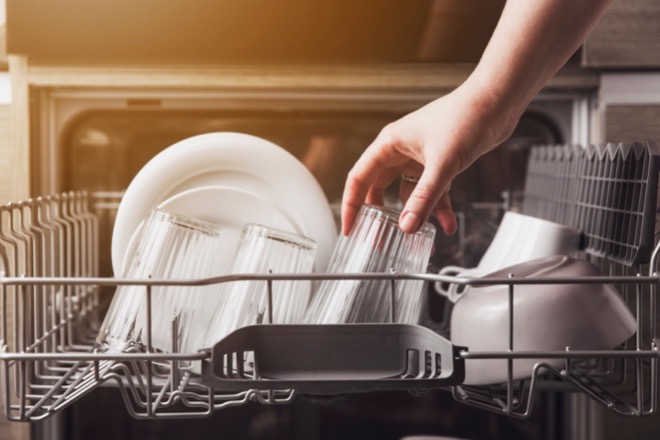
Within the home, one of the most overlooked opportunities for water conservation is the dishwasher. An Energy Star® certified dishwasher can save more than 8,000 gallons of water each year, according to the U.S. Department of Energy. But Cascade found that communicating water savings alone was often not enough to overcome barriers to dishwasher use. That’s because many consumers have previously experienced dishwasher failures, such as stuck-on food, water marks or baked-on grime. If dishes come out dirty, people stop trusting that their dishwasher will get the job done. These failures lead to pre-washing, rewashing or washing everything by hand. The result is more time spent washing dishes and more water and energy (the tap uses on average four gallons every two minutes versus four gallons in an entire Energy Star certified dishwasher cycle).
The opportunity: Design a system that makes the more sustainable behavior a better experience. For dishwashing, that primarily comes down to two enablers:
- Energy and Water Efficient Dishwashers: Advances in technology have reduced water and energy usage by 45% and 25%, respectively, per dishwasher cycle. As dishwashers get more efficient, detergent performance must increase to offset the low water and energy conditions.
- Chemistry: To clean even the dirtiest dishes, the R&D team had to analyze what is on dirty dishes, and which residues result in the most frequent cleaning failures. Through in-home “soil studies” the team analyzed what people were cooking, how they loaded their dishwashers, and where cleaning performance fell short. Those insights informed how formulations should innovate to tackle the hardest-to-clean dishes without requiring any pre-rinsing or rewashing.
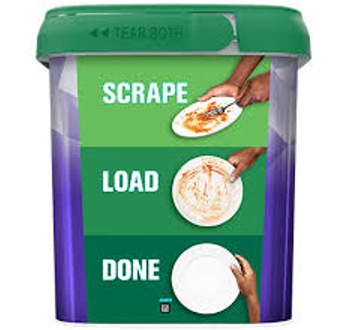
This led to the design of Cascade Platinum Plus, a formulation with improved chemistry designed to clean the toughest jobs. The system was reinforced through on air and on pack communication “Scrape, Load. Done” to cue trust that the dishwasher would get it right without pre-washing or re-washing. This messaging spanned media channels to reinforce the behavior.
Case Study: How to Make Refill and Reuse Work in Everyday Life
Refill and reuse models often struggle because they feel inconvenient, whether they are heavy, messy or require an extra trip to the store. According to the Ellen MacArthur Foundation, there are four primary reuse models designed to drive a more circular economy. Among these is refill-at-home, which Dawn is advancing via two of its products, addressing barriers and making the experience easier and faster.
Dawn EZ Squeeze dish soap helps people easily dose soap with a no-flip, no-mess cap. The packaging team then identified features that could elevate the experience, including a redesigned refill jug with an EZ-pour spout that improves ergonomics and reduces pouring time by 45%. They created a dispenser worth refilling and paired it with a bottle that makes refilling effortless. Dawn jugs make it easy to save money and reduce waste.
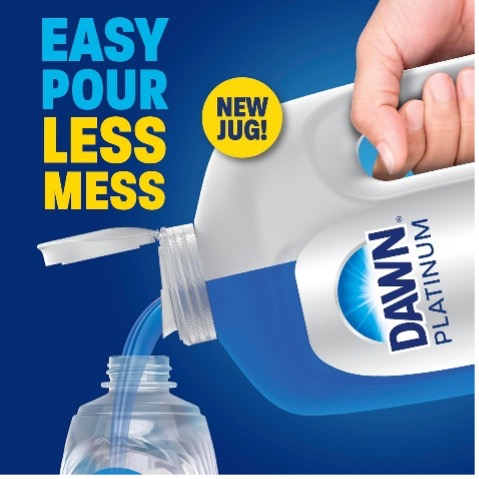
The lesson: Even small improvements can transform the refill experience from something that feels cumbersome into a habit that works better in everyday life.
The same principle applies to Dawn Powerwash, a formulation designed to break down grease significantly faster, requiring less time and water to get the job done. The starter kit-and-recharge model encourages people to reuse the trigger.
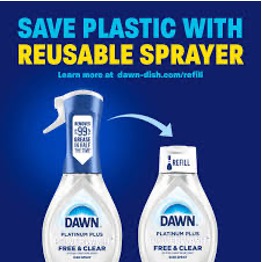
Driving refill and reuse requires reducing the effort needed and increasing the benefit, such as the improved refill experience and lower cost per ounce, offered by the Dawn jugs or Dawn Powerwash recharge packs priced lower than starter packs.
Scaling refill and reuse comes down to both lowering the consumer burden and increasing the value they receive. On Dawn jugs, that means a better experience with improved ergonomics, less mess. and a lower $/ounce. On Powerwash, the friction of pouring is removed altogether with a reusable trigger and reinforced through lower cost refills.
Both are helping drive more sustainable behaviors at the sink, making the refill experience convenient and more appealing. Not only does this drive a reduction in plastic, it removes the friction points that stall behavior change.
A System for Behavior Change
This is an opportunity for sustainability professionals to continue to think in systems: designing formulas that work with packaging that reduces consumer tensions in the home. By eliminating trade-offs, it becomes easier to reduce, reuse and recycle.
But this is just one piece of the puzzle. Lasting progress is built on well-designed products that fit within a broader network supporting their use. It takes an ecosystem of retailers, appliance makers and NGOs to build trust. When that support is in place, behavior change becomes much easier to sustain.