New framework goes beyond emissions to score corporate climate action
How would your company rate on the Climate Contribution Framework? Read More
- In addition to footprint reduction, the Climate Contribution Framework rates companies on sales and financing of climate solutions.
- To reduce the burden on companies that use it, the new framework builds on existing standards.
- Investors can use the framework to compare the climate performance of companies in the same sector.
The most consistent complaint levelled against existing frameworks for assessing corporate progress on climate? They’re too narrowly focused on emissions, say critics. Meanwhile, other important actions, such as scaling sales of low-carbon products, go unrecognized.
These frustrations have prompted a flurry of alternative approaches. One of the most detailed and best developed is the Climate Contribution Framework (CCF), launched last November by Sweep, a sustainability data platform; and the Mirova Research Center, which studies sustainable finance. The aims, say the creators, include rewarding action that doesn’t show up in emissions inventories, enabling comparisons between companies in the same sector and creating a “meta-framework” that integrates multiple performance standards.
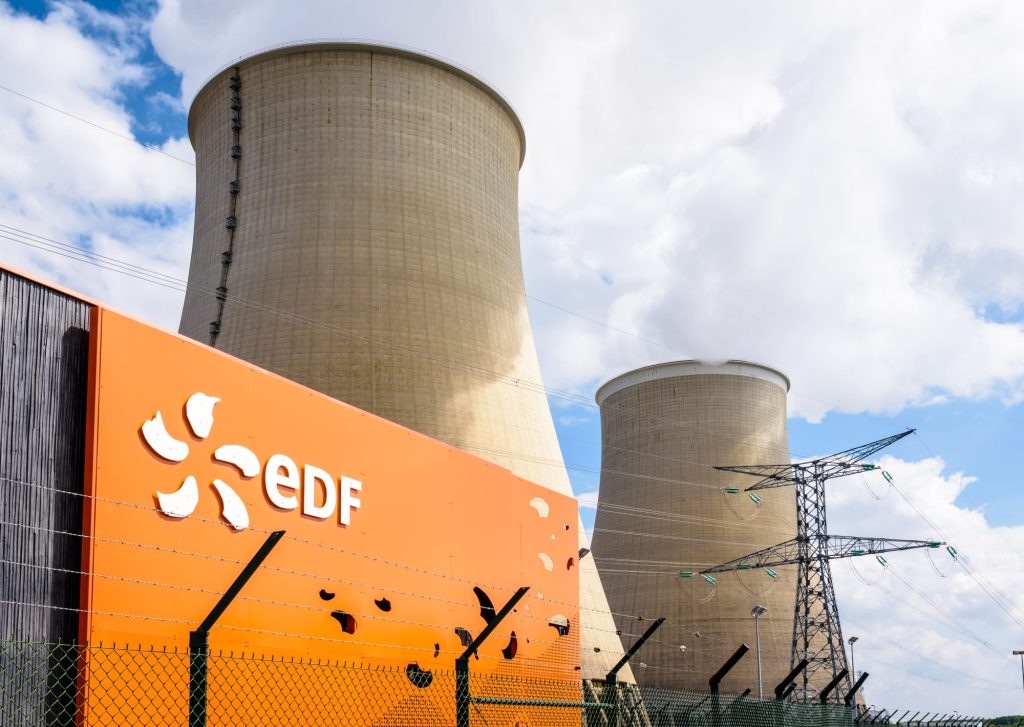
Trellis spoke with Alexandre Marty, head of climate and natural resources at French utility EDF, one of the piloting companies, to discover how his employer earned a 73 percent score.
How the scores are assembled
CCF scores are built from three pillars, each of which is scored on a 0-100 scale:
- Pillar A: Carbon Footprint Reduction. Includes cuts made to date, the ambition of future targets and the robustness of plans to achieve those goals.
- Pillar B: Climate Solutions. Recognizes the impact of heat pumps, wind turbines and other products sold by the company.
- Pillar C: Climate Financing. Encompasses support for solutions beyond the company’s value chain, including carbon credits.
The scores for each pillar are combined into a single number using weights specific to the sector the business operates in. Cement manufacturers, for example, would receive higher weightings for footprint reduction because of the companies’ substantial operational emissions. Whereas the financing pillar might be emphasized for a bank, reflecting its capacity to support climate action in other areas of the economy.
For more details on the pillars, scoring system and underlying methodology, see the framework’s white paper.
What the process was like for EDF
Because businesses complain of being overwhelmed with requests for sustainability data, the authors of the framework tried to minimize the additional reporting burden by basing each of the pillars on existing assessments and standards.
“We didn’t want to be a standard that just came and said ‘we’re going to try to supplant everyone else’,” said Brad Schallert, director of sustainability services at Winrock International, a project developer that helped create the CCF methodology.
As a power-sector company, the footprint pillar dominates the weighting used to determine EDF’s overall score. Some of the data for this pillar was pulled from an assessment of the company’s targets carried out by the Transition Pathway Initiative, an organization that helps investors understand how companies are transitioning to a low-carbon economy. Information on EDF’s policy engagement, another component of the same pillar, came from an analysis carried out by the World Benchmarking Alliance, a nonprofit that tracks the sustainability progress of 2,000 leading companies.
The CCF also awards companies an overall “Contribution Performance” rating based on the pillar scores and the potential of the sector as a whole to contribute to climate mitigation.
EDF’s results
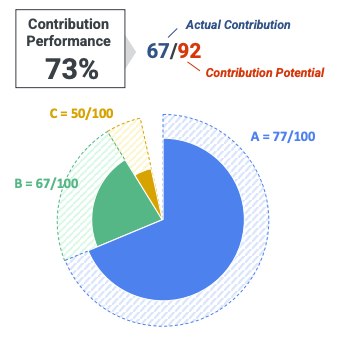
Marty estimated it took him a few days to assemble the necessary data. “It’s not that cumbersome,” he said.
“It’s going to guide us in improving what we do to calculate and promote avoided emissions associated with our climate solutions,” he added. “Because you can see here that we don’t score very well.”
The CCF was attractive to EDF in part because it recognizes the progress the company has already made on reducing emissions. Ninety-five percent of the electricity generated by the company comes from low-carbon sources, with nuclear making up almost 80 percent of the total. As a consequence, it can be challenging for the company to achieve additional reductions on the same scale as other companies, as some other frameworks require. “We simply can’t do that,” said Marty.
What’s next for the framework
Scores for other companies piloting the framework, including Renault and Schneider Electric, are due to be released next month. To enable more comparisons, the CCF team is also considering using public data to score companies that haven’t opted in.
The backers of the framework hope that investors will pay attention to the results, and that companies will be incentivized to improve scores and surpass rivals. “Companies could start to look at this and base decisions off it,” said Schallert.

Subscribe to Trellis Briefing