100,000s of tons of emissions are missing from automakers’ disclosures, think tank says
Almost every manufacturer included in Carbon Tracker's study is said to have undercounted vehicle-use emissions. Read More
- Faulty assumptions about lifetime miles driven are causing automakers to underestimate one category of Scope 3 emissions.
- Actual emissions from the category are on average 33 percent higher, said the nonprofit.
- The gaps mean investors may be underestimating transition risks in the sector.
Major automakers are significantly understating the emissions generated by the vehicles they sell, according to research from Carbon Tracker, a financial think tank.
The discrepancy between manufacturers’ figures and Carbon Tracker’s estimates, researchers said, is the result of “unrealistic” assumptions about lifetime use of vehicles and other modeling parameters.
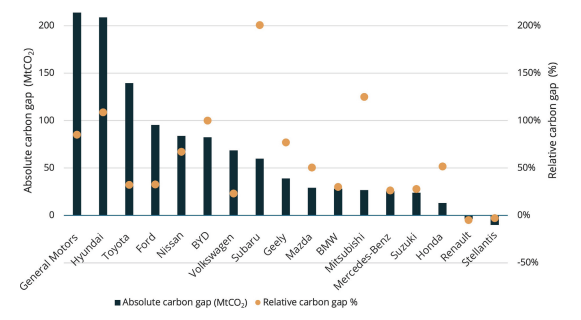
This creates a “Carbon Gap” between reported emissions from the use of sold products — Category 11 of Scope 3, which typically accounts for around four-fifths of an automaker’s total emissions — and what the think tank said are its more accurate numbers:
- The relative gap between reported 2024 emissions and the Carbon Tracker estimates is greatest for Subaru, which the researchers found is responsible for three times more vehicle-use emissions than the company published.
- General Motors, which has a higher sales volume than Subaru, has the largest absolute gap between reported and actual emissions — more than 200 million metric tons of carbon dioxide, 85 percent of its published total.
- Ford and Toyota have gaps of around 33 percent — average for the 18 companies in the study.
Absolute and relative “Carbon Gaps“
Assumptions about lifetime miles driven is the primary reason for the gap. In Subaru’s case, Carbon Tracker said the company uses an estimate based on its domestic Japanese market even though around 70 percent of its sales are in the U.S., where lifetime milage is greater.
Real-world use of plug-in hybrids also skews the data. Industry tests assume these vehicles run on battery power more often than is actually the case: The researchers cited a study of 800,000 European vehicles that found five times more emissions than industry numbers suggested.
A Ford spokesperson said the company’s assumptions are consistent with best practices for Scope 3, Category 11 reporting, and are publicly disclosed. Subaru, GM and Toyota declined to comment.
“For the investor, absolute Scope 3 Category 11 totals cannot be taken at face value,” the researchers wrote. The Carbon Gap is not an accounting nuance, they added. Rather, it represents “material financial risk,” from additional exposure to carbon pricing mechanisms and the mispricing of long-term risks in the transition to a low-carbon economy.

Subscribe to Trellis Briefing