Gucci maker Kering’s long-time focus on materials innovation pays off
The fashion company’s steady adoption of recycled materials and fibers sourced through regenerative is chipping away at emissions. Read More
- Kering’s chief sustainability officer has been on the job since 2012, providing strategic longevity.
- The fashion company has published an annual environmental profit and loss statement since 2014.
- Central purchasing programs across brands started with gold and are extending into leather.
Kering, the $14.5 billion French luxury company behind Gucci, Saint Laurent and Bottega Veneta, has reduced its absolute greenhouse gas emissions by one-third since 2022.
That includes a 4 percent decrease for direct operations and electricity, and a 28 percent cut for emissions related to land and agriculture, Kering reported in its impact report published in June.
Crucial to this progress: a multi-year push to embrace recycled materials ranging from leather to plastic to precious metals alongside a transition to fibers sourced through regenerative agriculture.
This work is guided by insights from Kering’s environmental profit and loss (EP&L) accounting system, which catalogs its impacts on nature, including emissions, water use, waste, land use and pollution. The annual EP&L statement was created in 2014 to guide and prioritize decarbonization decisions. For example, raw materials production and processing account for 63 percent of its emissions; manufacturing contributes another 8 percent. Hence the deep focus on these levers.
“Governance is key because if sustainability is not at the right level, and you don’t have the right governance to manage sustainability, it’s only a word because the real sustainability is really to change the business model and continue to develop our business for the long run,” said Marie-Claire Daveu, chief sustainability and institutional affairs officer at Kering.
Daveu is one of the longest-tenured corporate sustainability leaders in any industry, hired in 2012 after a stint in the French government. She reports to Kering CEO Luca de Meo.
Centralized purchasing
Kering employs individuals fully dedicated to sustainability strategy, but each brand has its own champions to reflect individual priorities. That said, the company is coordinating purchases across groups to scale alternative materials.
For example, Kering has used a central purchasing program since 2017 to buy gold that is either certified as recycled or from artisanal mines recognized for Fairtrade or Fairmined practices.
Similarly, it launched the Kering Accelerator for Regenerative Materials in 2024 to scale purchases of cotton, wool and cashmere sourced from land cultivated using regenerative farming practices.
Kering pre-reserves orders for these fibers, which gives growers more economic stability. The program has improved traceability: Kering can trace at least 98 percent of these materials back to their country of origin. A similar program for leather is being launched this year.
Low-carbon and recycled materials
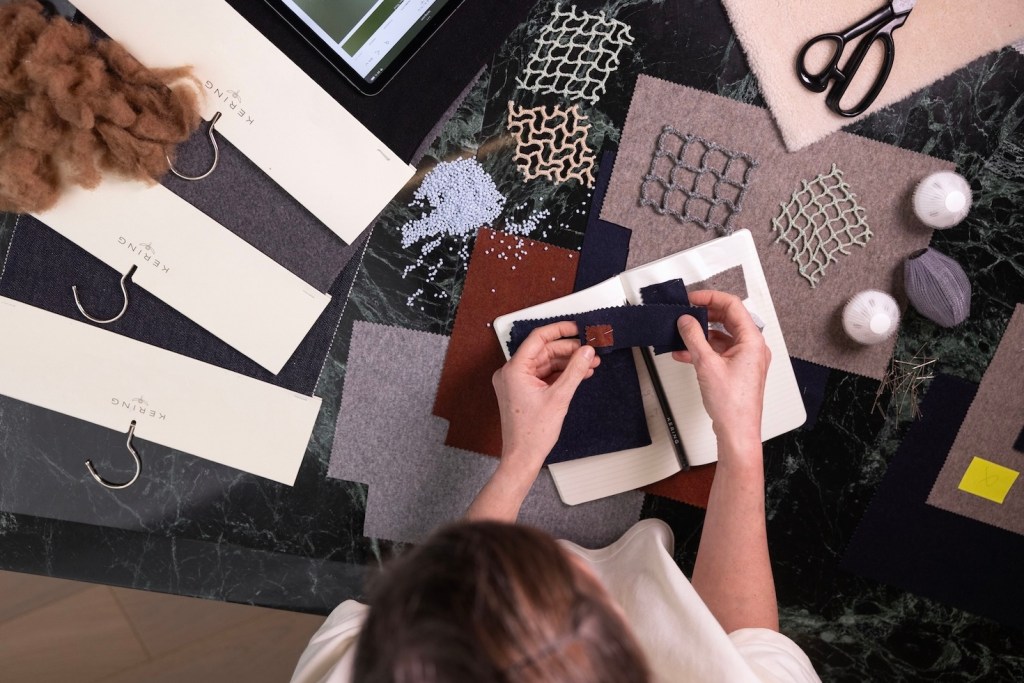
Kering uses both a corporate-level and brand-centric approach to embracing innovations that lower the emissions of its products. The company’s Material Innovation Lab in Milan, for example, has identified more than 600 manufacturers that provide lower-impact options for designers to use, according to Kering.
Kering Ventures, launched in 2019, is the company’s vehicle for investing in potential new suppliers. Two examples are VitroLabs and Sqim, which are pioneering alternatives to leather sourced from animals.
University collaborations are also instrumental for scaling research and for encouraging next-generation designers to view recycled or previously used materials as a canvas for innovation, Daveu said.
Kering has helped develop curriculum for institutions including HEC Paris, London College of Fashion, Parsons School of Design, National University of Singapore and Tsinghua University, among others.
Circular future
Like many other fashion houses, Kering encourages resale of its products through certified marketplaces. It owns a 5 percent stake in Vestiaire Collective, which specializes in luxury goods.
“When you restart a new life for products, we think it’s a good example of where sustainability and luxury go hand in hand,” Daveu said. “It’s not only an environmental topic. It’s a social advantage because you can sell quality products to younger people, to a generation that may not be able to buy new products.”
Gucci has taken the lead in Kering’s work related to materials reuse through its “Circular Hub” in Tuscany in Italy. Its goal is to promote shared research, facilitate the development of new supply chains and logistics networks, and train designers and industrial partners to embrace these principles at the beginning of a product’s life cycle.
For example, Kering encourages designers to think about how to construct new products so they can be disassembled or repaired more easily. If materials are damaged during that process, they’re harder to reuse in a luxury product.
“It’s very important to be sure that designers understand how much it’s key, and that they don’t see sustainability as a constraint but more as a way to stimulate creativity,” Daveu said.

Subscribe to Trellis Briefing