How FedEx’s CSO engineers sustainability into long-term strategy
Karen Blanks Ellis reports to the logistics giant’s legal team and her sustainability impact team includes representatives across every business function. Read More
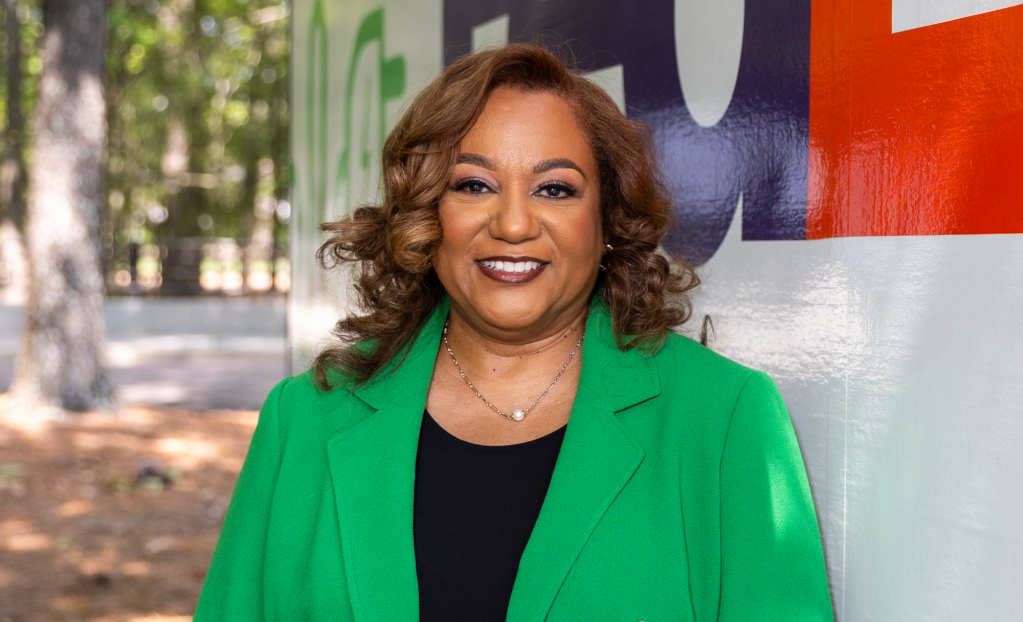
- Karen Blanks Ellis, trained as a chemical engineer, joined FedEx in 1997 and was named CSO two years ago.
- In 2025, FedEx cut 1.1 million metric tons of carbon dioxide equivalent (mtCO2e) and saved $264 million by retiring old aircraft.
- The carrier met its 2025 goal to transition at least half of new PUD vehicle purchases to electric models but is reassessing its 2030 pledge
FedEx has significantly expanded its purchases of unblended sustainable aviation fuel (SAF) with contracts to buy more than 20 million gallons for use at five major U.S. airports in California, Florida, New Jersey, New York and Texas through 2027.
The deal, announced Sept. 15, marks another big step toward the shipping and logistics giant’s goal to source at least 30 percent of its jet fuel from non-fossil-fuel sources by 2030. FedEx, which reported $83 billion in sales for 2025, is starting to blend SAF with traditional jet fuel to reduce emissions across its fleet of nearly 700 aircraft to reach that milestone.
FedEx signed its first SAF deals in mid-2025. The new agreements represent quadruple that amount. “We want SAF, and we want more of it,” said Karen Blanks Ellis, chief sustainability officer and vice president of environmental affairs at FedEx, during the latest episode of the Trellis Climate Pioneers interview series. (The interview happened before the deals were disclosed.)
Right now, current SAF production approaches can’t guarantee enough supply to produce the volumes that FedEx needs. “We need some innovative thinking around feedstocks,” she said.
Ellis, trained as a chemical engineer, joined FedEx in 1997 and was named CSO two years ago to replace the company’s first CSO, who retired. Her boss is the deputy general counsel, who reports to the FedEx executive vice president and general counsel, part of the executive committee.
“Over the last couple of decades, most of our work, most of our commitments, most of our goals have been voluntary, but these days a lot of work is subject to regulatory schemes,” Ellis said. “Our close relationship embedded inside of legal really helps us to effectively and efficiently get the counsel that we need and works really well to make sure we protect the interests of the company.”
Delivered results
While SAF is critical for the future, fleet modernization has been the most important lever in FedEx’s 15 percent reduction in operational emissions since 2021, Ellis told Trellis.
In 2025, the company cut 1.1 million metric tons of carbon dioxide equivalent (mtCO2e) and saved $264 million by retiring old aircraft. Fuel Sense, a 10-year-old efficiency program that leans heavily on route optimization, has helped the logistics network cut almost 1 billion in jet fuel consumption, which translates into 9.7 million mtCO2e in avoided emissions.
“In terms of efficiency, we’re going to have fewer unnecessary miles, fewer touches, lower fuel usage, better asset utilization,” Ellis said. “All of that will serve to lower our costs, to give our customers better service and, at the end of the day, we are definitely expecting to have lower emissions.”
FedEx’s direct emissions from fleets and operations were 14 million mtCO2e for fiscal year 2025, while the footprint from purchased fuel and electricity was 953,000 mtCO2e, according to the FedEx 2026 corporate responsibility report.
These two categories — Scope 1 and Scope 2 — account for 46 percent and 3 percent of the company’s overall footprint, respectively. Since 2009, FedEx has cut Scope 1 and Scope 2 emissions intensity by 60 percent, while growing daily package volume by more than 124 percent, the company reported.
FedEx makes sure business customers can interpret these emissions reductions in the context of their own business through its FedEx Sustainability Insights reports, which provide estimated emissions data for certain shipments. It’s pushing for more transparency, at a time when other companies have become more cautious, because it makes commercial sense.
“I’m a pragmatist, but progress and pragmatism, they really have to go together,” Ellis said. “There’s been a lot of change at the government level, change with the expectations of our customers, and we have to make progress despite these shifts. But we have to be pragmatic about how we do it.”
Ground control
FedEx’s ability to continue driving reductions year-over-year relies on close orchestration across the company, making individual teams accountable for results. Ellis’s key allies are part of the sustainability impact team, which represents all functions.
“They are executing the plans in the various operational areas, and the reason why this governance structure works is that it’s very intentional,” she said. “We have never thought that sustainability should be relegated to one department.”
That’s important as market dynamics change, as is the case for FedEx’s long-term strategy to better integrate its enterprise ground operations, called Network 2.0. That will result in a consolidation of its 200,000 vehicle fleet, which includes pick-up and delivery (PUD) vans, long-haul trucks and airport ground equipment.
FedEx met its 2025 goal to transition at least half of new PUD vehicle purchases to electric models — and owns approximately 9,500 on-road and off-road electric vehicles, but it’s reassessing “the pace” of its pledge to reach 100 percent of new orders by 2030.
This is a practical decision: FedEx doesn’t want to build out charging infrastructure to accommodate vehicles that might eventually be eliminated. Battery technologies are also evolving quickly, especially for larger vehicles. In December 2025, FedEx invested in Harbinger, a startup that makes medium-size hybrid and electric delivery vans.
FedEx remains committed to a long-term goal to operate an all-electric pickup and delivery fleet by 2040. “The journey might look a little different than what we anticipated five years ago, but we will still get there,” Ellis said. “The pace may be different. The tactics may also be different, but we’ll get there.”

Subscribe to Trellis Briefing