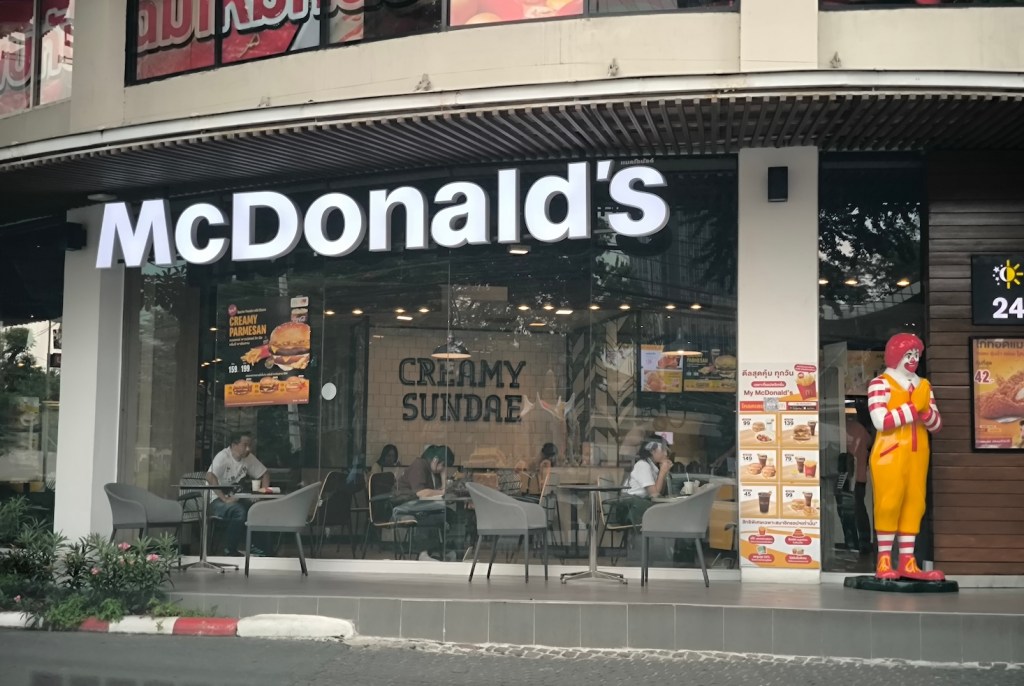
McDonald’s warns it will miss 2030 emissions goal, in frank disclosure
The fast-food chain is on track to surpass emissions cuts for operations and electricity, plans $1 billion investment in supply chain resilience. Read More
- The company doesn’t plan to revise its net zero by 2050 goal.
- Its disclosure is rare at a time when others are mum about their corporate sustainability plans.
- McDonald’s will invest $1 billion in supply chain resilience over the next decade.
McDonald’s doesn’t expect to reach its science-based target to halve the industrial and energy emissions from its vast supply chain and global franchise network by 2030.
Its statement to that effect was signed by Chief Supply Chain Officer Warren Anderson and Chief Global Impact Officer Jon Banner.
The two cited issues outside the company’s control including geopolitics, fragile global supply chains and slow clean energy deployment in certain regions.
“Meaningful progress requires systemic change across industries, infrastructure and policy, and cannot rest on the actions of one brand alone,” they wrote in a blog posted to the McDonald’s newsroom. “That means progress on Scope 3 emissions will be shaped not just by what McDonald’s does but also by how quickly the world around us changes.”
McDonald’s 2025 purpose and impact report from last September hinted toward the potential for delays in delivering on its 2030 target, citing a long list of systemic factors that it says make progress on indirect and supply chain emissions difficult, notably the complex network of relationships with franchisees; some are managed centrally while others have regional accountability or are handled through alternative licensing arrangements.
“When we made our commitment, there was an understanding that broader industry action and investment would move at a similar pace and that the regulatory environment would motivate others where needed,” McDonald’s Chief Sustainability Officer Beth Hart told Trellis. “That hasn’t happened at the scale we all expected — and against a multitude of other challenges none of us could have predicted.”
McDonald’s stands by its commitment to reach net zero by 2050, Hart said. More details will be forthcoming this summer in the company’s next purpose and impact report, after its latest greenhouse gas emissions inventories are validated.
“As we’ve been working through our most recent data for 2025, we’ve gained a clearer view of both our progress and the challenges ahead — particularly the risk to delivery of Scope 3,” Hart said. “We felt it was important to share that perspective now.”
Super-sized footprint
McDonald’s is on track to surpass the emissions-cut pledge for the combined emissions of its operations and electricity, which was validated by the Science Based Targets initiative in 2023 and calls for a combined 50.4 percent cut by 2030, according to the statement. But that’s only a tiny fraction of its emissions liability.
The footprint from McDonald’s beef and agricultural purchases, as well as industrial and energy activities that support its franchise relationships, account for almost all of the company’s greenhouse gas emissions; those are counted as part of the Scope 3 category, as defined by the Greenhouse Gas Protocol.
The company has reduced its Scope 3 footprint by about 3 percent since a baseline year of 2018, according to the September 2025 edition of the McDonald’s Purpose and Impact Report, but that won’t be enough to achieve its pledged 50.4 percent cut by 2030. McDonald’s has also made a separate pledge to reduce its forest, land and agriculture footprint by 16 percent by 2030; it didn’t provide a separate update for that category in its 2025 report.
McDonald’s revelation echoes the argument made by food and beverage giant PepsiCo, when it downgraded its sustainability targets in May 2025, blaming policy headwinds and the hefty price tag of low-carbon technologies such as electric vehicles.
“We can advocate, we can collaborate, we can work to try and move forward, but there’s only so much that we can do,” PepsiCo Chief Sustainability Officer Jim Andrew told Trellis.
Packaging commitment update
In its statement, McDonald’s also said it substantially achieved its goal to source 100 percent of its packaging from renewable, recyclable or certified sources by 2030.
The company hit 95.8 percent by the end of 2025, but global regulations that make recycled and renewable content more affordable are needed, according to the blog by Anderson and Banner.
“Without this, our continued investment in more sustainable packaging innovations and our franchisees’ ability to maintain affordable pricing for customers may be at risk,” they wrote.
$1 billion investment
To re-energize its 2050 net-zero target despite the 2030 miss, McDonald’s plans to spend at least $1 billion over the next decade on measures aimed at making its supply chain more resilient. Some of these investments are already under way, Hart said.
That includes regenerative agriculture programs for commodities that represent the largest part of the fast-food chain’s footprint: beef, soy, palm oil, coffee and fiber (for food packaging).
That refrain is familiar: McDonald’s has for more than a decade advocated programs for decreasing emissions associated with raising cattle. In September 2025, for example, it dedicated $200 million to support regenerative grazing and wildlife conservation on ranches covering more than 4 million acres.

Subscribe to Trellis Briefing