Sustainability pays a credibility tax. Some of it is self-imposed
Sustainability isn’t seen like other parts of the business. But there are things you can do, starting with not making it worse. Read More

- Sustainability investments often fail to get funding, even when there’s no overt pushback.
- Many common habits of sustainability professionals make the “credibility hole” deeper.
- To start, don’t use soft or generic value claims and don’t tell people you can’t measure sustainability’s benefits.
The opinions expressed here by Trellis expert contributors are their own, not those of Trellis or its editors.
A recent article in Harvard Business Review discussed sustainability investments that don’t get approved, even when “heads nod” and “there is no pushback.” The authors, who include Ann Tracy, the CSO of Colgate-Palmolive, and Steven Goldbach, who heads Deloitte’s U.S. sustainability practice, discuss the need to better demonstrate the ways sustainability creates value.
This has been my focus for more than 25 years, so unsurprisingly I agree.
But there’s something else that must be said: Sustainability starts with a credibility deficit compared to finance, operations, investor relations and other corporate functions. And too many common habits make it deeper.
Starting from behind
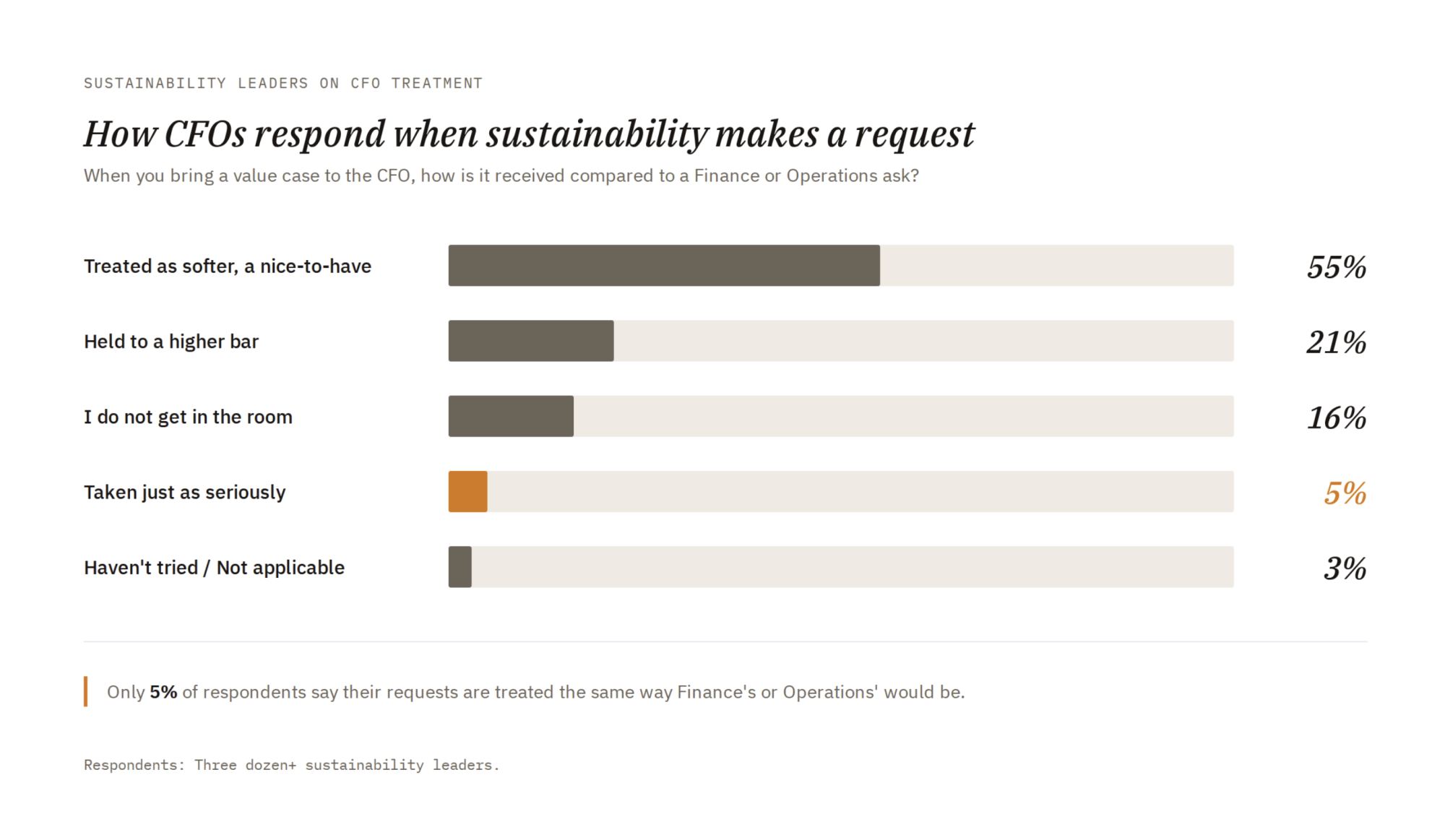
In the past two months, I’ve talked to sustainability leaders from many different organizations. Out of more than three dozen, the vast majority reported that requests for sustainability investments are not treated the same way as requests by finance or operations.
Only 5 percent of the leaders said that sustainability requests are treated equally, while more than half (55 percent) said sustainability investments were considered fluffy or “nice to have,” and more than one-fifth (21 percent) said they were held to a higher standard.
In fact, 16 percent of sustainability professionals said they don’t even get in the room with the CFO.
Other perspectives
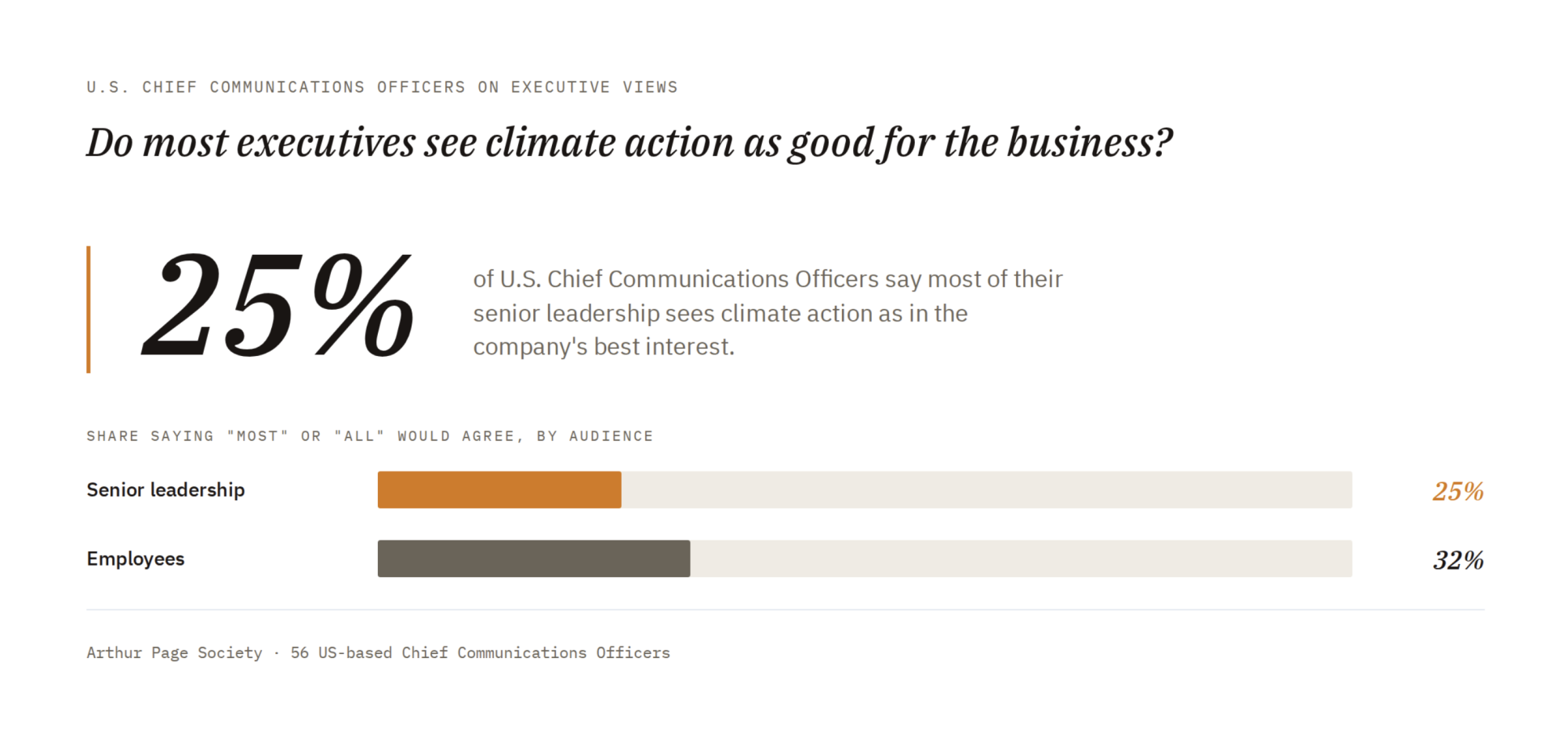
Other professionals see this too. When the Arthur Page Society asked 56 US-based chief communications officers whether most of their executives thought that climate action was “in the best interest” of the organization, only one-quarter of them said yes. (When they asked all employees the same question, 32 percent said yes.) This is part of the problem: If executives don’t buy the value initially, CSOs face a tougher road in convincing them.
It’s fair to wonder if this is only the subjective perception of sustainability and communications professionals. Is there objective data we can use to determine how sustainability is seen inside companies?
At Valutus we decided to tackle this question. We set out to determine whether sustainability professionals have equal business prominence compared to top execs from other areas of corporations.
Unequal billing
We looked at 200 top global companies and examined whether they listed their head of sustainability as part of the “About Us” page on their websites, as they do with their other top executives. The results were clear: 100 percent of the companies listed the CFO on the page; 85 percent listed the chief legal officer.
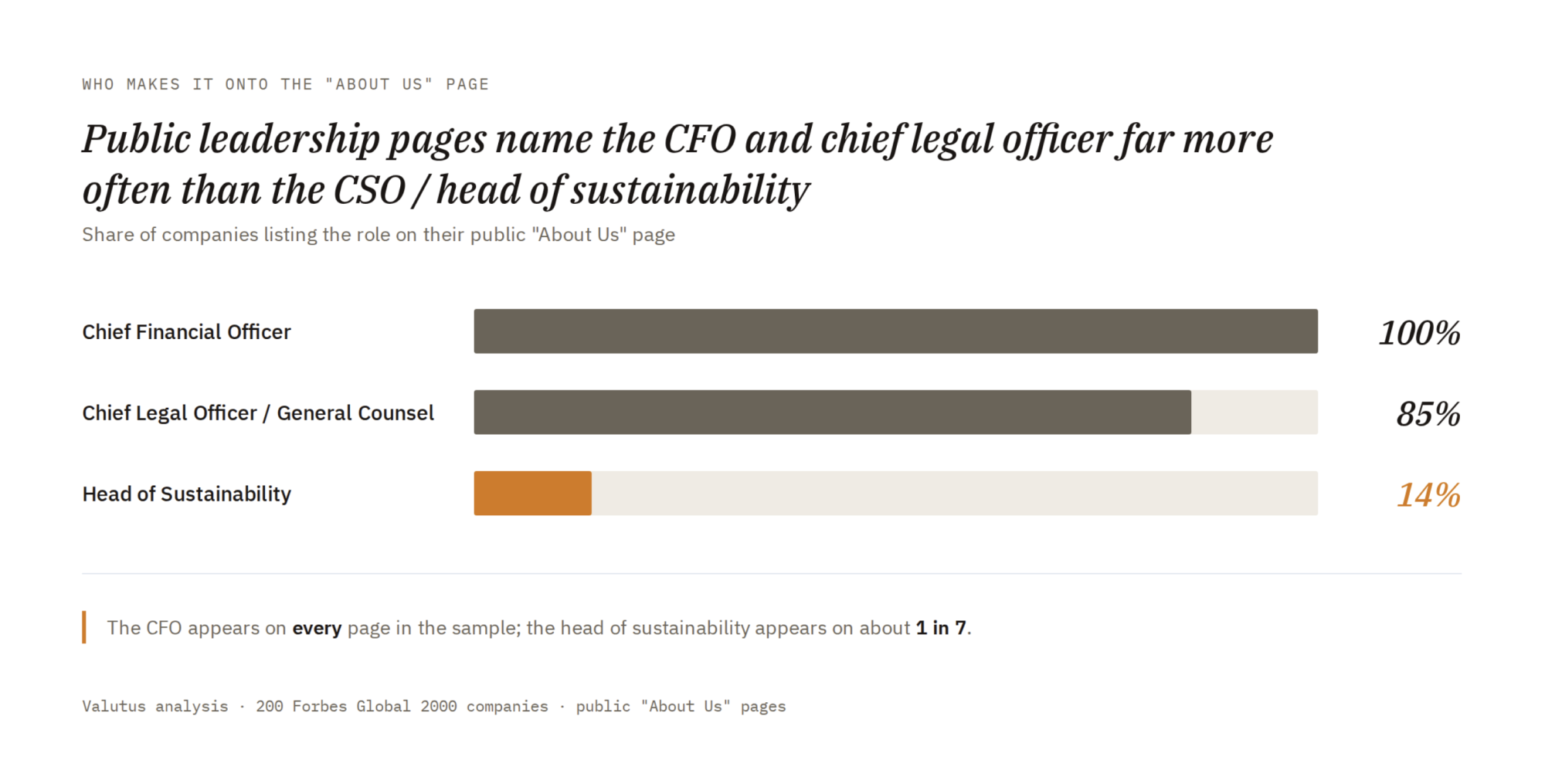
Only 14 percent listed the head of sustainability.
This also raises the question: Is sustainability special or are all non-revenue generating parts of the business seen this way? Legal doesn’t generate revenue, but the head of the legal function is more than six times more likely to be listed among the company’s top management.
What you can do
Some of this perception of sustainability is beyond your control, the result of previous failures or ingrained perceptions. But some of it you can change, especially by avoiding four things that hurt your credibility.
Words vs. action: First, don’t make it seem like you don’t know the difference between what people say and what they do. Reporting survey answers as if they were actual choice data is a good way to ruin your credibility.
A survey from a well-known sustainability organization said some consumers are willing to pay 9.7 percent more for sustainable goods. But this was only what people said in a survey.
Everyone knows that what people tell survey takers is not necessarily the same as what they actually do. (In fact, the original survey being cited pointed out that intent and action are not the same.) Not acknowledging this is credibility kryptonite.
Avoid self-deprecation: Second, don’t downplay or disown the sustainability function itself. Framing your own job as one the company should eventually not need is something no CFO or CTO does.
As Yalmaz Siddiqui, Disney’s sustainability lead, told Heather Clancy at GreenBiz 26: “The storyline that companies don’t need a CSO devalues the unique expertise … sustainability professionals bring.”
Be precise: Third, don’t use vague or mealy-mouthed language. Don’t say “companies can use sustainability to increase resource efficiency.” This is true in many cases, but it lacks concreteness (How exactly? When?). If you say something like that without those details, it damages your credibility.
Instead, use concrete language, such as: “Insurance premiums are rising. It’s harder to predict seasons, meaning the right goods aren’t always in stock at the right time. Both trace back to climate-related shifts in weather patterns.”
Prioritize measurement: Fourth, don’t tell people that you are incapable of measuring sustainability’s benefits. Millions of managers grew up hearing “if you can’t measure it, you can’t manage it.” Saying that you can’t measure immediately makes people suspect you can’t manage, either.
Unfortunately, some sustainability professionals still say just that. Saying “it just costs more” and “you may not be able to prove the financial benefits” is not something the rest of the business would do. Saying this to an executive who equates the ability to measure with the ability to manage immediately downgrades your influence.
False beliefs and the false zero
The belief that sustainability’s benefits are unmeasurable is not only damaging, it’s also false. A $20 billion apparel company compared suppliers with strong wage practices and those without and found the differences in attrition, work stoppages and on-time delivery (even using conservative numbers) were substantially more than the cost of the higher wages.
Had the benefits remained unmeasured, as MIT management professor John Sterman points out, they would have been given the value of zero: the one value they couldn’t have.
It’s unfair, but sustainability is still stuck paying a credibility tax. But the amount is within your control. Start by changing the things that make it worse.

Subscribe to Trellis Briefing