We’re good at counting embodied carbon. But do we know which reductions are worth it?

A framework for evaluating embodied carbon reductions by cost helps builders make smarter, more impactful decarbonization decisions. Read More
We know more about embodied carbon today than ever before. Thanks to the widespread adoption of Environmental Product Declarations (EPDs) and life cycle assessments (LCAs), the building industry has become increasingly proficient at measuring the carbon footprint of its materials. Scope 3 reporting is advancing from spend-based to activity-based data using carbon numbers more reflective of the building materials used. This progress has fundamentally changed the conversation around sustainable construction. But as embodied carbon reporting becomes standard practice, a new question has emerged:
Are we making better decisions because of it?
In our view, the building industry’s next challenge isn’t just collecting more carbon data, it’s becoming more adept at using it.
We call this carbon fluency: the ability to understand carbon reduction opportunities in context — evaluating not only how much carbon can be reduced, but what it costs to achieve those reductions, and whether that represents an effective use of resources relative to other available options.
From Measuring Carbon to Reducing It
Over the past five years, embodied carbon conversations have matured significantly. What began as requests for EPDs has evolved into broader discussions about reducing the climate impacts of building materials. That’s real progress.
At the same time, we’ve observed an important gap. Measuring carbon and managing carbon are not the same thing.
A carbon number without context is simply a number. By itself, it doesn’t tell decision-makers whether one option is better than another, whether the reduction justifies the investment or whether scarce resources are being directed toward the highest-impact opportunities.
Without a common framework for evaluating tradeoffs, organizations often struggle to understand whether the cost of a carbon reduction is high, low or somewhere in between. Conversations about green premiums and decarbonization investments can quickly become subjective because there is no shared reference point for evaluating the value delivered by each carbon-reduction opportunity. Understanding whether the opportunity delivers reductions at a competitive cost is what enables better decision-making.
Carbon Fluency Changes the Conversation
Carbon fluency borrows from a language all businesses understand: finance.
Companies don’t evaluate investments using a single metric. They consider the matrix of cost, return, risk and long-term value before deciding where to allocate capital. Sustainability decisions should be equally dynamic.
Instead of asking only how many tons of carbon can be eliminated, organizations should also ask if the cost is reasonable for the reduction provided.
That shift, from measuring carbon to putting cost per ton reduced in context, creates a far more practical framework for comparing decarbonization strategies and selecting the most effective. Rather than debating whether a lower-carbon product carries a 5% or 10% “green premium,” decision-makers can evaluate whether that investment actually makes sense relative to its cost.
Rightsizing Costs
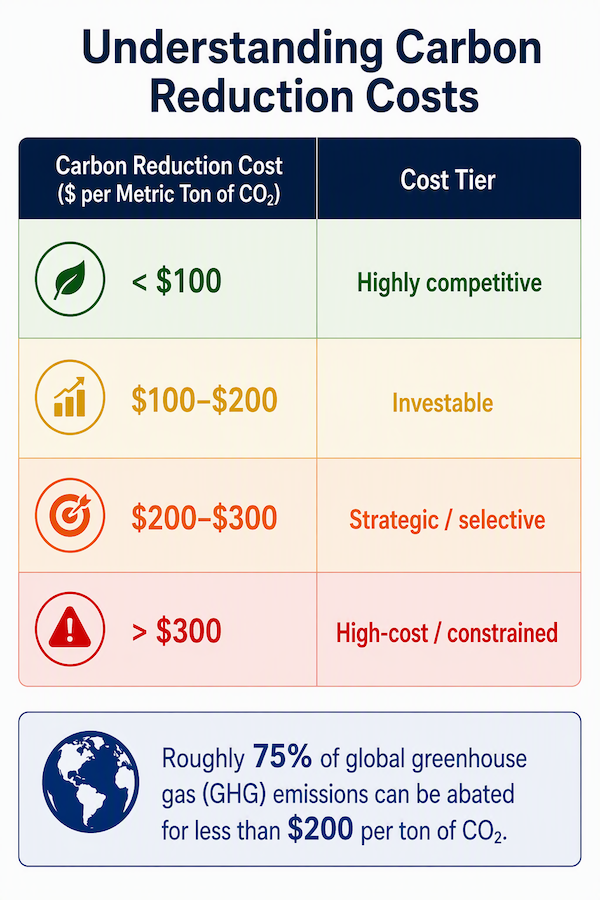
Carbon fluency requires context. Knowing that a lower-carbon solution costs $100, $200 or $300 per metric ton of CO2 reduced is only useful if decision-makers understand whether those figures are relatively competitive or expensive. Just as business leaders develop an intuition for what constitutes an attractive return on investment, carbon-fluent organizations develop a practical understanding of the economics of carbon reduction.
One useful reference point comes from broader decarbonization analyses — for example, this Goldman Sachs report, which suggest that roughly 75% of global greenhouse gas emissions can be abated for less than approximately $200 per metric ton of CO2. Viewed through that lens, carbon-reduction opportunities below $100 per ton may be considered highly competitive, reductions in the $100-$200 range may be broadly investable, while opportunities above $300 per ton often warrant more selective evaluation depending on strategic objectives, customer requirements or the availability of alternatives.
Writing Carbon Fluency into Law
One of the first major U.S. policies focused specifically on embodied carbon in building materials, California’s AB 2446 establishes a goal of reducing embodied carbon from new construction by 40% by 2035 while recognizing the importance of limiting cost impacts.
The concept of limiting cost impacts is where carbon fluency comes into play. Let’s assume that we have a goal to achieve the targeted 40% embodied carbon reduction while limiting the increase in materials cost to 5%. Does the 5% make sense? We can apply the cost per ton guidance above to answer this question.
Here’s what carbon fluency looks like in action, considering a simplified example. A typical 2,500-square-foot home may contain roughly 50 metric tons of embodied carbon and approximately $200,000 in building material costs. Achieving a 40% reduction means eliminating about 20 metric tons of carbon.
If those reductions cost $100 per metric ton, the additional investment is approximately $2,000, or about 1% of the material budget. At $300 per metric ton, that premium grows to about 3%. In both cases, the additional investment required is below the 5% materials cost that we were aiming for. For this simplified example, carbon fluency teaches us that a 5% materials premium does make sense to achieve the amount of carbon targeted for reduction.
This simple exercise illustrates why cost per ton matters. Instead of evaluating products solely on carbon intensity or upfront cost, builders can compare different strategies based on the carbon reductions they deliver for each dollar invested.
Carbon Fluency in the Field
Mattamy Homes, an early leader in embodied carbon measurement and reduction, views sustainability as both an environmental responsibility and a business opportunity.
“Our commitment to sustainability is rooted in a simple belief: We have a responsibility to protect the environment and a more sustainable home is ultimately a better-built home,” says Matt Byington, Sustainability Manager at Mattamy Homes.
To prioritize investments, Mattamy uses a framework it calls Return on Invested Carbon (ROIC) an approach that evaluates how much carbon reduction is achieved for every dollar invested.
“We aren’t simply chasing the largest carbon reductions,” Byington says. “We’re looking for the most effective and scalable ones.”
That philosophy recognizes that the most valuable solution is not always the one with the lowest carbon footprint. Often, the greatest overall climate benefit comes from practical improvements that can be deployed across thousands of homes.
Mattamy has found that optimizing material use, reducing waste, simplifying design details and collaborating with suppliers on lower-carbon products can deliver meaningful emissions reductions while maintaining performance and affordability.
The company also believes collaboration accelerates progress. “We don’t view sustainability as something to be guarded,” Byington says. “We actively share our findings, lessons learned and best practices because we want the entire homebuilding industry to move forward. The climate challenge is too large for any one company to solve alone.”
Looking Ahead
The building industry has made tremendous progress in measuring embodied carbon. The next challenge is developing the context to evaluate carbon reductions with the same rigor applied to any other investment decision.
Success will depend not only on reporting emissions, but on determining whether an embodied carbon-reduction opportunity represents a highly competitive investment, an investible opportunity or a relatively expensive pathway to the same outcome. Carbon fluency provides that context.
Carbon fluency doesn’t make decarbonization cheaper. It makes decarbonization smarter.
As the industry continues its transition toward lower-carbon buildings, we believe carbon fluency will become an essential capability for manufacturers, builders, designers and policymakers alike. The future isn’t simply about measuring carbon more accurately, it’s about developing the judgment to make better decisions with the information we already have.

Subscribe to Trellis Briefing

Shawn Hunter