Inside Workday’s second round of science-based targets
The new goals include the enterprise software company’s first absolute emissions reduction commitments for operations and purchased electricity. Read More
- Workday fell short of its pledge to help 70 percent of its suppliers, based on spending relationships, adopt emissions reduction commitments.
- It will continue to match its electricity consumption with renewable energy through 2031, a goal it has met for the past six years.
- Workday expects AI vendors to start providing more emissions data and is teaming up with other software firms to encourage deeper transparency.
Enterprise software firm Workday has adopted fresh greenhouse gas (GHG) emissions reduction commitments across most of its carbon footprint after meeting two of three pledges it made in 2020.
The new near-term targets call for the company to cut absolute GHG emissions for its operations and electricity use — Scope 1 and Scope 2 — by 42 percent by fiscal year 2031, compared with a 2025 baseline.
Workday has also pledged to continue matching power consumption at its office buildings and data centers with renewable energy through 2031 and to reduce the footprint for purchased goods and services, capital expenditures and business travel by 52 percent per dollar by 2031.
Hard realities
The new goals, validated by the Science Based Targets initiative and tied to the company’s 2031 fiscal year, build on lessons learned over the past five years — including how hard it can be to influence the behavior of suppliers.
That was the one place Workday fell short over the past five years with its first set of publicly declared science-based targets it set in the 2020 timeframe.
It had pledged to help 70 percent of its suppliers, based on spending relationships, adopt their own emissions reduction commitments. At the end of its 2026 fiscal year, though, 24 percent of the relevant Workday suppliers had set targets, slightly less than the previous year.
“Some organizations aren’t ready, and they were clear with us about that,” said Workday Chief Sustainability Officer Erik Hansen.
Workday delivered on its other two initial pledges. It has matched the electricity consumption of its offices and data centers for the past six fiscal years, and reduced the absolute emissions related to business travel by 31 percent, beating its goal of 25 percent.
Achieving the latter commitment required encouraging Workday employees to fly only when essential and investing in certificates for sustainable aviation fuel, alongside close to 20 other corporate buyers, fuel providers and airlines.
“This first cycle of science-based targets taught us that true corporate sustainability cannot exist in a silo,” Workday said in its 2026 global impact report. “Achieving ambitious targets requires continuous deep stakeholder buy-in across every department — from global real estate and procurement to product engineering and finance.”
Workday has established an internal price on carbon emissions, which it uses to allocate related investment costs aimed at mitigating them. It plans to steadily increase that price over the next few years.
The company opted to set new targets largely because sustainability is integral to its core values of integrity and customer service, and the company has customers that expect commitment. “We knew we had to refresh our goals,” Hansen said.
‘Actionable’ decarbonization
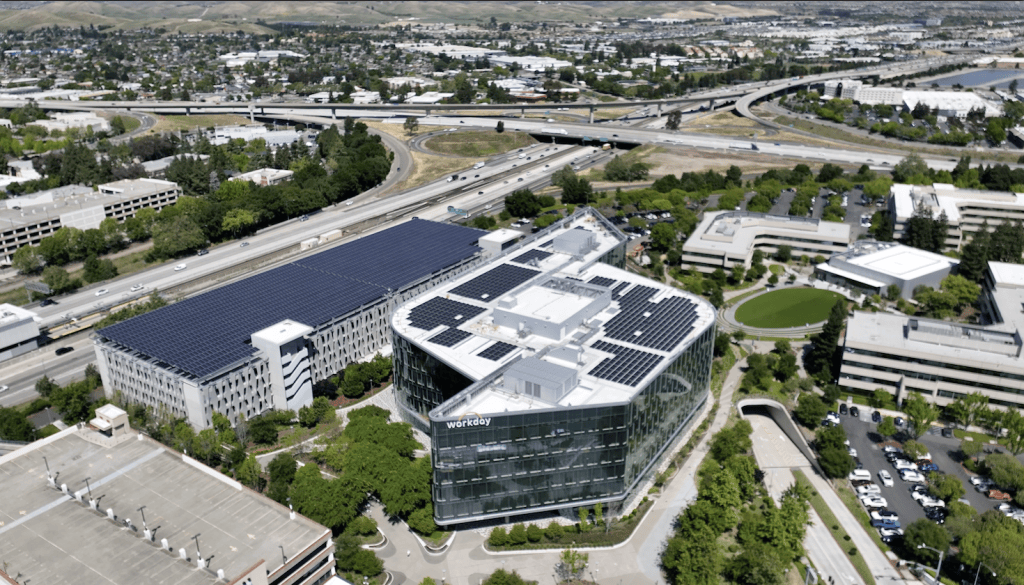
Building electrification and the elimination of natural gas at Workday offices are two strategies the company will use to address its new Scope 1 and 2 reduction pledges. It will also continue its investments in on-site solar and energy storage.
Although Workday fell short of its Scope 3 pledge, its dialogues with close business partners, including cloud services providers Google and Amazon Web Services, laid the groundwork for the new intensity-based targets related to its three biggest Scope 3 categories, Hansen said.
Workday routinely requests emissions data as part of contracts, a step that will be a “linchpin” for identifying places where the footprint can be reduced.
For example, its analysis of cloud infrastructure uncovered places where it was buying too much capacity. By “rightsizing” those services, it significantly reduced the energy its software uses. It also optimized code for its applications, so that it processes more quickly, and moved to more efficient infrastructure.
In 2025, these measures helped Workday cut 5,000 metric tons of carbon dioxide equivalent (MT CO2e) and saved millions of dollars.
Workday reported 335,490 MT CO2e in emissions for 2026; its data center and cloud footprint was roughly one-third of the total.
It expects its artificial intelligence vendors to start providing more emissions information and is teaming up with other software companies to encourage deeper transparency from AI model developers. “We need to engage with the AI ecosystem more fulsomely,” Hansen said.
Workday is taming its AI-related footprint by choosing “carbon-conscious” foundational models and prioritizing data architectures that eliminate unnecessary computing overhead. For example, the company uses Gemini as the default AI model for its own agentic AI platform, Sana, based on Google’s 24/7 carbon-free electricity commitment.
“It’s our job to hold them accountable to their targets,” he said, referring to Google and Workday’s other AI and cloud computing partners.

Subscribe to Trellis Briefing