9 must-read books for sustainability pros (2026 edition)
Another set of titles that deserve a place on your shelf. Read More
In 1962, marine biologist Rachel Carson published “Silent Spring,” her meticulously documented case against the indiscriminate use of pesticides. The book is widely credited with helping to catalyze the modern environmental movement, and its central insight — that ecological systems are interconnected in ways industry routinely ignores — still underpins the way sustainability professionals think about their work.
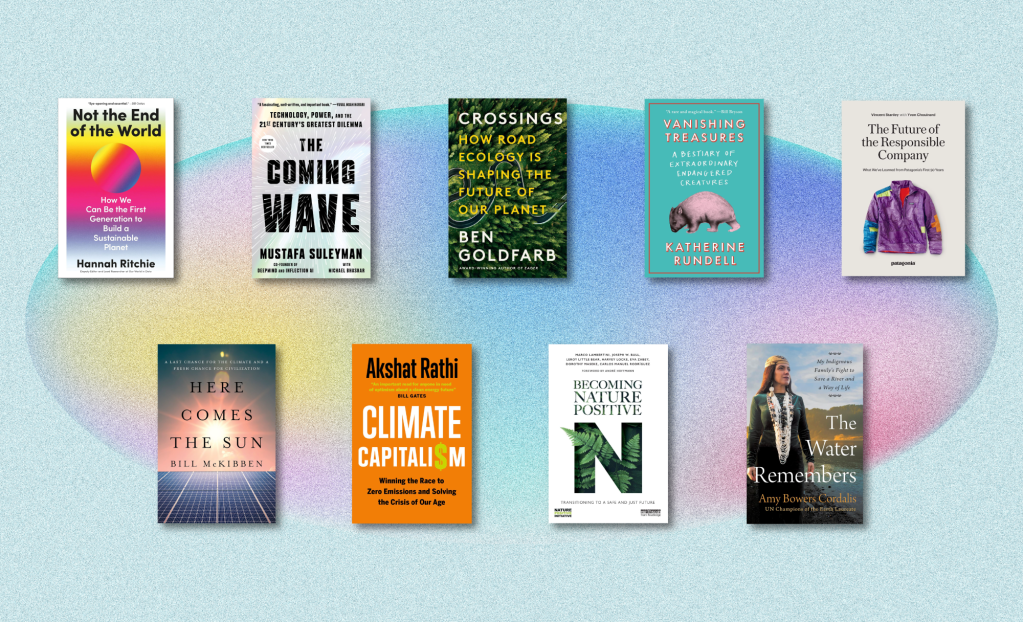
The sustainability canon (writ large) has grown considerably since then, expanding well beyond ecology to include artificial intelligence, corporate governance and more. Here are nine recent books on topics of relevance to sustainability professionals.
‘Not the End of the World: How We Can Be the First Generation to Build a Sustainable Planet’
By Hannah Ritchie
Published in 2024, this book comes from Ritchie’s perch as deputy editor and former head of research at Our World in Data and senior researcher at Oxford’s Martin Programme for Global Development. Drawing on data across seven major environmental problems — air pollution, climate change, deforestation, food systems, biodiversity, ocean plastics and overfishing — Ritchie challenges both climate doomism and complacency, arguing that the numbers show real, if incomplete, progress. Bill Gates called the book “eye-opening and essential.” It’s a useful model for professionals navigating a polarized public conversation about how bad, or good, things really are.
‘The Coming Wave: Technology, Power, and the Twenty-first Century’s Greatest Dilemma’
By Mustafa Suleyman and Michael Bhaskar
DeepMind co-founder and current Microsoft AI CEO Mustafa Suleyman teamed up with writer and publisher Michael Bhaskar for this 2023 book, which introduces what the authors call “the containment problem” — the challenge of maintaining control over powerful, fast-proliferating technologies like AI and synthetic biology. It’s an increasingly relevant read for sustainability leaders confronting AI’s ballooning energy and water footprint from data centers, even as the same technology promises breakthroughs in materials science and grid optimization.
‘Crossings: How Road Ecology Is Shaping the Future of Our Planet’
By Ben Goldfarb
Named a best book of 2023 by the New York Times, this work makes the case that roads are among the most underappreciated forces reshaping the planet. Goldfarb, an environmental journalist, reports from around the globe to show how the roughly 40 million miles of roadway on earth fragment habitats, sever migration routes and contribute to what he calls an “insect apocalypse,” while also profiling the road ecologists building wildlife crossings and other fixes. Though its lens is ecological rather than corporate, the book offers sustainability professionals a fresh angle on biodiversity and land-use decisions.
‘Vanishing Treasures: A Bestiary of Extraordinary Endangered Creatures’
By Katherine Rundell
Published in 2024, this book pairs Rundell’s scholarly background in Renaissance literature with a naturalist’s eye for wonder, devoting 23 illustrated essays to endangered animals from seahorses to golden moles. Rundell has said humanity now resembles “Noah’s Ark in reverse,” having lost more than half of the world’s wild animal populations in the past 50 years. It’s a lighter, more playful entry than most sustainability reading lists offer, but the argument that people protect what they find magical, not just what they’re told is at risk, is worth thinking about.
‘The Future of the Responsible Company: What We’ve Learned from Patagonia’s First 50 Years’
By Vincent Stanley and Yvon Chouinard
This 2023 update to 2012’s “The Responsible Company” arrives a year after Patagonia’s founder made headlines by transferring all of the company’s stock to a purpose trust and a nonprofit so that, in the authors’ words, the earth is now its only shareholder. Stanley, who has been with Patagonia since 1973 and serves as its “director of philosophy,” pairs that governance story with practical guidance on cutting environmental footprints, building durable products, mapping supply chains and earning the trust of workers and communities.
‘Becoming Nature Positive’
By Marco Lambertini, Joseph W. Bull, Leroy Little Bear, Harvey Locke, Eva Zabey, Dorothy Maseke and Carlos Manuel Rodríguez
This multi-author book, released as an open-access title in 2025, brings together voices from the Nature Positive Initiative, Business for Nature, the Global Environment Facility and Blackfoot scholarship to define what a “nature positive” economy actually requires. Chapters move from the science of biodiversity loss through the practical mechanics of nature-positive business strategy, finance and governance, aiming to turn what has become a popular but loosely defined corporate buzzword into something measurable. For sustainability professionals under pressure to set nature-related targets alongside carbon goals, it’s one of the more rigorous attempts to translate “nature positive” from slogan to strategy.
‘Climate Capitalism: Winning the Race to Zero Emissions and Solving the Crisis of Our Age’
By Akshat Rathi
Published in 2024 by a Bloomberg Green senior reporter and “Zero” podcast host, “Climate Capitalism” argues that the clean energy transition has quietly become one of the great business opportunities of the era. Rather than dwelling on the case against capitalism made by earlier climate authors, Rathi travels across five continents to profile bureaucrats, engineers and executives bending the emissions curve, from a Chinese official who helped mainstream electric vehicles to an American oil executive pursuing carbon removal. His summary of the shift is blunt: It’s now cheaper to save the world than to destroy it. For sustainability leaders trying to make the business case for climate investment internally, it’s a useful supply of real-world proof points.
‘Here Comes the Sun: A Last Chance for the Climate and a Fresh Chance for Civilization‘
By Bill McKibben
McKibben’s 21st book, published last year, arrives nearly four decades after he began writing about climate change in his 1989 debut “The End of Nature.” Where much of his earlier work leaned toward what he’s called his own “dark realism,” this volume is built around a genuinely optimistic economic fact: Solar and wind power crossed below fossil fuels on cost in the early 2020s, and by 2024 more than 92 percent of new electricity capacity added worldwide came from renewables. McKibben backs that arc with ground-level reporting, noting how citizens in Pakistan installed enough rooftop solar in a single year to cover a third of the national grid, and how California nearly halved its natural gas use in two years — while also tracking the fossil fuel industry’s fight to slow the shift down.
‘The Water Remembers: My Indigenous Family’s Fight to Save a River and a Way of Life’
By Amy Bowers Cordalis
This 2025 memoir comes from a Yurok attorney who became general counsel for her tribe and helped lead the largest dam removal and river restoration project in U.S. history, on California and Oregon’s Klamath River. Cordalis traces nearly two centuries of her family’s fight to protect the Klamath and its salmon, from a great-uncle’s landmark Supreme Court case affirming the Yurok Nation’s water and fishing rights to the catastrophic 2002 fish kill that pushed her into law and, eventually, into the coalition that convinced regulators to tear out four dams and reopen hundreds of miles of the river. For sustainability professionals accustomed to thinking about “stakeholder engagement,” it’s a firsthand account of what long-term, generational advocacy actually looks like.
Subscribe to Trellis Briefing