Simplifying the sustainability certification ecosystem
For many professionals, it can take a year or more to learn a new language for carbon inventories. Read More

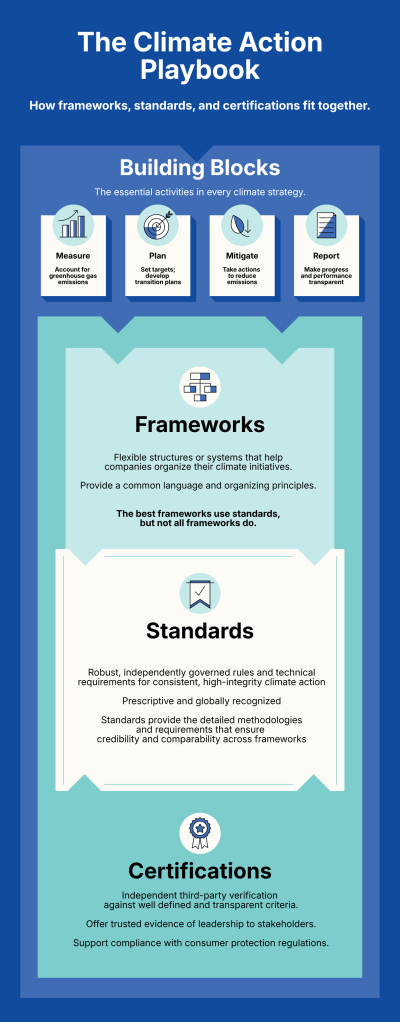
- Every corporate climate strategy is built from four universal building blocks: measurement, planning, mitigation, and reporting, all of which a high-integrity strategy must cover.
- Frameworks and standards add prescriptive guidance, narrowing the range of approaches. The best are transparently administered, independently managed and regularly updated.
- Certifications go a step further, providing independent third-party validation that a company’s actions meet a given standard.
The opinions expressed here by Trellis expert contributors are their own, not those of Trellis.
The quest to decarbonize is the most fundamental mission of corporate sustainability, but its language can be confusing. When the same term means different things to different companies, or even different teams within one company, work often gets duplicated or misses the mark. Worse, it can lead to legal battles and challenges from critics. The result is wasted hours, increased costs and reputational damage that a clearer map could have prevented.
In my most recent column for Trellis, I offered methods to choose from the array of hundreds of sustainability certifications that are available globally. Here I’ll dig into the details of the subset of climate certifications, to make the complexities easier to navigate for anyone who is creating, updating or critiquing a climate strategy.
The building blocks
All corporate climate initiatives rest on four building blocks: measurement of greenhouse gas (GHG) emissions, planning for the climate transition, mitigation of climate impacts and reporting on actions and outcomes.
Use these building blocks to size up any climate strategy, whether it’s tied to a product, brand, building, farm or other entity. It’s critical to understand the specifics, which vary considerably. Planning, for example, may include modeling, risk assessment, creating a climate budget or other activities. Mitigation may take place in supply chains, through carbon offsets, sustainable fuels purchases or other measures.
Frameworks and standards
The building blocks may be assembled in countless ways. Frameworks and standards add prescriptive guidance, addressing that variability with structure and norms. Some frameworks lay out best practices for one building block, such as the planning frameworks offered by Quantis and the Environmental Defense Fund. Others, such as the Exponential Business Playbook, cover all four blocks.
Many corporations create tailored frameworks that fit their business priorities. In its Climate Transition Action Plan, Adidas lays out an end-to-end framework for measurement, planning, mitigation and reporting, focusing on materials, suppliers’ use of clean energy and product end-of-life management. Nike’s “Move to Zero” initiative focuses on mitigation through the use of clean energy and circular materials, and is aligned with the company’s commitment to a science-based target.
Across sectors: standards
While frameworks can be subjective and used only by the individual company, standards are developed for wide-scale use across multiple sectors, and are designed to be models of high-integrity action.
The best frameworks incorporate widely accepted standards. The newly formed Purpose Pledge, a framework for natural products companies spearheaded by Dr. Bronner’s, lays out 10 principles for corporate responsibility that incorporates numerous standards such as Regenerative Organic, TRUE Zero Waste and The Climate Label certification.
Standards including the well-known GHG Protocol, the newer AIM Platform Standard and many other climate and nature standards, represent the combined views of hundreds of stakeholders and are transparently administered by independent nonprofit entities.
The landscape continues to evolve quickly. Standards are regularly updated through consultative processes, as is happening now with the GHG Protocol and ISO. Environmental NGOs frequently lay out new frameworks and technical support to accelerate decarbonization progress. Last year, for example, the ITPN framework created a new standard for climate transition planning within the public and private sectors.
The proof: certifications
The final layer is the one that validates organizational actions: Certifications offer credibility through independent third-party verification of adherence to a framework or standard. Certifications enhance stakeholder trust by demonstrating that actions meet a high bar for performance and are tracked over time. Certifications can also help clear compliance hurdles when actions are required by a law or regulation. For example, the EU’s new Empowering Consumers Directive requires certain marketing statements to be certified by a third party before companies can tout them.
The best product- or entity-level certifications cover all four building blocks and lean on third-party standards for the underlying requirements — for example, by requiring GHG measurement to meet ISO-14064 guidelines and mitigation projects to meet Green-e standards.
The key: consistency
Frameworks and standards evolve to meet changing realities, but the risk of this constant realignment is that companies spend a lot of time adjusting yesterday’s plan to today’s framework, chasing moving goalposts rather than scoring goals. Continual change can also make it confusing for stakeholders to evaluate a company’s actions.
For many sustainability teams, it can take a year or more to learn a new language for carbon inventories. That timeline can be cut by spending money on external support — money that most sustainability teams lack.
Here are some simple rules to help keep the bar high and the pieces straight:
Mitigation is the North Star. The climate is ultimately affected by one thing: greenhouse gas concentrations in the atmosphere. Mitigation is the only building block that tackles this, and it is critical to have clear metrics on the resources going into it and the results coming out. No strategy is complete without a clear approach to mitigation activities.
Don’t get stuck. It’s common for measurement to become a barrier to subsequent actions — or an excuse for inaction. Look for comprehensive data, but use estimates and ranges, and acknowledge the imprecision.
Re-use and recycle. There are countless frameworks and many peer-reviewed standards. Resist the urge to build from scratch; instead, adapt existing models. The best ones are designed to be flexible, so that you can easily apply them to your business. The result will come together faster and be more credible.
Define your outcomes. Clearly define key results and outcomes and make them accessible to both internal and external stakeholders. Report regularly on your progress toward achieving those outcomes. Use standards and frameworks to decide what to report.
Look for overlap. To avoid redundant work, link your outcomes to their building blocks and see where you can reuse the underlying data, reports and metrics. For example, a GHG inventory used for CSRD reporting should count toward most standards and certifications.
Know your audience. The choice of how to communicate your company’s climate actions depends on whom you’re speaking to. Regulatory compliance is a different use case from consumer marketing or employee engagement. One key to success is knowing how much information to convey: Too little information may lead to non-compliance or greenwashing. Too much can overwhelm your audience. Certifications can help by giving you a simple, high-level badge, backed by data and documentation.
Organize your work and draw a clear map of gaps and overlaps in your strategy. Use certifications as a means to offer stakeholders independent proof of action, avoid greenwashing accusations and maintain credibility.

Subscribe to Trellis Briefing