When food meets fiber: How companies can boost paper-based packaging recyclability
Paper recyclers are unwilling to accept any more food contamination than they’re already handling. Read More
- Most recyclers agree that contamination right now is a minor issue.
- But recyclers aren’t willing to accept any more food residue than they’re already seeing.
- Companies can help build alignment on food residue thresholds, clarify on-pack language to limit confusion and support consumer education.
The opinions expressed here by Trellis expert contributors are their own, not those of Trellis or its editors.
I’ve got five senses, but somehow none of them feel sufficient for understanding when my peanut butter jar is clean enough to be recycled. And I’m not alone: As long as people have been recycling, they’ve been wondering, “How clean is clean enough?” Can this pizza box get recycled with grease on it? Will my takeout tikka masala container make it to its next life?
These are valid questions. The municipal collection programs taking our recycling have long communicated that packaging needs to be food-free and close to dry before recycling it. Packaging without food residue helps the people sorting recyclables at material recovery facilities minimize problems with odors, pests, sortation equipment or — worse yet — contamination that prevents sorted materials from being sold to or used by recyclers.
Right now, there’s no consensus around what percent of recycled paper packaging gets tossed due to contamination. But we know that food residue can be problematic for recycling. Just how problematic is it for paper-based food packaging? And when can we call a package clean enough?
As consumer preference for paper-based packaging continues to rise, a new study from the Sustainable Packaging Coalition (SPC) investigates the issues created by food residue on recyclable paper packaging — and how the industry can minimize residue to keep valuable materials in circulation.
Grease not bits
We interviewed dozens of recyclers to determine their tolerance for food residue and found some good news. Most paper recycling facilities only see food residue as a minor issue — hurray for scraping your paper takeout containers! But most recyclers are at capacity: None of the recyclers interviewed in the study are open to receiving any more food residue than they’re already seeing.
Because food residue can be difficult for paper recyclers to define and quantitatively measure, we have to rely on qualitative indicators and definitions that help illustrate the level at which food residue becomes a disqualifying issue.
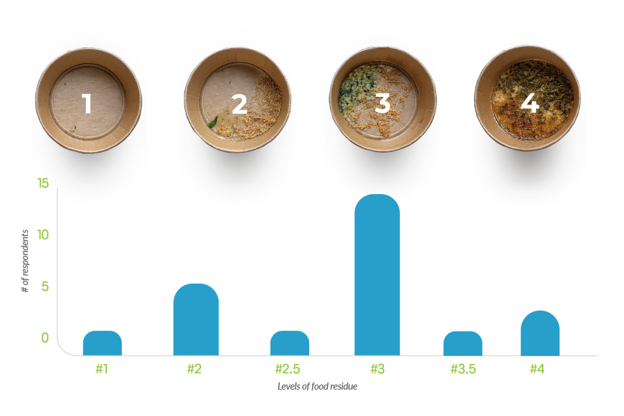
Recyclers and brokers were asked at which point food residue would disqualify a piece of packaging for recycling. The industry converged on the amount of food shown in bowl No. 3. Source: SPC
We asked recyclers and packaging material brokers the point at which food residue would disqualify a piece of packaging for recycling. Respondents concentrated their answers around the third picture, in a threshold that can be described as “We don’t want actual pieces of food entering our operations.” Food material absorbed into the paper itself, such as grease, is less of a concern, but actual food pieces have a higher likelihood of causing pests, odors, or reducing the quality of the final sorted paper. In other words: Greasy paper packaging beats unscraped paper packaging.
These findings are consistent with other research conducted on food contamination, namely Smurfit WestRock’s seminal 2019 study on corrugated cardboard pizza boxes, which found that typical amounts of residual grease and cheese do not negatively affect the boxes’ recyclability.
So, food residue isn’t a dealbreaker for paper packaging — but that doesn’t mean we’re off the hook. The real questions now are: Do consumers know what “clean enough” looks like, and will they get there?
How to keep paper-based food packaging recyclable
The second portion of our study went to a different source: consumers. In collaboration with Clemson University, the SPC studied the impact of on-pack messaging and education on consumer actions around cleaning food residue off of packaging before recycling. More good news for packaging producers: There’s a needle to move and we know how to move it.
On-pack messaging, particularly when paired with education, helps consumers correctly prepare packaging for recycling. While most consumers surveyed (80 percent) know implicitly to clean food residue off of packaging before tossing it in the recycling bin, nearly all participants presented with explicit, on–pack instructions knew what to do with their packaging before recycling.
A little bonus education went a long way. Participants who received packaging with a How2Recycle label and watched an educational video were twice as likely to properly recycle items that required cleaning, removing at least 50 percent of the original food residue.
What needs to happen next
You or I scraping food from paper-based packaging won’t solve the problems of contamination or consumer confusion alone. To keep the paper-based food packaging in circulation, the industry can do three things:
Build paper industry alignment on food residue thresholds: Alignment between players in the paper packaging industry on what is and is not too much food contamination on paper packaging is a critical first step.
Identify the right on-pack language to limit confusion: Once we reach consensus around acceptable levels of food contamination, we can then translate those thresholds into clear on-pack language to help consumers understand what level of cleaning a package requires for recycling.
Support on- and off-pack education: Education doesn’t end at the on-pack recycling label and language. Consumer recycling education campaigns can help make sure consumers know how to look for and use recycling instructions when recycling their packaging.
Paper packaging recyclability doesn’t depend on perfection, but to curb contamination, progress will hinge on clearer guidance that helps consumers keep valuable fiber in circulation. By aligning on “clean enough,” and communicating that threshold, the industry can recover more paper, waste less material and help reduce pressure on virgin resources like trees.

Subscribe to Trellis Briefing